
In the haunting atmosphere of the Baztán Trilogy, few moments resonate with as much primal dread as the silent encounter between Amaia Salazar and her mother, Rosario. Even when separated by the cold glass of a psychiatric ward or the digital barrier of a security screen, Rosario’s awareness of her daughter is uncanny. She does not need to see Amaia with her eyes. She senses her daughter’s presence through a visceral, almost subterranean connection.
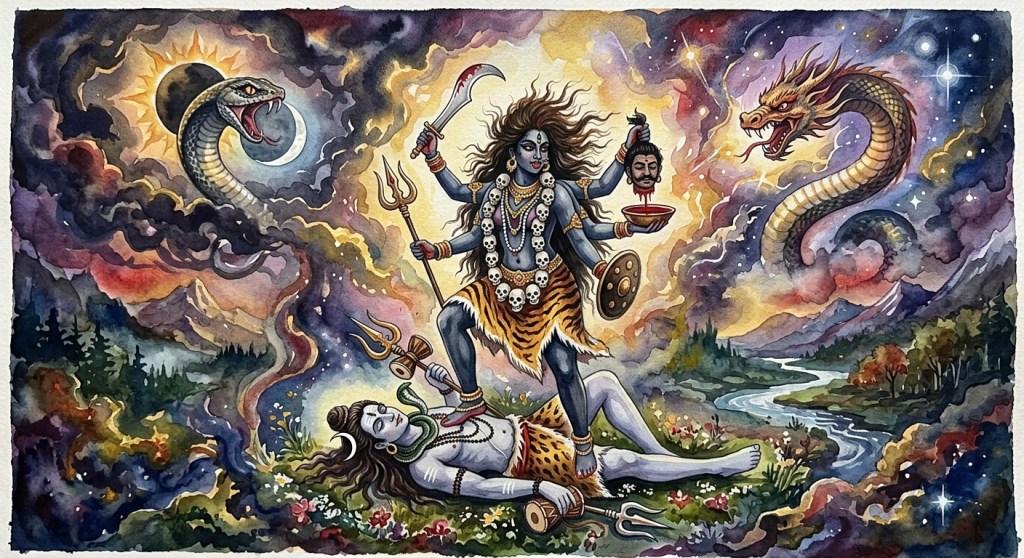
From a Shakta perspective—a tradition that views the entire universe as the play of the Divine Feminine, or Shakti—this bond is not inherently good or evil. Instead, it is a raw manifestation of power. Rosario represents the terrifying inverse of the nurturing mother, reminding us that the same force that gives life also possesses the absolute right to take it back.

The Totality of the Feminine Force
To understand a mother who chooses to harm her child through a Shakta lens, we must first set aside the modern, sanitised image of the “Perfect Mother.” In the Shakta tradition, the Great Mother is not just a provider of milk and comfort. She is the totality of existence. She is the blooming flower, but she is also the forest fire. She is the predator as much as she is the prey.
When we look at Rosario through this prism, we see a woman who has become entirely consumed by the destructive aspect of the Goddess. In this worldview, nature does not always protect its young; sometimes, a storm wipes out a nest to make room for new growth. By viewing Rosario as an embodiment of this untamed, chaotic energy, we begin to understand that her hostility toward Amaia is a horrific expression of the dark side of the creative cycle—the phase where life is reabsorbed into the source.
The Stagnation of Shakti
Why would a mother choose to become a predator to her own flesh and blood? Within this spiritual framework, the answer often lies in the distortion of Gunas, or the qualities of nature. A healthy mother channels Sattva (harmony), but Rosario is gripped by a toxic blend of Tamas (inertia) and Rajas (misdirected passion).
Rosario does not see Amaia as a separate being deserving of life. She sees her as an extension of herself that she wishes to reclaim. This is the archetype of the “Devouring Mother.” In Shakta philosophy, the Mother is the source of all energy.
If that energy is turned inward and poisoned by past trauma or spiritual darkness, the mother begins to view the daughter’s growth as a theft of her own power. Every breath Amaia takes is seen by Rosario as a life-force stolen from her own veins. Because Rosario feels her own “Shakti” waning or stagnant, she develops a desperate, violent urge to pull the child back into the void—to “eat” the child’s future to feed her own starved ego.
The Illusion of Ownership
A significant reason for maternal harm in this perspective is the delusion of Maya. In a healthy dynamic, a mother recognises the child as a divine spark on its own path. However, Rosario is blinded by the illusion that she ‘owns’ the life she produced. She suffers from a spiritual possessiveness where the umbilical cord is never truly cut. It is converted into a leash.
When Amaia succeeds—becoming a police officer, a symbol of authority and order—it acts as a mirror to Rosario’s own internal chaos and perceived failures. To a mother trapped in this dark state, the child’s independence is felt as an act of betrayal or a literal tearing of the mother’s skin. The harm she inflicts is a misguided attempt to ‘stitch’ the child back into herself, refusing to allow the natural progression of the universe which demands that the child surpass the parent.
The Screen and the Subtle Cord
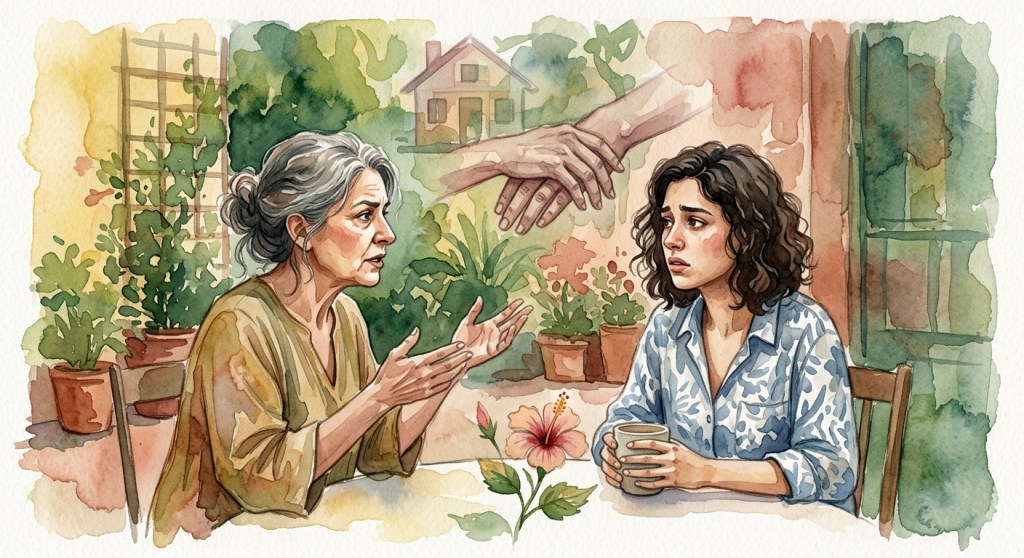
The scene where Rosario senses Amaia through a screen perfectly illustrates the Shakta concept of the subtle body. Our connections to our mothers are not just physical or emotional; they are energetic. This umbilical cord of Shakti remains long after birth as a psychic frequency.
For Amaia, this connection is a source of terror because it means she can never truly hide. The “predator” knows her scent across any distance. For Rosario, it is a sensory organ. Because they share the same fundamental essence, Rosario can “feel” Amaia’s presence in the atmosphere. It suggests that even when a mother chooses to harm, the link remains potent and supernatural.
The tragedy lies in the fact that Rosario uses this divine, energetic connection not to guide her daughter, but to hunt her. It is a reminder that the most sacred bonds are often the ones that carry the greatest potential for destruction.
Breaking the Cycle of the Goddess
In the end, the struggle between Amaia and Rosario is a struggle for the right to exist as an independent spark of the Divine. From a Shakta viewpoint, Amaia’s journey is about reclaiming her own Shakti from a mother who tries to hoard it.
The story suggests that while we cannot choose the mother we are born to or the dark energy they may carry, we can choose how we use the Shakti we inherited. Amaia survives by transforming the terror of her mother’s gaze into the strength of her own resolve, eventually learning that the Mother’s power can be used to heal the world, even if it could not heal her own home.



 Twinn Swan
Leave a comment