
The Arulmigu Sri Rajakaliamman Glass Temple stands as a testament to pure devotion, vision, and generational faith. What began over a century ago as a humble shelter has transformed into a glowing house of worship to create a physical home for divine light. The temple’s evolution reflects a journey of deep Bhakti devotion. By cladding almost the entire temple in hundreds of thousands of pieces of coloured glass, the sacred space becomes an active, physical manifestation of Jyoti—the divine light that guides the soul out of darkness.
The Compassionate Mother: Sri Rajakaliamman
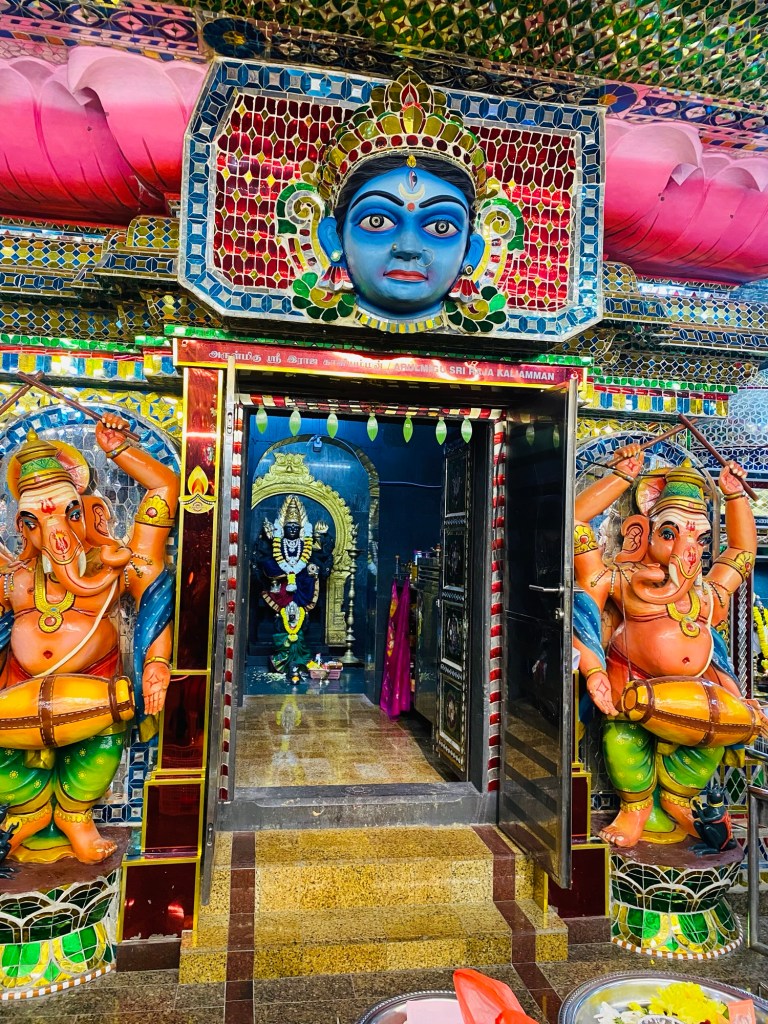
At the heart of this luminous temple resides the presiding deity, Goddess Rajakaliamman. While she is a manifestation of the powerful Goddess Kali, devotees do not approach her with fear. Here, she is worshipped simply and deeply as Amma—the ultimate Mother who protects, heals, and cradles her children through the struggles of worldly life. Within the quiet inner sanctum, the atmosphere changes from the bright, shimmering outer hall to one of absolute peace and reverence.
The experience of receiving Darshan—the sacred gaze of the Goddess—is the spiritual anchor of the temple. Adorned in beautiful saris and garlanded with fresh flowers, Sri Rajakaliamman’s eyes look upon her devotees with immense compassion. This contrast between the quiet, steady sanctum and the glittering, reflective outer hall carries a beautiful message: while the external world is constantly moving, colourful, and distracting, the divine presence within the soul remains quiet, calm, and unchanging. Devotees surrender their worries, grief, and ego at her feet, seeking the motherly Shakti (energy) needed to overcome their daily struggles and find mental peace.
Seeing the Divine Within the Self
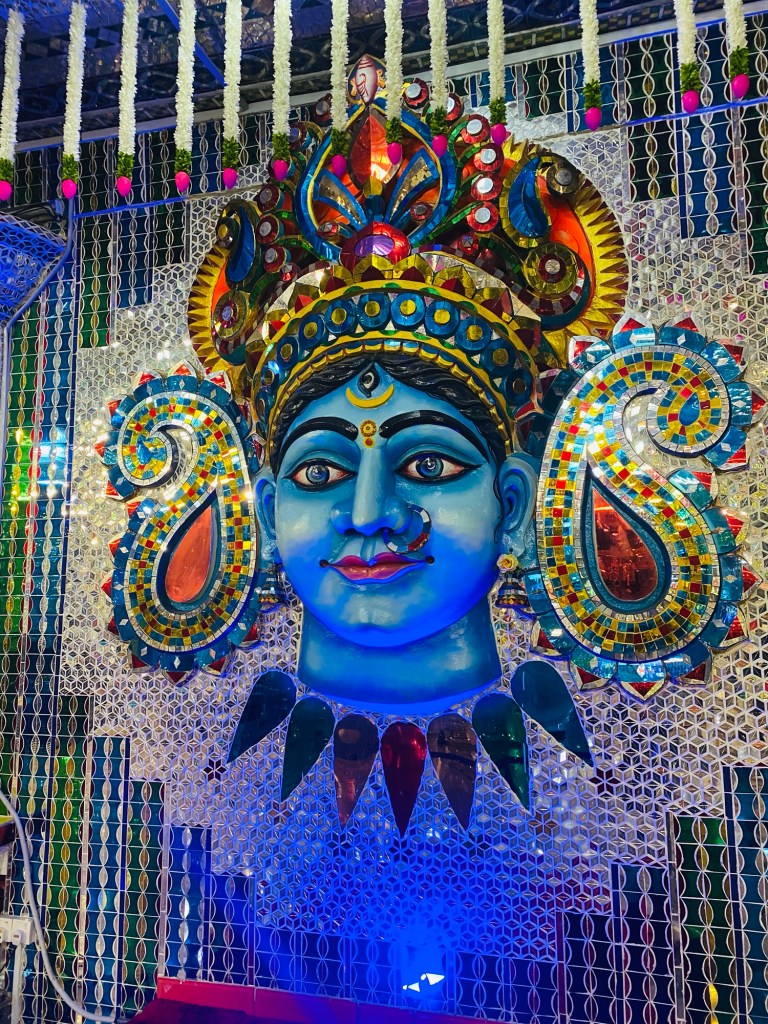
The defining feature of the temple—its brilliant mosaic of hundreds of thousands of pieces of red, blue, yellow, green, purple, and white glass—began as a simple, divinely inspired vision. While riding in a tuk-tuk in Bangkok, Guru Bhagawan Sittar was struck by a distant light shining like a diamond, which turned out to be a small piece of glasswork on a temple entrance. Realising how a single ray of reflected light could draw a seeker from kilometres away, he envisioned a temple in Johor Bahru fully wrapped in glass to draw souls toward the divine.
In Hindu thought, light is the purest symbol of God, representing knowledge and the soul’s eternal nature. Because the pillars, walls, and ceilings of the temple are covered in mirrors, devotees see their own reflections wherever they look. This serves as a powerful reminder of the core truth that the individual soul (Atma) is a reflection of the supreme divine energy (Brahman). Furthermore, the coloured glass shows how a single, white beam of light fractures into many brilliant colours. In the same way, though human beings might follow different cultural paths and call God by different names, all of humanity is searching for the same single source of divine truth.
The Shiva Lingam
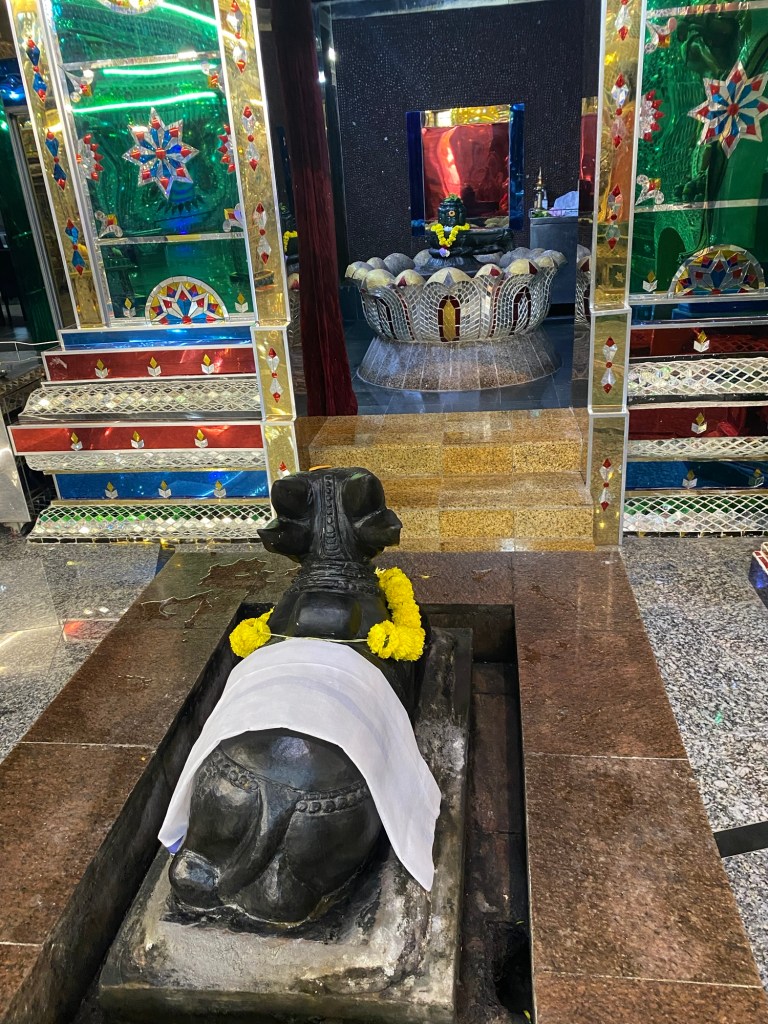
Deeper inside the temple, the Athma Lingam sanctuary offers a quiet space for Lord Shiva, balancing the dynamic motherly energy of Goddess Rajakaliamman with the introspective, silent consciousness of Shiva. In this unique space, devotees can gently pour rose water. The spiritual weight of this sanctuary is carried by its walls, which are completely covered in Rudraksha beads imported directly from the sacred forests of Nepal.
The Rudraksha bead, born from the tears of Shiva, is highly revered for its protective and meditative energies. During the temple’s construction, every single bead was pressed into the walls by hand while priests and devotees chanted sacred mantras. Because of this, the walls are believed to be spiritually charged, holding the physical vibration of continuous prayer. The rough, earthy texture of the Rudraksha beads stands in quiet contrast to the smooth, dazzling glass of the main hall. It marks a transition for the devotee from the outward reflection of light to the inward, quiet practice of meditation, where one can sit in silence and listen to the subtle rhythm of the universe.
Shared Humanity and the Message of Unity
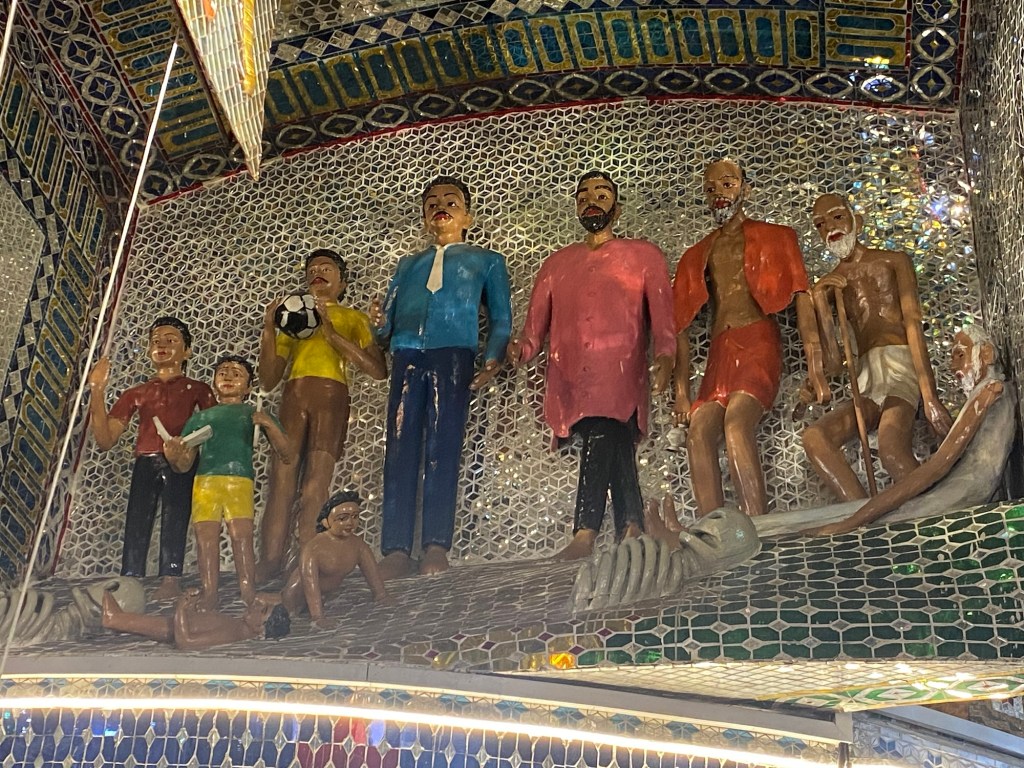
The spiritual vision of the glass temple reaches beyond sectarian lines, reflecting the multicultural harmony of Malaysia. Near the ceiling, ten gold-finished sculptures depict the cycle of life, showing the human journey from birth, through youth and middle age, to old age and death. This visual reminder of Samsara teaches impermanence, urging devotees to focus on the eternal soul rather than temporary worldly attachments.
This message of universal love is made even clearer by the presence of white marble statues of great spiritual guides, including Gautama Buddha, Guru Nanak Dev Ji, Sai Baba, and Jesus Christ. These Great Souls are all messengers of the same Divine Creator. Under the watchful, loving gaze of Mother Rajakaliamman, the barriers that divide people fade away, leaving only the pure, reflective light of human kindness and spiritual oneness.






Leave a comment