
In an era where global action cinema has frequently conflated raw masculinity with toxic male dominance, Aditya Dhar’s Dhurandhar (2025) and its sequel Dhurandhar: The Revenge (2026) arrive as a fascinating case study. Together, they have rewritten box office history while quietly challenging the narrative foundations of the “dysfunctional alpha-male” blockbuster.
By steering clear of violence against women and decoupling masculine strength from the subjugation of the feminine, the Dhurandhar films construct an alternative model of heroism—one where true courage is measured by the magnitude of the battles a man chooses to fight, rather than the vulnerability of the people he seeks to dominate.
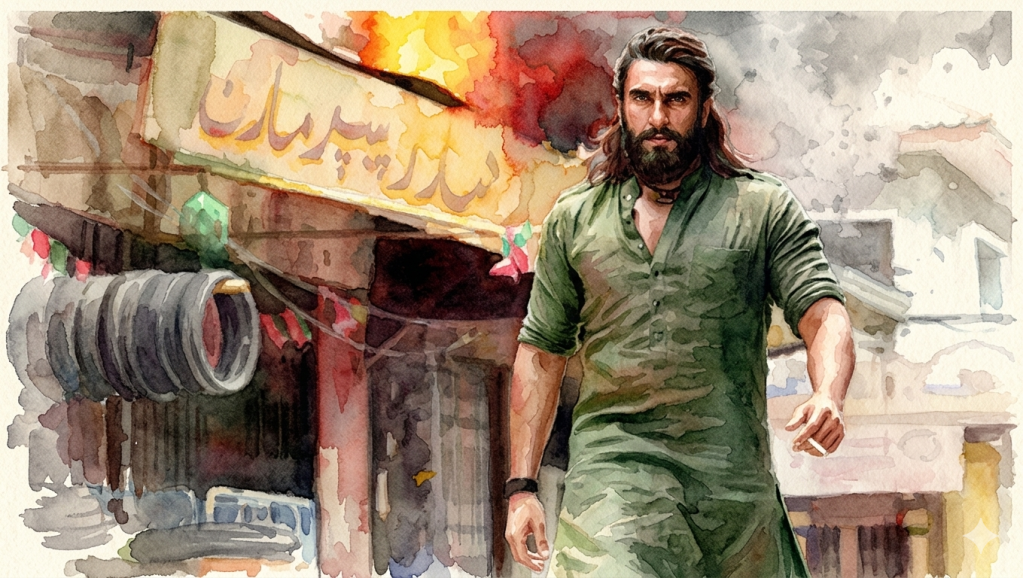
Led by a searing performance from Ranveer Singh as the undercover operative Jaskirat Singh Rangi (operating under the alias Hamza Ali Mazari), the films are undeniably intense, R-rated, and brutal. Yet, beneath its blood-soaked canvas lies a distinct, highly deliberate ethical framework.
Rejection of Gendered Violence
For decades, action cinema has relied on a reliable, albeit lazy, narrative shortcut to establish high emotional stakes: the brutalisation of female characters. Whether through graphic domestic abuse, sexual assault, or casual objectification, women in hyper-violent thrillers are too often reduced to motivational collateral—disposable entities whose suffering exists solely to justify a male protagonist’s subsequent rampage.
Dhurandhar actively rejects this template. In a world depicting gritty underworlds, espionage, and ruthless Karachi syndicates, the film remarkably avoids subjecting its female characters to graphic physical degradation or sexual violence. Women like Ulfat (played by Saumya Tandon) and the young Yamali (played by Sara Arjun) exist within a deeply patriarchal, male-dominated landscape, yet the narrative treats them with absolute dignity.
This creative restraint demonstrates a fundamental respect for both the audience and the medium, proving that an action film can achieve a state of high tension and grit without relying on the cheap shock value of gendered trauma. The Dhurandhar films understand that a hero’s darkness or a villain’s depravity does not need to be validated by the victimisation of women; the stakes of geopolitical conflict and personal betrayal are more than enough to drive the narrative forward.
True Courage in Real Battles
At the heart of the Dhurandhar films is a critical distinction between performative masculinity and actual courage. In many contemporary cinematic universes, “toughness” is displayed through fragile ego tantrums, domestic entitlement, and a systematic policing of women’s lives. In contrast, the protagonist’s journey as Hamza reveals a masculinity defined by discipline, silence, and the carrying of an immense, invisible weight.
Hamza’s courage is not performative because it is operational. Infiltrating the dangerous syndicates of Lyari, establishing a deep-cover identity, and navigating a labyrinth of betrayal requires a psychological fortitude that goes far beyond physical bravado. He fights real, structural battles against terror networks, political corruption, and systemic threats to peace.
Because his battles are external, heavy, and consequential, he has no need to engage in the petty, insecure power plays of domestic misogyny. The men of Dhurandhar who possess genuine strength do not need to belittle the women around them to feel powerful. By shifting the arena of conflict away from domestic dominance and toward genuine, high-stakes espionage and defense, the films show that true bravery lies in sacrifice, strategic restraint, and the endurance of pain for a cause larger than oneself.
Redefining Masculinity: Strength Without Malice
The concept of masculinity in the Dhurandhar duology is both classical and modern. It is classical in its embrace of the protector archetype—the warrior who bears the scars of battle so that others do not have to. Ranveer Singh’s physical performance is a testament to this; his body is depicted as an instrument of immense kinetic force, heavily scarred and constantly tested, yet it is never used as an instrument of arbitrary domestic tyranny. His woundedness becomes proof of his moral seriousness and his commitment to his duty.
At the same time, this masculinity is modern because it allows space for empathy, vulnerability, and respect. Even in moments of extreme pressure and desperation, the protagonist maintains an ethical boundary. He does not cross the line into cruelty toward the vulnerable. True strength, the films suggest, is outward-facing and protective; it is defined by what a man can bear, not what he can inflict on those weaker than him.
By portraying a protagonist who is incredibly lethal yet fundamentally decent in his interpersonal dynamics, director Aditya Dhar constructs a framework of masculinity that is both aspirational and honorable. It dismantles the false dichotomy that a film must either be a soft, sanitized drama or a hyper-violent festival of misogyny.
A New Standard for the Action Genre
The historic box office success of the Dhurandhar films—crossing monumental thresholds globally—sends a powerful message to the film industry. It proves that audiences do not require the degradation of women to enjoy high-octane, R-rated action. It demonstrates that a film can be gritty, dark, and thrilling while still maintaining a progressive, respectful approach to gender dynamics.
The courage on display in Dhurandhar is of a rare kind in modern cinema. It is the courage to stand firm against external chaos, to protect rather than exploit, and to redefine what it means to be a strong man in a violent world. By showing that true heroes fight real battles rather than indulging in misogynistic power trips, the franchise has not only delivered historic cinematic entertainment but has also raised the bar for how masculinity is articulated on the silver screen.





Leave a Reply