
The ancient epic Mahabharata is frequently celebrated for its grand depiction of heroic battles, courtly politics, and tragic rivalries. Yet beneath its dramatic narrative lies a philosophical inquiry into the nature of human purpose, duty, and spiritual evolution.
Central to this epic worldview is a clear hierarchy of human values. In the universe of the Mahabharata, the value of an individual is judged not by worldly status, physical dominion, or material possessions, but by spiritual purity and intellectual enlightenment. The epic asserts that the cultivation of self-knowledge and truth is the supreme calling of human existence, while the wielding of political power and the accumulation of wealth represent necessary, yet subordinate, stages of human realisation.
Knowledge as the Highest Duty
In the ethical landscape of the epic, knowledge (Jnana) is revered as the ultimate light that dispels the darkness of ignorance and ego. Ancient society held that a person devoted to truth and wisdom possessed a dignity that transcended all earthly titles. This perspective was embodied in the figure of the sage or scholar.
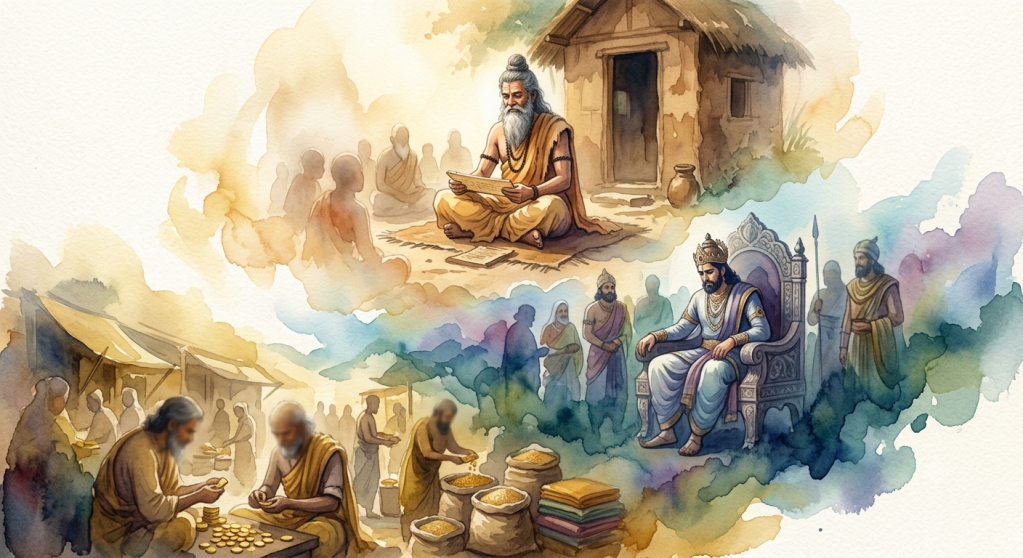
A seeker of truth might inhabit a humble hut on the fringes of a forest, clothed in threadbare garments or bark, possessing no material property. Yet, when such a person entered the gilded halls of a royal court, kings and emperors would descend from their thrones to bow in reverence.
This deference was not a formality, but a recognition of cosmic reality. Temporal rulers governed physical territories, but sages governed the self. Knowledge was understood to be incorruptible, unyielding to time, and free from the anxieties of loss.
In contrast to physical power, which relies on coercion and weapons, spiritual and intellectual mastery operated through moral authority and clarity of insight. The Mahabharata repeatedly illustrates that emperors like Yudhishthira or Dhritarashtra, despite commanding vast armies and holding power over millions, constantly sought the counsel of learned figures. The epic establishes that true authority stems from inner enlightenment, making the pursuit of knowledge the highest duty (Dharma) to which a human soul can aspire.
Power as a Secondary Instrument of Duty
Below the pursuit of truth lies the realm of governance, protection, and political power. In the value system of the Mahabharata, the motivation to rule and maintain order is a noble undertaking, but it remains a secondary class of pursuit when compared to the quiet contemplation of the sage. Power is inherently outward-facing, bound to the anxieties of diplomacy, warfare, administration, and statecraft.
The epic treats power as a tool rather than an end in itself. Political authority exists solely to maintain a peaceful framework within which knowledge, righteousness, and societal well-being can flourish. When power becomes detached from higher wisdom, it swiftly devolves into tyranny, arrogance, and chaos, as demonstrated by figures who valued dominance over ethical rectitude.
A ruler who lacks self-control and spiritual understanding is viewed as a danger to society. Thus, the exercise of political dominion requires constant guidance from those who have renounced power. Power is placed second because it relies on external force and circumstances, whereas true wisdom rests entirely within the individual spirit.
Wealth as the Subordinate Pursuit
At the foundational tier of this value hierarchy lies the accumulation of wealth and material prosperity. The Mahabharata does not condemn material resources; indeed, it recognises that society requires economic sustenance to function, feed its citizens, and support charitable endeavours. However, elevating the pursuit of riches to one’s primary life purpose is viewed as the lowest manifestation of human ambition.
The drive for material accumulation is characterized by desire, attachment, and boundary-setting. Riches can be stolen, lost, or rendered meaningless by death, making them the most fleeting of all human acquisitions. A person driven primarily by the urge to amass wealth remains trapped in a cycle of greed and anxiety, forever measuring worth through external objects rather than internal growth. In the moral framework of the epic, concentrating one’s vital energy on material possessions reflects an unrefined state of consciousness, one that mistake the instruments of survival for the goal of life itself. Riches are meant to serve life, not to command the human soul.
A Timeless Moral Architecture
This ancient perspective offers a striking contrast to modern paradigms that often equate personal worth with financial net value or political influence. The Mahabharata constructs an enduring moral vision where human advancement is measured by self-transcendence rather than self-aggrandisement.
By positioning the humble scholar or sage above the mighty monarch, and the responsible ruler above the wealthy merchant, the epic establishes a timeless principle: the measure of a human life lies in what one understands and embodies, not in what one controls or owns. True power resides in self-mastery and true wealth is found in wisdom that time cannot erode.





Leave a Reply