
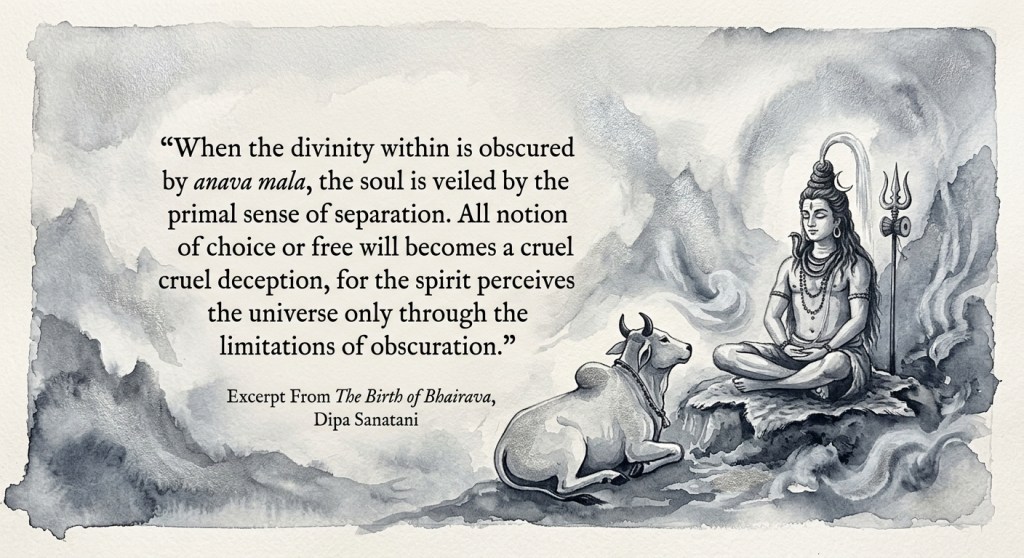
There are moments when the mind catches a glimpse of the extraordinary, only to watch it slip through the fingers of everyday consciousness. In The Birth of Bhairava, I reflected on this exact tension.
We often talk about Oneness as a lofty, poetic ideal—something to be pondered in quiet contemplation or quoted in spiritual circles. Yet, in our lived reality, we constantly operate from behind a dense veil. The tradition of Shaivism calls this veil anava mala, the primordial impurity of limitation that instills in us the illusion of smallness, individuality, and isolation.
It is the original obscuration that convinces us we are solitary islands floating in an indifferent ocean, entirely distinct from the world and the people around us. Because of this deeply ingrained sense of separation, we fail to recognise a fundamental truth: what we do to another, we are truly and only ever doing to ourselves.
When we inflict harm, project judgment, or guard ourselves with resentment, we believe we are protecting or asserting an independent “I” against an external “other.” The cruelty or indifference we extend outward does not disappear into the void. It heavy-handedly shapes the inner landscape of our own consciousness. We cannot wound another without first nursing the poison within our own spirit. Conversely, every act of compassion, patience, and reverence immediately softens the walls of our own inner prison.
The tragedy of anava mala is that it corrupts our perception of agency. We move through life believing we are making clear, autonomous choices, when in truth, our decisions are merely reactions filtered through the lens of fear, self-preservation, and perceived lack. So long as the spirit perceives existence through the limitations of this obscuration, free will remains an illusion—we are simply playing out the scripts written by our own felt sense of isolation.
To break through this impurity requires more than an intellectual agreement with the concept of unity. It requires a quiet, unrelenting turning inward to face the primal veil itself. Only when we begin to recognise how heavily anava mala colours our vision can we start to dismantle the false boundaries between self and other, awakening at last to the unbroken divinity that binds us all.




Leave a Reply