
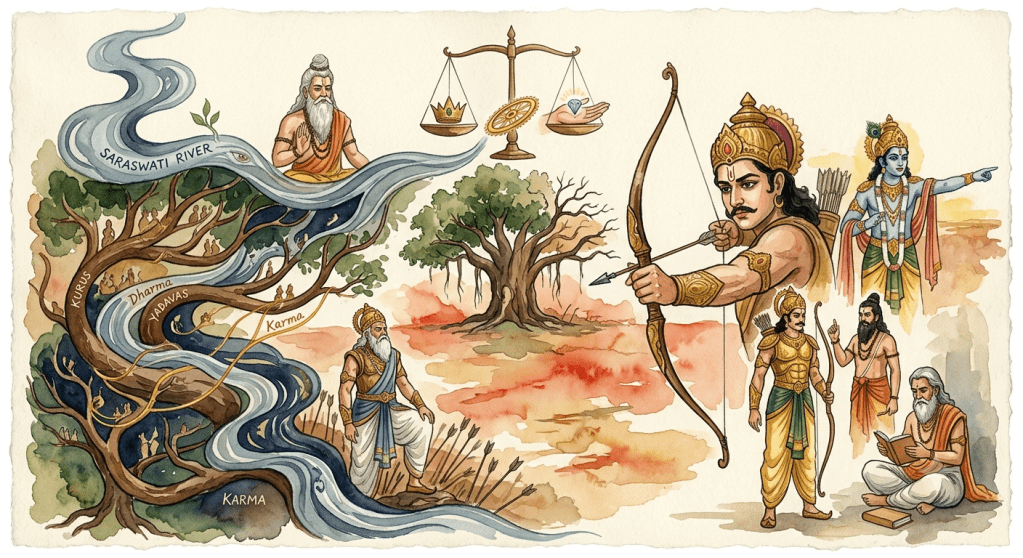
The Mahabharata is often remembered as a monumental war between two factions of a royal dynasty, the Pandavas and the Kauravas. Beneath its grand battles, supernatural weapons, and cosmic scale, however, lies a deeply human and enduring sociopolitical conflict: the friction between birthright janma and merit karma. Almost every major event, alliance, moral crisis, and personal tragedy in the epic stems from a fundamental question regarding human worth: should a person’s status, rights, and authority be determined by the circumstances of their birth, or by their intrinsic capability, virtue, and character?
The Crown and the Cradle: The Myth of Primogeniture
The central political conflict of Hastinapura begins long before the war on the field of Kurukshetra. It is rooted in the succession crisis of the Kuru throne. King Dhritarashtra, born blind, is bypassed for the throne in favor of his younger brother Pandu because physical integrity and capability were deemed necessary for righteous governance—an early instance where physical merit superseded simple seniority. However, after Pandu’s early death, the question of succession returns with terrifying urgency.
Duryodhana, Dhritarashtra’s eldest son, bases his entire claim to the kingdom on hereditary birthright. In his worldview, being the royal prince born to the reigning monarch grants him absolute entitlement over the realm. He perceives any attempt to pass the crown to Yudhishthira, Pandu’s eldest son, as an existential injustice.
Yudhishthira, by contrast, commands the respect of the elders and citizens not merely because of his lineage, but because of his unwavering adherence to dharma, fairness, and administrative wisdom. The war of Kurukshetra is thus lit by the spark of Duryodhana’s obsession with birthright, blind to the moral and governance merit of his cousin.
Karna and Ekalavya: The Tragic Erasure of Merit
While the royal houses fight over crowns, the epic presents its most heart-wrenching commentaries on merit through characters who were denied their rightful place due to low or obscure birth. Chief among them is Karna. Gifted with extraordinary martial talent, generosity, and courage, Karna is perpetually humiliated and disqualified from royal tournaments because he is raised by a charioteer. His tragic arc is defined by society’s refusal to measure him by his supreme skill as an archer, choosing instead to label him a suta-putra (son of a charioteer).
Karna’s alliance with Duryodhana is born directly out of this dynamic. Duryodhana, opportunistic yet astute, grants Karna the kingdom of Anga on the spot, declaring that martial valour, not noble lineage, makes a king. In doing so, Duryodhana validates Karna’s merit when the societal elite, including figures like Bhishma and Drona, reject him.
A similar tragedy unfolds with Ekalavya, the Nishadha prince whose dedication and self-taught mastery of archery surpass even that of Arjuna. Guru Drona, bound by his commitment to preserve the elite privilege of the Kuru princes, demands Ekalavya’s right thumb as gurudakshina. This act is a stark, brutal example of societal institutions deliberately crushing raw merit to safeguard the birthright and social supremacy of the upper caste and royal bloodlines.
The Irony of Institutional Privilege
The institutions depicted in the Mahabharata are constantly torn between preserving institutional hierarchy and recognising authentic talent. The royal preceptor Dronacharya himself embodies this tension. Drona is a Brahmin who acts as a master of military science, a role traditionally reserved for Kshatriyas. He crosses class boundaries when it serves his personal ambitions and vendettas, yet he strictly enforces those same boundaries upon others like Karna and Ekalavya to protect his favoured royal pupil, Arjuna.
Even Draupadi’s swayamvara (husband-selection ceremony) highlights this hypocrisy. The challenge presented to the suitors—stringing a massive bow and striking a hidden target—is ostensibly a contest of pure merit. Yet, when Karna steps forward and prepares to fulfil the challenge, Draupadi refuses to let him attempt it, citing his low birth. The contest claims to reward superior ability, but in reality, that ability is only permitted expression within the bounds of recognised lineage.
Krishna and the Redefinition of Worth
Amidst these societal contradictions, Lord Krishna emerges as the ultimate subverter of rigid social structure. Krishna himself is born in a prison and raised by cowherds, existing outside the orthodox centres of high royal power. In the Bhagavad Gita, spoken to Arjuna on the brink of battle, Krishna offers a revolutionary redefinition of societal structure and human value. He asserts that the fourfold division of society was created based on innate qualities (guna) and actions (karma), rather than hereditary descent.
Through Krishna’s guidance, the narrative gradually exposes the fragility of birthright. A king who possesses royal blood but lacks righteousness, wisdom, and self-control brings ruin upon his people. True nobility is defined not by ancestral pedigree, but by righteous action and selflessness. The eventual destruction of the Kauravas signifies the collapse of a system that prioritises bloodline and entitlement over ethics and capability.
The Eternal Legacy of the Epic
The Mahabharata does not offer a naive or neat resolution to the battle between birthright and merit. Instead, it presents a nuanced and painful critique of human society. It shows how systems built on inherited privilege inevitably breed resentment, corruption, and systemic injustice, while simultaneously acknowledging how difficult it is for individuals to break free from the shackles of inheritance and birth.
By centring its grand narrative on characters whose lives are shaped, elevated, or destroyed by this conflict, the epic transcends its ancient Indian origin. It remains a timeless exploration of human dignity, demanding that every generation confront the choice between honouring inherited power or celebrating individual worth.






Leave a Reply