
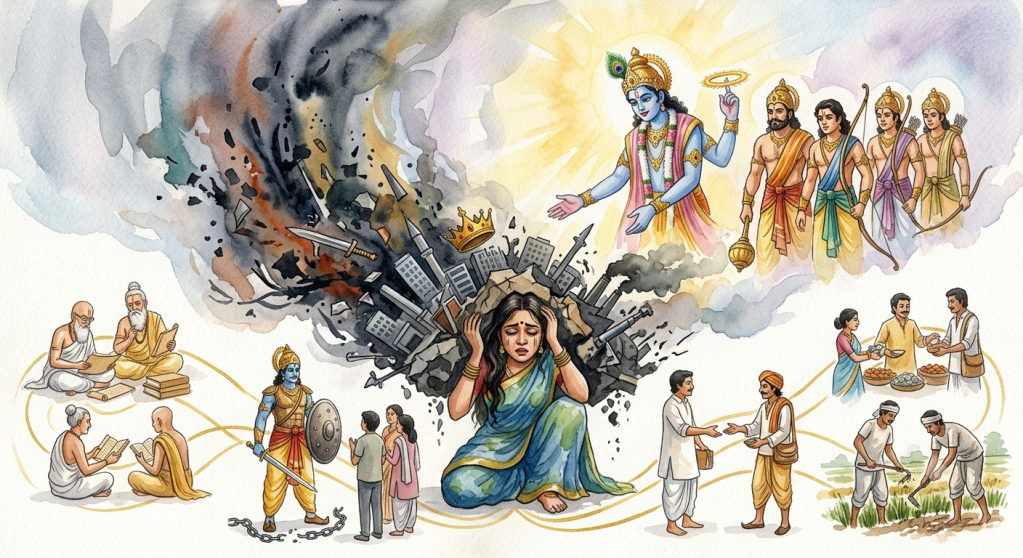
In the traditional cosmic narrative, the transition into Kali Yuga is marked by an increasing level of moral decay and the corruption of earthly power. The Earth, personified as Mother Bhumi, suffers not under the physical weight of human population, but under the unbearable burden of adharma—unrighteousness, tyrannical governance, and the arrogance of rulers who have abandoned their sacred duties. It is to relieve Earth of this heavy burden that Lord Krishna and the Pandavas descend into the mortal realm. Their overarching mission is not the destruction of specific despots, but the restoration of dharma, re-establishing an equilibrium where authority is held accountable to moral law.
This epic backdrop provides a powerful lens through which to examine the functional structure of ancient society, particularly the varna framework. Far from being a justification for arbitrary tyranny, the cosmological intervention in the Mahabharata demonstrates that power on Earth is never absolute. When the ruling apparatus becomes oppressive and self-serving, cosmic and socio-political forces inevitably converge to dismantle it, signaling that authority exists solely to serve a higher ethical and social purpose.
Varna as Character, Action and Social Equilibrium
To understand how this framework functions as a check on power, one must separate the foundational philosophical conception of varna from its later, highly degenerated hereditary manifestations.
At its core, the varna system was articulated not as a mechanism for dogmatic purity or rigid lineage, but as a dynamic functional division of society aimed at state stability and harmonious social order. The fourfold classification was created based on guna (qualities of character and temperament) and karma (action and occupational duty), explicitly omitting birthright as the primary determinant.
In this classic formulation, a person’s place within the social structure is earned and maintained through intrinsic character and demonstrated conduct. The system envisioned an interdependent ecosystem where knowledge (Brahmana), protection and governance (Kshatriya), commerce and agriculture (Vaishya), and labour and service (Shudra) operated in mutual reciprocity. Because stability depended on each group fulfilling its unique function with integrity, social status was inherently tied to the performance of duty rather than static privilege.
The Contingency of Power and the Rajadharma Imperative
The application of this philosophy to the ruling class, the Kshatriyas, reveals its most potent socio-political dimension: the conditional nature of sovereign power. Within the framework of Rajadharma (the duty of kings), the ruler does not possess divine right in the Western absolutist sense. Instead, the king is a custodian of dharma. The authority to collect taxes, command armies, and enforce law is granted on the explicit condition that the ruler protects the subjects, ensures justice, and maintains conditions under which all members of society can flourish.
When varna is defined by character and action, political legitimacy becomes directly contingent on fulfilling this social contract. A ruler who exhibits greed, cowardice, or tyranny forfeits the character essential to a Kshatriya. By failing in action, such a ruler breaks the contract and degenerates into a burden upon the Earth. The Mahabharata repeatedly emphasises that an unrighteous king who fails to protect his people is not a true sovereign, but a thief in royal robes, subject to dethronement or destruction.
Evaluating the Efficacy of the Cosmic Warning
Does this conceptual architecture effectively warn the ruling classes that their status is impermanent and conditional? Historically and philosophically, it provides one of the most compelling ethical checks available to an ancient society. By tying political status to spiritual and moral accountability, the framework creates a psychological and cultural deterrent against tyranny.
First, it strips the ruling class of any claim to inherent superiority. If status depends on guna and karma, then a monarch who acts without virtue loses moral authority in the eyes of the populace and the intellectual guardians of society. Second, the narrative of the Pandavas and Krishna serves as an active warning: when human institutions fail to self-correct, the natural and divine order will conspire to bring down corrupt dynasties, no matter how formidable their military strength may appear. The ultimate annihilation of the Kaurava court stands as a stark lesson that power divorced from righteousness is self-destructive.
The traditional definition of varna transformed social status from an unassailable hereditary right into a fragile, revocable trust. By establishing that the Earth itself rebels against bad governance, the philosophical tradition delivered a clear and enduring warning to the ruling elite: privilege without responsibility is an invitation to ruin, and sovereignty endures only so long as the social contract is upheld.





Leave a Reply