
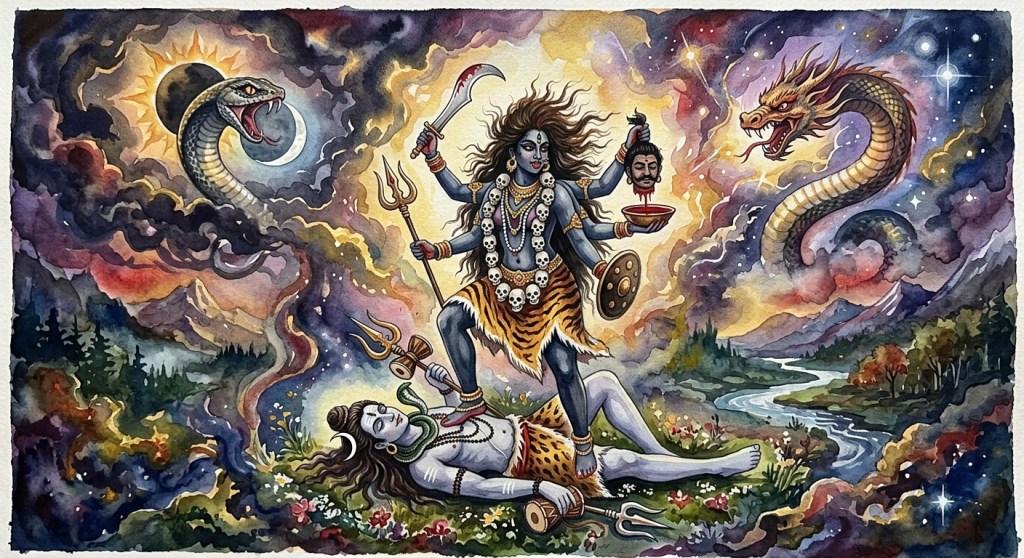
A karmic relationship rarely announces itself as karmic while it is happening. It announces itself as intensity, as recognition, as a pull that feels older than the two hours, two weeks or two months you have actually known this person. Karmic astrology gives a precise language for that feeling and it lives in the axis of Rahu and Ketu, the lunar nodes that map the soul’s unfinished business across time.
Ketu is the placement we already know intimately. It is fluency without hunger, skill without satisfaction, a sign and house we have already lived inside so completely that continuing to live there feels like standing still.
Rahu is the opposite condition: an area of life we reach for compulsively, without instinct, and often without grace, because it has not yet been earned through lived experience. Every serious relationship worth calling karmic tends to activate this axis in one partner or both, because relationships are the fastest, most unavoidable arena for confronting exactly what we have outgrown and exactly what we still lack.
Entanglement
This is also where the relational power in these unions gets complicated, and where most karmic relationships generate their characteristic friction. The very fluency each partner brings from their Ketu is exactly what the other person’s Ketu-comfort wants to lean on.
This is the deeper reason karmic relationships come into our lives at all. They are not primarily here to make us happy, though they can, and they are not primarily here to make us comfortable, though early on they often masquerade as comfort because the Ketu-recognition between two people is so immediate.
They are here to apply pressure precisely where we have avoided growth, using the one instrument most capable of reaching that place: another person whose own unfinished business happens to interlock with ours.
Ketu’s role in this cannot be reduced to something purely regrettable or purely a debt to be paid down. Ketu is also mastery, the storehouse of a skill so deeply integrated it no longer requires conscious effort. The power in a karmic relationship is not one-directional, with the Rahu person suffering and the Ketu person simply cruising on accumulated gifts.
The Ketu person’s task is subtler and in some ways harder: to keep offering that mastery as a gift and a demonstration rather than as a crutch the other person leans on forever.
Karmic relationships, understood through the nodes, are ultimately relationships of reciprocal debt and reciprocal gift, arriving not to be endured but to be worked. The soul does not select these unions for comfort. It selects them because two unfinished stories, read correctly, turn out to be each other’s next chapter.



Leave a Reply