
“Once there, he introduced the girl to his extended family in his world of rock and sky.
A Thousand Names by Dipa Sanatani
“They welcomed her with kindness, but their diet, a staple of carrion, was a bitter contrast to the girl’s familiar world.
“Her tears painted the sky with sorrow, a silent plea that echoed through the canyons.
“The condor’s kin,
a brood of carrion eaters,
were creatures of
shadow and decay,
their diet restricted
to the remnants of life.
“Unlike them, the maiden was a creature of light and life, her way of life a stark contrast to norms of their world.
“Even though the condor had trapped the maiden in his lofty nest, he wondered how this being of light would fare in their world of shadows.”
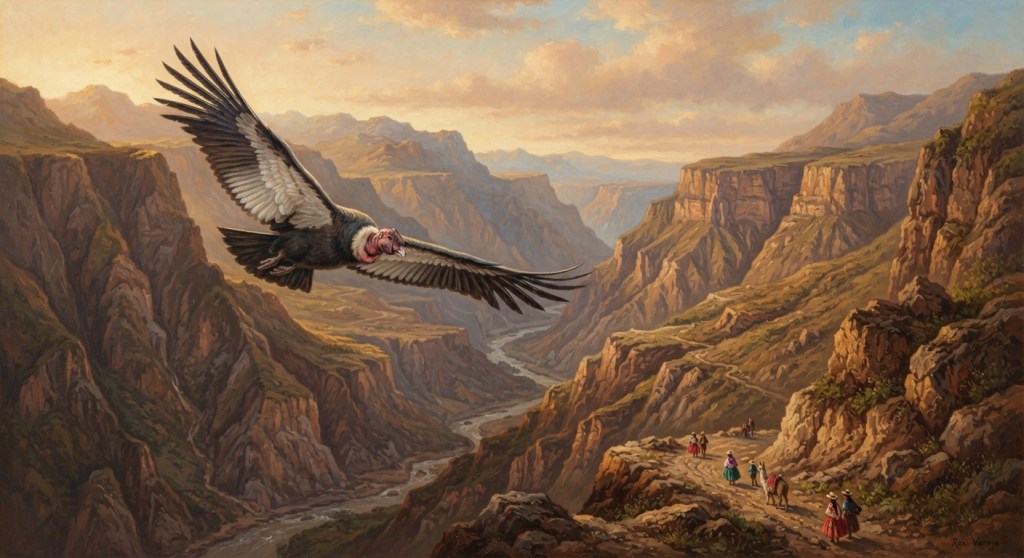
This scene in A Thousand Names retells a well-known Andean tale: a condor carries off a young woman, and a hummingbird helps her escape.
The condor traps the girl because he wants to possess her as his wife, failing to recognise that his desire alone cannot create consent or companionship. Blinded by entitlement, he treats her captivity as the beginning of a marriage rather than an act of violence, never considering the fear, grief and justice his actions will provoke.
His failure to understand her—particularly her desires, autonomy, and deeply held emotional needs—ultimately becomes his undoing: the life he tries to secure through force cannot be sustained, and the person upon whom he inflicted that suffering will ultimately escape his control.
That memory still feels like an invitation to look upward, trust the unseen, and recognise the sacred connections between earth, sky, and spirit—ideas that also lie at the heart of my book, A Thousand Names.






Leave a Reply