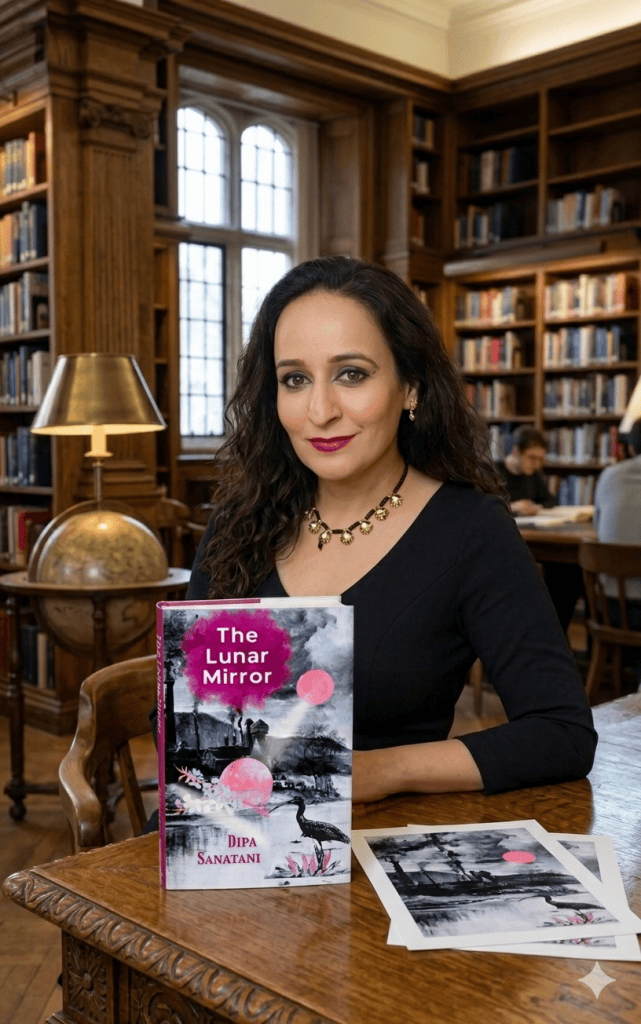
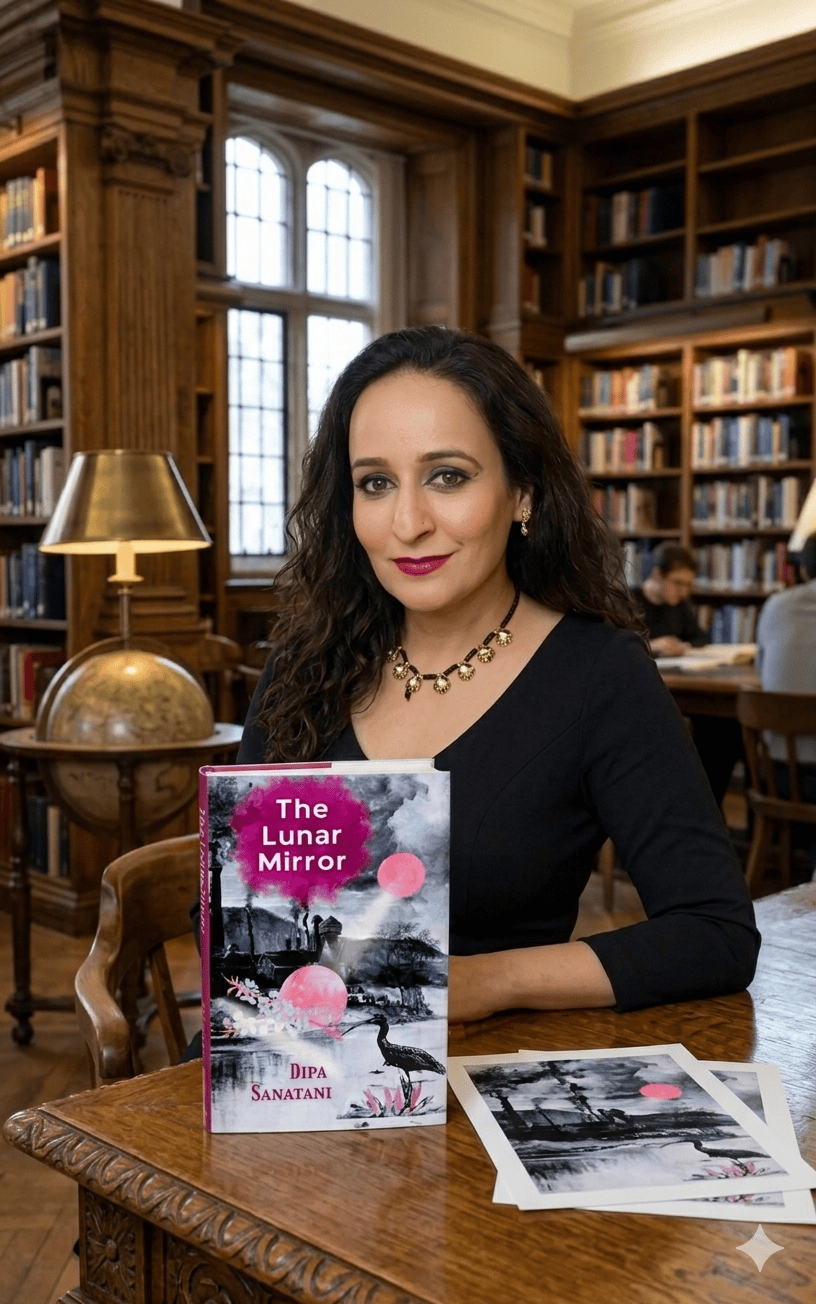
What does a soul carry when it crosses between lives, and who among the living can feel it waiting? I wrote The Lunar Mirror to follow those questions into the Void, where the future cannot take form until the soul has been drawn backward, engulfed by the weight of its forgotten incarnations. Visions surface there that breach the veil between worlds, and the people who receive them find that such sight arrives as a burden. The moon gave me the inspiration for this deeply introspective novel, since it reflects borrowed light from the sun through its phases of shadow.
A Light Borrowed
The moon generates no light of its own. It receives, reflects, waxes and wanes, and passes through phases of light and dark. That quality made it the right symbol for a book about the interior life, about memory, and about the mind with its tides of emotion and its rhythmic cycles of time.
I dedicated the book to Shiva as Someshwara, the Lord of the Moon, who carries the crescent in his hair as an expression of his mercy for souls undergoing samsara. The dedication sets the register: quieter, more interior and more cyclical than the blaze of a solar divinity.
The same devotion shaped the structure. The book has 108 chapters, each corresponding to one of Shiva’s 108 names. The destroyer, the healer, the dancer, the silent one and the dweller in the burning ground each receive their turn, and no single name contains the whole. The circle of a mala has no beginning or end, and each chapter sits like a bead, complete in itself while belonging to a larger whole that appears only at the end.
Fullness and Emptiness
The animating idea is the pairing of purnam and shunyam, drawn from the Vedic invocation which declares that this is full, that is full, and that fullness remains even when fullness is taken from fullness. What looks empty holds potential, becoming and the seeds of whatever will one day manifest. What looks full will in time empty and make room for a new cycle of arising.
This philosophy asks the reader to sit with loss, absence and the spaces between things. In the novel, it becomes a way of understanding grief, longing, spiritual desolation and the slow return of wholeness.
The Interval Between Lives
A realm between death and life returns throughout my books, and here it holds the souls that linger carrying their attachments. It is a threshold of reckoning and waiting, governed by the weight of what the soul still holds onto as its own.
The attachments I was most drawn to are the spiritual ones: devotion that hardened into dependency, love of the divine entangled with ego, practices that were once living and have settled into habit. A question moves under those chapters. What does the soul carry across, and how much of that weight is sacred?
Souls in this interval know displacement, dispossession and disembodiment. They are suspended between a past they have left and a future they have yet to inhabit, and they move from culture to culture and country to country across lifetimes. The novel follows that wandering, and a person’s essence emerges as a tapestry woven from many places and eras.
Those Who See
Some people perceive across the boundary between the living and the dead, and I wanted to write them with their cost intact. Their sight announces the soul’s evolution, yet it arrives as a burden. To hold the keys to the future in a world unprepared for prophecy is to meet fear, denial and disregard from those who cannot see. Their task is heavy, and they serve as bridge-builders between forgotten pasts and imminent futures.
The Nodes and the Ringed Planet
Karmic Astrology gave me a precise vocabulary for the soul’s movement. Ketu anchors inherited gifts and haunting nostalgias. Rahu supplies the forward thrust into the unknown, with the ambition, hunger and trial and error that accompany it. Saturn sets the boundary conditions that force a soul to mature. Each phase of Rahu and Ketu is a stage the soul must meet and master on the way to integration.
The same forces operate across generations. A civilisation reaching toward innovation carries its ancestral memory with it, and the novel gives technological progress a sacred role as the soul expanding its reach through material form. Greed, fear, obsession and alienation serve as raw material for spiritual alchemy.
The Egyptian Thread
Ancient Egyptian religion stands beside the Hindu foundations of the book as a lunar theology in its own right, arising from an entirely independent civilisation. Thoth, the scribe of the gods and keeper of divine knowledge, presided over the moon and recorded the weighing of the soul after death. He is the god of the interval, the pause between one cycle and the next, and he shares territory with purnam and shunyam.
Egypt understood the space between lives as a structured and populated place that the soul must navigate, which aligns closely with the cosmology of my book. Two civilisations arrived independently at many of the same understandings about the moon, and I count that convergence as evidence that spiritual truth outlasts the doctrinal containers that hold it, and the lunar divinity belongs to every tradition that has looked up at it.
The Mirror Polished
The Mirror in the title serves as an instrument of radical self-honesty. The conflicts, attractions and repulsions we meet in others are projections cast on the silvered surface of our own consciousness, and the mind shines only by reflecting the light of the Self.
The dark moon marks the phases where the path seems obscured by doubt, and those phases incubate the soul.
As the waters of the psyche grow still, the reflection clears, the distinction between reflector and reflected dissolves, and the seeker looks through the mirror into the Infinite.
Om Namah Shivaya.



Leave a Reply