
A film put the question to me that my books—across sixteen works of modern sacred literature, from Sacrifice and The River Empress to The Birth of Bhairava—keep asking: what happens to the spirit after it has departed from the body?
Death returns throughout my work as a doorway, and beyond that doorway turns samsara, the wheel of rebirth that Shiva sets in motion out of mercy and that Shakti, the Mother, carries every soul through. Two works of storytelling—Yōjirō Takita’s Departures and Alan Ball’s Six Feet Under—offered me my earliest creative inspiration for this realisation, while the Shaiva revelation of grace gave it a meaning that I can only offer in the sacred silence.
This is not a topic for lectures or sermons.
Departures: The Courtesy Owed to the Dead
The Japanese film Departures (Okuribito, 2008) follows a young cellist who, after his orchestra disbands, serendipitously undertakes work preparing the dead for their coffins before the gathered family.
His work is performed in a hush, with great tenderness, and the handling of a body becomes an offering made to the one who is leaving. I came to the film for the austere beauty of its rites, and I stayed because it kept returning to a question that the rites alone cannot answer: what becomes of the spirit once it has departed from the body?
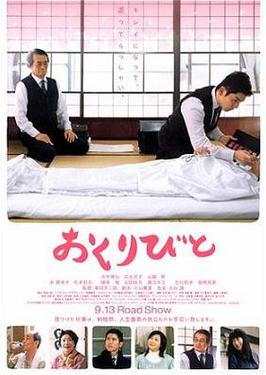
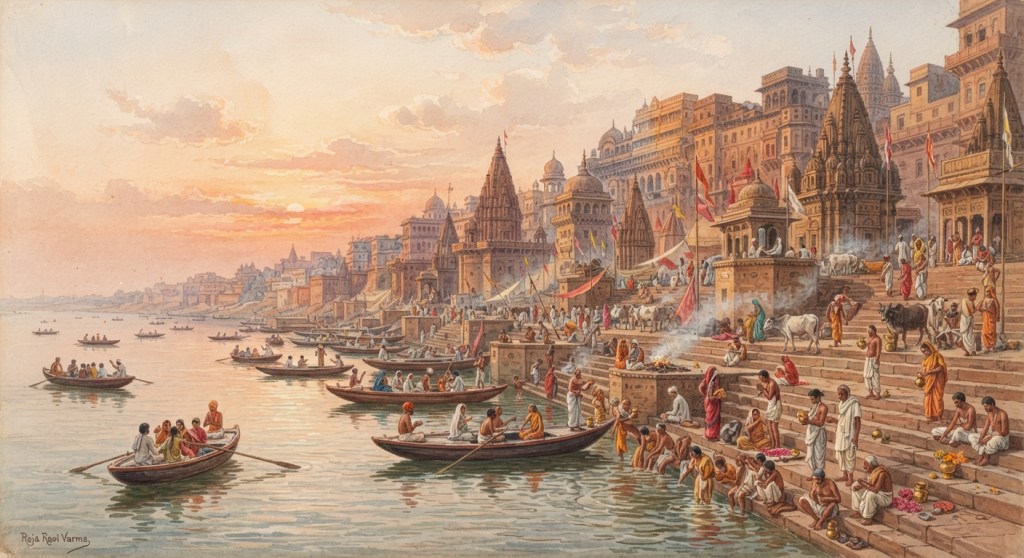
What gave the film its philosophical depth was a journey made by its lead actor, Masahiro Motoki. While in India, he went to Varanasi and stood before the ceremony in which the dead are cremated at the river’s edge and their ashes given to the Ganges.
A man who had met death through the quiet courtesies of Japanese custom looked upon River Ganga, who has received the departed for countless ages, and carried that sight home into the film. I find it deeply fitting that a story deeply Japanese in its manners should draw part of its spiritual depth from the banks of the Ganga.
Departures turned my attention to samsara and the afterlife, and it sent me to the city that Motoki had seen.
Kashi: The City of Moksham
Varanasi, which the devout call Kashi, belongs to Shiva. It is the place he has never forsaken, and tradition holds that the city rests upon his trident, beyond the reach of time. The burning ghats the courtyard of the Lord himself, who is Mahakala, Lord of time, and Smashanavasin, he who dwells in the cremation ground with the ash of the pyre upon his body.
To be cremated at Kashi is to be placed in the fire of Shiva, and the ashes given to the Ganga enter the river that first descended through his matted locks. This is the passage of moksham Motoki glimpsed on that riverbank. It is the eternal end for moksham is freedom from the cycle of life and death.
A death rite is an act of devotion to Shiva and Shakti, performed over a soul that is, once again, entering their keeping. Beside Shiva stands Shakti, who in Kashi is Visalakshi, whose shrine makes the city a seat of the Goddess as surely as of her Lord.
The Lord whispers liberation and the Mother holds the soul as it crosses.
Six Feet Under: The Dead Hold the Lamp
If the film taught me to stand reverently beside the dead, the American series Six Feet Under showed me how the living are held in their light. The programme follows the Fisher family, who run a funeral home, and each episode takes its thematic tone from a death.
The characters are never permitted to treat that death as finished. It becomes a lamp, and by it they see their present fortunes and misfortunes: their marriages, their ambitions, their failures of nerve and their small mercies. This recognition shaped my books more deeply than any single image or plot.
A bereavement on the first page can govern the emotional weather of everything that follows, so that a courtship, a quarrel or a long-delayed act of courage is lit by it. The dead hold the lamp and the living walk by it, and I have tried to write each death as a sacred event with which the story keeps faith.
Why One Life Could Never Be Enough
I have always respected the Western understanding of the afterlife, and I took the series seriously on its own terms. Even so, my conscience–despite ten years of evangelical Christian education–could never rest in the belief in a single life followed by an eternal heaven or an eternal hell.
One life, however long, seemed too brief a stage for the work a soul has to do, and a final verdict passed upon it sat poorly with my spiritual sensibilities.
My books are written from the conviction that the Eastern traditions have held steadfast to for a very long time: the soul returns, again and again, and each return carries it further along the road toward Shiva…
One Foundation Beneath Many Shores
The Japanese word for this turning is rinne (輪廻), written with the same characters that carry samsara across East Asia. The concept travelled far for within it was a philosophical system that could survive any dogma.
Japanese Shinto, Buddhism and Hinduism share a common philosophical foundation in the conviction that life and death belong to a greater turning of the wheel, and that one’s existence is never extinguished at the threshold.
My own books draw from the Shaiva stream of that river, coloured throughout by Shakta recognition of the Mother.
Grace, Shakti and the Long Refinement
Within Shaivism, the cycle receives its tender and moral meaning. Shiva loves every soul. Personal effort is essential, and the aspirant is asked to practise, to discipline the mind and to serve.
Yet God-realisation ultimately depends on divine grace, which the tradition counts among Shiva’s own acts and which Shakti bestows as the power of the Lord descending upon the soul. The devotee may walk toward the goal with great diligence, but the final crossing remains a gift.
So exalted a state asks of a great deal of the aspirant. Reaching it requires passing through spiritual trials, purification and refinement over many lifetimes, and the Mother tends the soul through every one of them.
A soul is tested, burnished and tested again, and the griefs, losses and hard relationships of one life become the gold-working of the next. This is the principle that animates the characters in my books. Their sufferings carry weight because they belong to a long and holy process, and each death matters because it hands a soul from one stage of refinement to the next.
Samsara is Shiva’s Mercy
The conviction at the heart of all my books is a single sentence: samsara is Shiva’s mercy. Yes, you will live again. If Shiva loves every soul, and if the soul needs many lifetimes to be refined into readiness for realisation, then the wheel of rebirth is the very means by which that love keeps its promise.
Every return is another opportunity extended to the soul, and every death is a door held open by Mahadeva, with Shakti standing in the doorway as Mother. A single life with a final judgement would offer one chance.
Shiva offers as many as the soul requires.
This is why my books return again and again to the deathbed, the cremation ground and the grieving household. These are Shiva’s places, and I enter them with folded hands. The film sent me to the ghats of Kashi, the series showed me how the living are illuminated by their dead, and the Shaiva and Shakta understanding of grace showed me what the whole movement means.
Death is the doorway, samsara is the wheel, and the hand that turns it is merciful.
Om Namah Shivaya.


Leave a Reply