
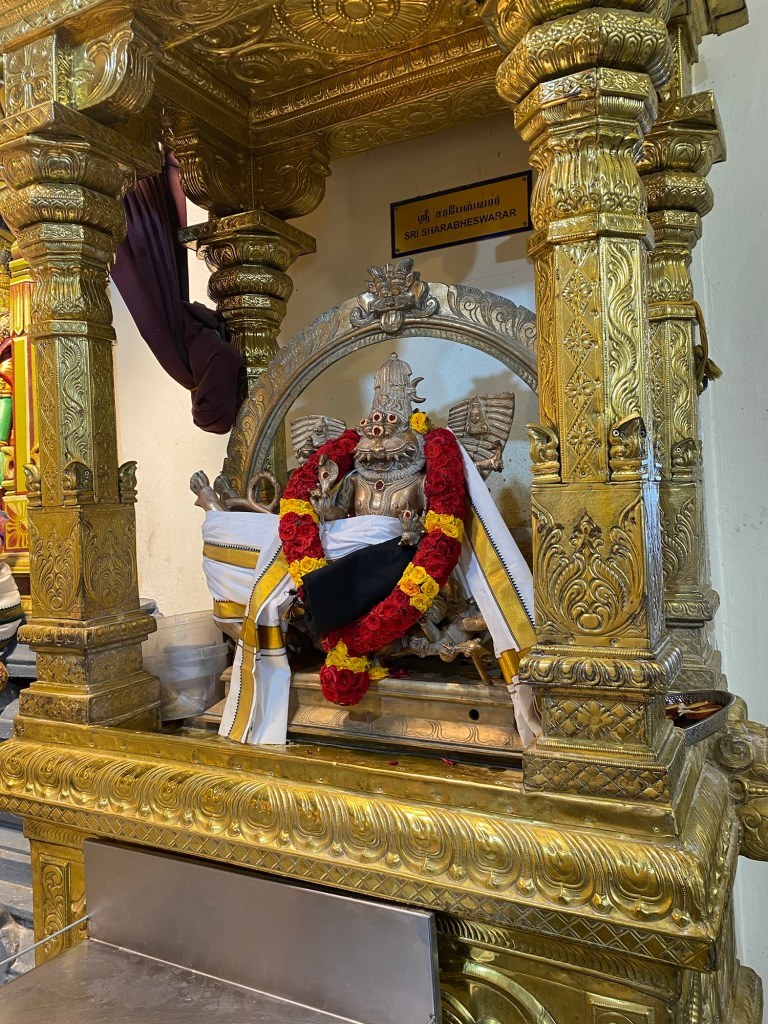
For many devotees navigating the spiritual landscape as part of the Hindu diaspora, the introduction to specific deities often occurs in sacred pockets of ancient traditions far removed from the Indian subcontinent. My own journey into the mystery of Sri Sarabeshwara began many years ago in the heart of Singapore’s Chinatown.
It was amidst the rhythmic chanting and the fragrant smoke of a havan at the historic Sri Mariamman Temple that I first encountered the formidable presence of this deity. In that space, where the ancient traditions of Tamil Nadu meet the cosmopolitan energy of a global city, the energy of Sarabeshwara felt both primal and protective.
The Form of the Ultimate Healer
Sri Sarabeshwara, or Lord Sharabha, is perhaps one of the most complex and awe-inspiring manifestations within the Shaivite tradition. He is an avatar of Lord Shiva, appearing as a magnificent hybrid creature—part lion, part bird, and part human. Legend describes him as possessing eight legs, two wings of immense span, and the face of a fierce lion crowned with matted locks.
In the grand tapestry of Hindu mythology, this form was assumed to bring balance to the universe. Following the destruction of the demon Hiranyakashipu, Lord Vishnu’s avatar, Narasimha, remained in a state of fierce, uncontrollable ecstasy.
To pacify this celestial fury and ensure the world was not consumed by the heat of Narasimha’s rage, Lord Shiva manifested as Sarabeshwara. This intersection of Vaishnava and Shaiva narratives highlights a fundamental truth often cherished in the diaspora: that the Divine moves in whatever form is necessary to restore cosmic order.
The Purpose of Worship and Spiritual Protection
Worship of Sri Sarabeshwara is centred primarily on the themes of protection, healing, and the removal of seemingly insurmountable obstacles. He is often referred to as the “Dispeller of Bad Omens” and the “Healer of Incurable Diseases.” In a world that can feel chaotic or spiritually isolating, he represents the ultimate “Force Majeure” that can neutralise negative energies, whether they are external or internal.
The Sarabha Upanishad and various Agamic texts emphasize that he is the “Lord who removes all fears.” Devotees seek his grace to overcome legal entanglements, health crises, and the evil eye drishti. The Sarabheswara Havan—the fire ritual like the one I witnessed in Singapore—is considered a potent tool for purification, transforming the “heat” of one’s problems into the “light” of spiritual clarity.
The Divine Consorts: Durga and Pratyangira Devi
A defining characteristic of Sri Sarabeshwara’s iconography is the presence of his two wings, which are said to embody two of the most powerful manifestations of the Divine Feminine: Goddess Durga and Goddess Pratyangira Devi. These consorts are his power shakti.
Goddess Durga, occupying one wing, represents the protective maternal force. She is the vanquisher of demons and the provider of courage. Her presence signifies that the wrath of Sarabeshwara is fundamentally rooted in the desire to protect the devotee, much like a mother protecting her child.
Goddess Pratyangira Devi, occupying the other wing, is a specialised force of protection. Often depicted with a lion’s face, she is the goddess of the Atharva Veda, specifically invoked to counter black magic and negative vibrations. Together, these two goddesses provide a balanced shield: Durga offers the strength to move forward, while Pratyangira ensures that no hidden harm can reach the seeker.
A Diaspora Perspective on an Ancient Force
The Sri Mariamman Temple in Singapore stands as a testament to how these ancient energies travel across oceans. To worship him is to acknowledge that life presents challenges that require more than just gentility—it sometimes requires an intervention. Whether in the heart of a bustling Southeast Asian city or in a private home shrine half a world away, Sri Sarabeshwara remains a symbol of the Divine’s commitment to protecting the soul from the shadows of the world.




Leave a Reply