
The Architecture of a Sunday
Sunday belongs to the Sun. In Jyotisha, Vedic astrology, each day of the week is presided over by a celestial body, and Surya, the solar deity, claims the first day. This is not symbolic housekeeping. It is a cosmological statement: Sunday carries the energetic signature of solar consciousness — illumination, authority, vitality, the relentless will to shine.
In cultures across the ancient world, from Rome to India, the sun was almost invariably coded as masculine. It is the eye of the sky, the sovereign, the self that cannot be hidden. And yet, even on Sunday — even on the Sun’s own day — there comes a window of time that belongs to his enemy.
Rahu Kalam on Sunday falls in the late afternoon, roughly between 4:30 and 6:00 PM depending on the latitude and the length of the day. It is the hour assigned to Rahu, the shadow planet, the north node of the moon — a force that, in mythological terms, literally swallowed the Sun. That is not an accident. That is a teaching.
Rahu and the Dragon’s Mouth
In the Samudra Manthan story — the churning of the cosmic ocean — the demon Svarbhānu disguised himself among the gods to drink the nectar of immortality. Surya and Chandra, the sun and moon, recognised him and alerted Vishnu, who severed Svarbhānu’s head before the nectar could pass his throat. But the head had already tasted immortality. It became Rahu. The body became Ketu. And Rahu, in eternal vengeance, periodically swallows the Sun — causing solar eclipses.
Rahu Kalam, then, is the daily echo of that mythological moment. A time when Rahu’s influence eclipses solar clarity. Practitioners of Jyotish traditionally avoid beginning new ventures during Rahu Kalam — not out of superstition in any shallow sense, but out of a recognition that certain forces distort clear perception. Rahu is the planet of obsession, illusion, ambition without wisdom, desire without understanding. He is the hungry head without a body — craving without digestion, wanting without the capacity to truly receive.
On Sunday, Rahu Kalam arrives as a direct confrontation between solar energy and its shadow. The sun at his most regal, and then: the eclipse. The king blinded.
Surya and the Solar Self
To understand what is at stake, it helps to understand what Surya actually represents in Vedic thought. Surya is not simply the physical sun. He is Atmakaraka — the significator of the soul, of self, of the core identity. He represents the father, the king, the visible self that we present to the world. His gaze is direct. He cannot be looked at without pain, which is perhaps why so many traditions warn against the ego: to stare too long at one’s own light is blinding.
Surya presides over dharma — right action, right order, the principle that things should be as they should be. He is also the deity most associated with pride. In the epics, solar kings are magnificent and terrible in equal measure — this is the solar masculine: luminous, unwavering, and in its shadow form, catastrophically rigid.
The Male Ego as a Solar Phenomenon
The connection between the sun, masculinity, and ego is not culturally arbitrary. Across traditions — Vedic, Greek, Egyptian, Zoroastrian — the sun represents the principle of individuation, of standing apart, of being seen. These are qualities essential to a functioning self. Without a solar centre, there is no coherent identity, no direction, no capacity for sustained action.
But the sun also burns. It blinds. Unchecked solar energy in a person manifests as the need to dominate all light in the room, to make every situation revolve around one’s own orbit. The male ego, in its pathological form, is solar energy without humility — Surya without his charioteer, without Aruna, the dawn, who moderates the sun’s full force so that life on earth can survive it.
The Vedic tradition understood this. Surya is always depicted with a charioteer and seven horses — the seven colors of light, the seven chakras — a whole system of mediation between the solar core and the world it illuminates. Raw, unmediated solar force is not sustaining. It is scorching.
And yet men are so often taught that this is precisely what they should be: unmediated. Unwavering. The source of light for others, never themselves needing light. The king who does not bend.
When Rahu Kalam Arrives
So here is the tension that Sunday’s Rahu Kalam makes visible: at the peak of solar dominance — on the Sun’s own day — comes the daily eclipse. The shadow arrives right on schedule, invited by the very architecture of time itself.
In practical Jyotish, this is a warning about clouded judgment, about beginning things under distorted perception. But as a metaphor for masculine psychology, it is extraordinarily precise. The male ego, precisely at the moment of its greatest self-certainty, becomes most vulnerable to its own blind spots. The shadow arrives not from outside, but from the accumulated hunger of everything the solar self has refused to digest — desires unacknowledged, needs disguised as authority, fear dressed as strength.
Rahu is, above all, the unprocessed. He is the head without the body, meaning: he is cognition without feeling, ambition without groundedness, identity without integration. He is what happens when a man constructs his sense of self entirely from what can be seen — achievement, status, the brightness of his accomplishments — while suppressing whatever cannot be shown. Rahu is the darkness that gathers under very bright lights.
The eclipse, when it comes, is not a defeat. It is a revelation. What you are when your light is temporarily obscured — that, too, is you.
What the Shadow Wants
Traditional Jyotish advises resting, reflecting, and avoiding new beginnings during Rahu Kalam. There is wisdom in this that extends beyond superstition: the shadow period is not for action. It is for witnessing. To watch what emerges when the solar performance pauses — the insecurities that scramble for cover, the hungers that surface when there is no audience — is to begin to know oneself more fully.
The male ego’s deepest wound is often the belief that it must always be in its noon position: overhead, dominant, casting minimal shadow. It is exhausting. It is also cosmologically incorrect. Even the sun sets. Even Surya descends each evening into the waters, into the underworld, to be reborn. The solar journey is not a fixed performance of brightness. It is a rhythm that includes darkness as generative necessity.
Rahu Kalam on Sunday is the tradition’s way of encoding this truth into time itself. Even on the day most consecrated to solar consciousness, the shadow gets its hour. Not to destroy the sun — Rahu can swallow, but never truly extinguish — but to remind the solar self that it does not exist in isolation. That there are forces older than pride, hungers more ancient than order, and that to refuse them is not strength but a kind of cosmological arrogance.
Learning to Eclipse Gracefully
The question that Sunday’s Rahu Kalam poses to anyone operating from a predominantly solar — masculine, ego-driven, achievement-oriented — mode of being is not: how do I avoid the shadow? The question is: how do I meet it?
Because Rahu Kalam comes whether you are ready or not. The shadow arrives on schedule. The eclipse happens. The only variable is whether the person under eclipse has built enough inner life to survive the temporary loss of their own radiance — to sit in the dimming and not mistake it for annihilation.
Men who have only ever defined themselves by what they can illuminate rarely survive their own eclipses intact. They rage against the darkening. They double down on performance precisely when the performance breaks down. They are undone by what they refused to integrate.
But a man who has learned to receive as well as radiate, to be seen in his uncertainty as well as his strength, to acknowledge the body below the ambitious head — he can move through Rahu Kalam, and through the darker seasons of his life, with something that the Vedic tradition might simply call vairāgya: a kind of luminous non-attachment to one’s own light.
The Sun rises again every morning. Even on Monday — the Moon’s day, the day of feeling, of water, of the mother — Surya returns. He always returns. But he returns renewed only because he was willing to descend. That is what Sunday’s Rahu Kalam, in its quiet way, keeps trying to teach.
Durga Puja During Sunday Rahu Kalam
What has been said above belongs to one register — psychological, mythological, contemplative. What follows belongs to another: devotional practice. The two are not in conflict, but they are not the same, and they should not be collapsed.
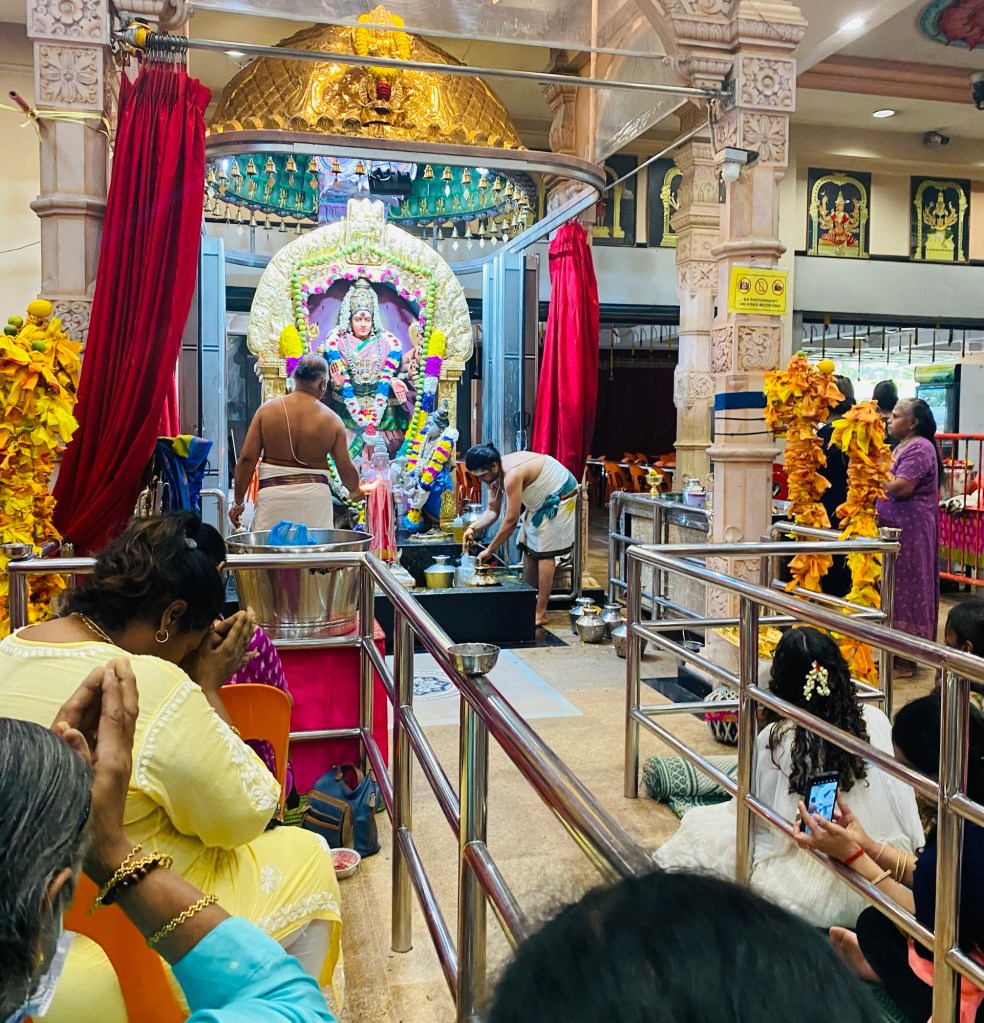
In certain Shakta traditions and among practitioners following specific regional customs, Sunday’s Rahu Kalam is a time actively consecrated to Durga. This may seem counterintuitive given the standard injunctions against auspicious beginnings during Rahu Kalam, but the logic is precise and worth understanding on its own terms.
Durga is not a deity of auspicious beginnings in the conventional sense. She is not Lakshmi, who blesses abundance, or Saraswati, who presides over creative flourishing. Durga is the force that arises specifically in response to what cannot be overcome by ordinary means. Her mythology is not one of ‘blessing’, but of necessity — she emerges when the gods themselves have been defeated, when solar and masculine power has been exhausted, when Rahu, metaphorically speaking, has already won. She is the force that operates precisely where conventional agency fails.
This is why Rahu Kalam becomes her hour. The shadow period — inauspicious for human initiative, for the ego’s projects and plans — is not inauspicious for Shakti. The very qualities that make Rahu Kalam dangerous for ego-driven action make it potent for surrender to the divine feminine. Rahu dissolves boundaries, obscures the rational self, breaks down the certainties of solar consciousness. In a devotional frame, this dissolution is not a problem. It is preparation. It clears the ground that Durga’s presence requires.
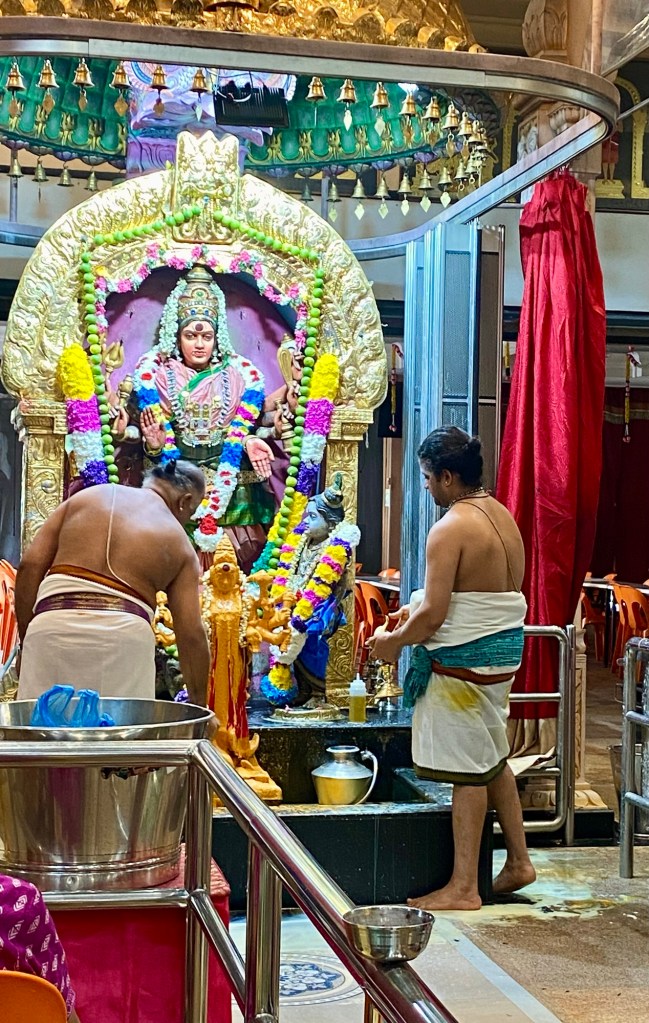
The puja performed during this window typically emphasises protection — kavach, armour — and the removal of Rahu’s malefic influence through the intercession of the goddess. Red flowers, particularly hibiscus, are offered. Lamps are lit. The Durga Saptashati or specific Rahu-related stotras may be recited. The premise is that Durga, as Mahashakti, encompasses and exceeds Rahu’s power; that what Rahu distorts, she can clarify; that what the shadow obscures, her fire illuminates from a different angle entirely.
There is something cosmologically elegant about this. If Rahu Kalam on Sunday is the hour when the shadow falls across the Sun’s own day — when masculine solar consciousness is at its most eclipsed — then calling upon Durga in that window is an acknowledgment that the restoration of clarity does not come from more solar effort. It comes from a different order of force altogether. Not Surya reasserting himself. Not willpower pushing through the fog. But the goddess arriving into the darkness that the ego could not navigate alone.
Whether one approaches this as living devotional practice or as a symbolic framework, the theology is consistent with everything the earlier sections of this piece have been circling: that the eclipse is real, that solar energy has genuine limits, and that what meets those limits — what waits on the other side of the shadow — is not more light of the same kind, but something older, fiercer, and more complete.




Leave a Reply