
The word samhara arrives in Sanskrit like an exhale that cannot be reversed. Linguistically, the root means “to draw together” or “to collect”. It means dissolution, withdrawal, retraction — the act by which what was projected back into consciousness is drawn home.
In the five-fold cosmological schema of Shaivism, samhara is the third great act of Shiva: following srishti (creation) and sthiti (sustenance), it is the moment when consciousness reabsorbs the content it has cast outward into the world. It is not annihilation in the nihilistic sense. It is retrieval.
Samhara Bhairava — the eighth and last of the Ashtabhairavas, the terrifying face of Shiva whose domain is total dissolution — is the deity who embodies, enacts, and ultimately is that retrieval.
To speak of Samhara Bhairava is to speak of an endpoint that is also a threshold. He stands at the outermost ring of the Bhairava tradition, the final guardian before the void that is not emptiness but pure, undifferentiated potential. Where the first seven Bhairavas correspond to deities, directions, elements, and aspects of the cosmic drama, Samhara Bhairava transcends the drama entirely. He is the form in which all forms dissolve.
The Architecture of the Ashtabhairavas
To understand Samhara Bhairava’s place, one must understand the system from which he emerges. Shiva holds sovereignty over the eight directions of the universe through eight terrifying emanations, the Ashtabhairavas. Each governs a direction, embodies a cosmic principle, and carries a distinct set of weapons, a vahana, and a consort drawn from the Ashta Matrikas, the eight mother-goddesses whose fierce energies mirror and complete those of the Bhairavas.
The first seven — Asitanga, Ruru, Chanda, Krodha, Unmatta, Kapala, and Bhishana — are identified with the principal Vedic and Puranic deities: Vishnu, Brahma, Surya, Rudra, Indra, Chandra, and Yama, respectively.
They are the divine forces that run the machinery of the cosmos: creation, maintenance, judgment, illumination, divine intoxication, and the skull-bearing passage through death. Each is potent and terrible in its own right. Together they constitute the universe’s ongoing operation. But they do not account for its ultimate ground.
That ground is Samhara Bhairava. He is identified not with any relative deity, but with Paramatman — the Supreme Self, the ultimate reality that underlies and contains all the others. The seven preceding Bhairavas represent aspects of the divine at play within time and form. The eighth withdraws the play entirely. He is, as one tradition puts it simply, the true Bhairava. The others are faces; he is the face behind the faces.
The Lightning That Remains When the Storm Clears
Every detail of Samhara Bhairava’s form carries meaning cultivated over centuries of Tantric theology and artistic practice. He blazes with a yellow-orange radiance described in Puranic sources as the brilliance of lightning — not the lightning of the storm, but the flash that illuminates everything at once and then leaves darkness behind, a darkness in which one suddenly can see.
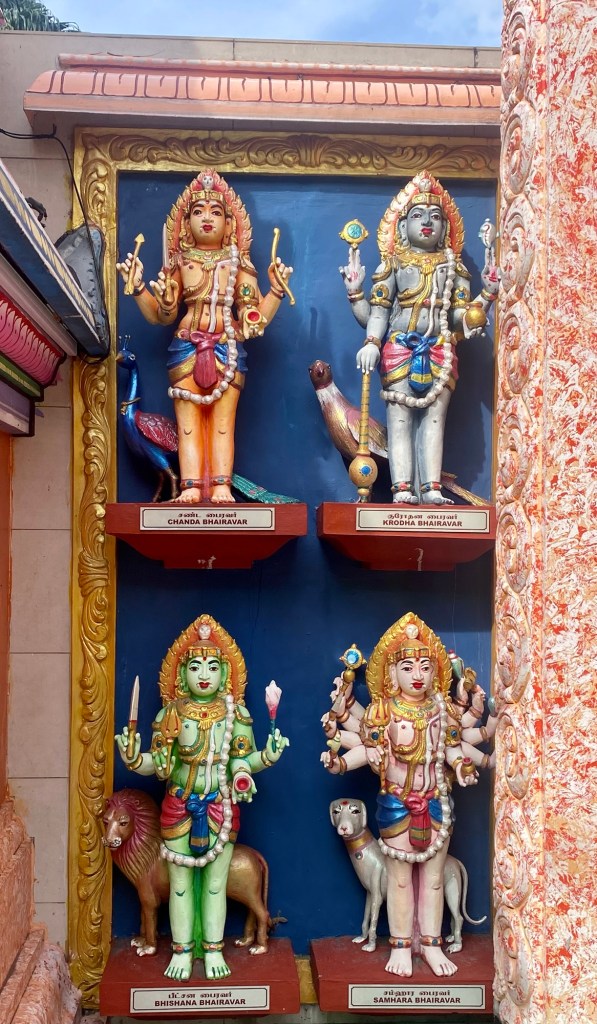
He appears most prominently in his ten-armed form, each hand bearing an instrument of sovereignty over the world he is appointed to dissolve. His weapons vary across textual sources — the Shilparatna and other iconographic manuals enumerate different configurations — but typically include the trishula (trident), the khadga (sword), the khatvanga (the skull-topped staff of the Kapalika ascetics), the pasha (noose), the damaru (small hourglass drum), the shankha (conch), the chakra (discus), the gada (mace), and the ankusha (elephant goad).
Each instrument governs a different form of bondage, a different thread of ignorance and attachment that must be severed before the soul can proceed into liberation.
The dog serves as his vahana, his divine vehicle — an animal whose association with Bhairava is ancient and layered. Dogs inhabit thresholds, cremation grounds, the margins of settled life. They are ritually impure in orthodox Hinduism, associated with the dead and the outcast, which is precisely why they appear at the feet of the deity who dwells beyond purity and impurity alike.
The dog is also unswervingly loyal, a guardian who asks nothing but to serve — and in the deeper reading, he represents the shadow-self of the seeker, the part of consciousness that must be acknowledged rather than expelled in order to progress. Samhara Bhairava faces northeast, the direction called Ishanya in Sanskrit, traditionally associated with Shiva, with the sacred, with the subtle convergence of divine energies.
His consort is Chandika, also called Chandi, an aspect of Shakti who is herself a force of fierce annihilation. She is not a gentle feminine complement but an active, independent power, a Mahadevi who destroys the demonic and illuminates the devotee. Their union is not decorative but ontological: Samhara Bhairava as the absolute consciousness, Chandika as the absolute power. In Kashmir Shaivism’s language, Prakasha and Vimarsha — light and self-awareness — are inseparable. The deity cannot be understood without his Shakti, and she cannot be understood without him.
Samhara as Grace
In the non-dual framework of Kashmir Shaivism as articulated by Abhinavagupta and elaborated in texts like the Vijnana Bhairava Tantra, dissolution is understood as a grace. The five acts of Shiva — creation, maintenance, dissolution, concealment, and revelation — are not a sequence of events in linear time but an ongoing pulsation of consciousness, what the tradition calls spanda, the divine throb that is reality itself.
Concealment (tirodhana) is the act by which the infinite contracts into the appearance of individual, separate experience — the veil that makes the universe of distinct objects and beings seem real in its own right. Anugraha, revelation or grace, is the lifting of that veil. And samhara, dissolution, is what makes revelation possible: before grace can illuminate, the structures that obscure must be withdrawn.
In this framework, Samhara Bhairava is the liberator through dissolution. His function at the cosmic level — withdrawing the entire projected universe back into pure consciousness — mirrors his function at the personal level: dissolving the identity-structures, karmic accumulations, ego-formations, and attachments that bind the individual soul to the cycle of rebirth.
The tradition says clearly that his energy focuses on guiding devotees toward moksha, liberation. He keeps evil forces in check, yes; but his deeper gift is the dissolution of the past itself — the negative karma, the ancestral debts (pitru doshas), the old wounds of the soul that accumulate across lifetimes and become the invisible architecture of suffering.
One stotram associated with the Ashtabhairavas captures his function concisely: Samhara Bhairava kills one’s ego-self. Not the person, but the false edifice of selfhood that the person has mistaken for reality. This is why the tradition insists that he does not simply destroy — he liberates.
The Mahabharata, in its cosmological passages, speaks of Kalaagnirudra, the destroyer of all beings at the end of the age, as withdrawing all creatures into his own radiance. The fire of time does not exterminate; it retrieves. What was projected is returned. This is Samhara Bhairava’s deepest identity.
The Samhara Group: Sub-Emanations and Cosmic Architecture
According to the Shiva Agamas, each of the eight Bhairavas generates eight further emanations, producing sixty-four Bhairavas in total who stand as the sentinels of the entire universe. The Samhara group — those Bhairavas emanating from Samhara Bhairava himself — bears its own distinctive character.
These sixty-four Bhairavas correspond to the sixty-four Yoginis, fierce feminine powers who populate the Tantric universe. The Matrikas who correspond to the eight Bhairavas each govern eight more Matrikas in turn, forming eight chakras of yoginis and Bhairavas.
The homam (fire ritual) and puja dedicated to Samhara Bhairava follow Tantric protocols of considerable specificity. The mantra used in puja invokes his power to dispel spirits and ghosts, to cut through all fears, to dissolve all that obstructs. The ritual typically involves the presence of sixty-four yoginis through pujan, the invocation of the Ashtabhairavas together, and specific offerings that the tradition considers particularly dear to him.
Devotees who approach Samhara Bhairava seek relief from accumulated negative karma and ancestral debts. They come for protection from negative energies, but also — and this is the more theologically interesting dimension — for the dissolution of obstacles whose nature is internal: old grief, old sin, old patterns of thought and action that no amount of worldly effort can undo.
He is said to govern the planet Rahu, the shadow-planet of the lunar nodes, associated in Vedic astrology with karmic knots, obsession, and the compulsive patterns that a soul brings across lifetimes. His governance of Rahu is entirely fitting: what compels the soul into its darkest orbits is precisely what Samhara Bhairava is appointed to dissolve.
The Deity at the End of All Seeking
Samhara Bhairava occupies a peculiar position in the theologies of seekers. He is simultaneously the most forbidding and the most merciful. He offers no consolation, no gentle comfort, no middle path between the seeker’s current condition and liberation. He offers only what remains when everything else is taken away.
The tradition does not hide this. His stotrams explicitly celebrate his power to kill the ego-self. His homam mantra commands dissolution again and again: samharaya, samharaya — dissolve it, dissolve it. His iconography confronts the devotee with weapons designed to sever the last threads of attachment. He faces the northeast, the direction of Shiva, the direction from which grace descends, but a grace that looks like devastation until the devastation is complete.
What remains after Samhara Bhairava has done his work is not described in any of the texts as an experience of loss. It is described in the language of moksha, liberation — the light-consciousness of Paramatman, which is both the ground from which the deity arises and the destination to which his devotees are ultimately called. The eighth Bhairava, the one who dissolves all the others, is in the end not a deity who takes. He is a deity who returns.





Leave a Reply