
On the owl as the vahana of Goddess Lakshmi — keeper of paradox, guardian of the unseen
A Curious Companion
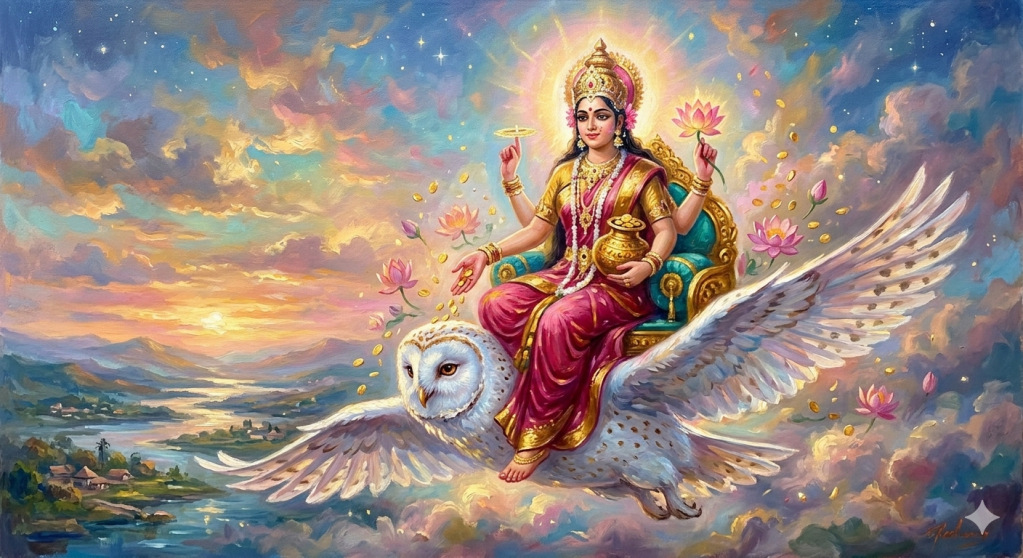
Among all the vahanas — the divine vehicles and animal companions of the Hindu pantheon — few are as quietly dissonant as the owl who carries Goddess Lakshmi. Here is a bird of the night, a creature associated in many cultures with ill omen and eerie silence, chosen as the mount of the very goddess of abundance, prosperity, and radiant good fortune. At first glance, the pairing seems contradictory. Look longer, and it becomes one of the most psychologically rich symbols in all of Hindu iconography.
The owl in question is the uluka, typically depicted as the Indian eagle-owl (Bubo bengalensis) or the barn owl — large, watchful, preternaturally still. In Sanskrit literature, the word uluka carries its own ambivalence: it names the bird, but it is also an epithet that suggests something slightly uncanny, a creature that does not quite fit the ordered world of daylight. Yet Lakshmi, resplendent in gold and lotus-pink, keeps this bird close.
What the Owl Sees
The owl is, above all else, a creature of exceptional vision in darkness. While other birds go blind at dusk, the owl’s eyes dilate and its senses sharpen. Mythologically, this makes it the perfect vehicle for wisdom that transcends ordinary perception — the ability to discern truth where others see only shadow.
Lakshmi is not only the goddess of material wealth. She presides over a far wider domain: sri, a Sanskrit term encompassing beauty, grace, auspiciousness, and inner radiance. To receive Lakshmi’s blessing, the tradition suggests, one must be able to perceive her — and she does not always arrive in obvious forms.
She may come quietly, at an unexpected hour, in circumstances that do not announce themselves as fortunate. The owl, with its ability to see in the dark, becomes a symbol of this perceptive faculty: the capacity to recognize abundance and grace where the untrained eye finds only obscurity.
To truly see Lakshmi is itself a form of wisdom — she does not always arrive in daylight.
The Paradox of Wealth and Blindness
There is a second layer to the owl’s symbolism, one that cuts in a more cautionary direction. In common Indian idiom, a person who squanders wealth, who cannot manage prosperity wisely, is sometimes called an ullu — a fool, literally an owl. The association points to the bird’s tendency to be dazzled and disoriented by sudden light, helpless in the glare of noon.
This is not a flaw in the symbol, but rather, it is the symbol’s depth. Lakshmi’s vahana embodies both the highest possibility and the lowest pitfall of prosperity. Wealth, in Hindu thought, is neither inherently good nor inherently corrupting. It is a form of power, and power reveals character. The owl reminds the devotee that one can sit in the presence of Lakshmi and still be blinded — not by darkness, but by the very brilliance of fortune itself. The challenge is to receive abundance with equanimity and discernment, not with grasping or with the dull complacency of one who mistakes possession for wisdom.
Night, Silence, and the Inner Life
The owl is a creature of extraordinary silence. Its feathers are structured to muffle sound almost entirely in flight — it arrives without warning, disappears without a trace. In the iconographic imagination, this silence is not emptiness; it is the silence of deep attention, of stillness before action, of the interior life that sustains all outer flourishing.
There is a strand of thought in the Lakshmi tradition, articulated in texts like the Sri Sukta — a Rigvedic hymn considered one of the oldest devotional texts to the goddess — that connects Lakshmi’s grace to dhyana, meditative quietude. The bustling marketplace is one of her domains, yes, but so is the still predawn hour when a householder rises before the world to tend the lamp and offer flowers. The owl inhabits exactly that hour. It is at home in the liminal space between night and day, between the world of dreams and the world of action, which is precisely where spiritual practice unfolds.
Companion, Not Merely Mount
In much of Hindu iconography, Lakshmi is depicted standing on a lotus or seated on a throne, with the owl present nearby rather than beneath her feet in the strict posture of a vehicle. This is significant. The owl is less a mode of transport — the way Garuda carries Vishnu across the heavens — and more a companion, a familiar, a symbol of an aspect of the goddess herself that is not immediately visible in her golden, bejewelled form.
She is the goddess who blesses granaries and banks, yes. But she is equally the goddess who moves through the night undetected, who withdraws from households that have grown arrogant or negligent, who visits in ways that only the wakeful can receive. The owl travels with her as her shadow-self, the quiet intelligence that underlies all her abundance.
Why This Paradox Matters
The spiritual tradition of Hinduism has long been comfortable with contradiction held in productive tension. Shiva wears a garland of skulls. Saraswati, goddess of learning, rides a swan but is sometimes accompanied by a peacock — a bird that, for all its beauty, eats snakes. Kali, terrifying in her destruction, is simultaneously the most fiercely loving of mothers. Deities are not meant to be simple, because life is not simple, and any divine figure worth devotion must be capacious enough to contain the full range of human experience.
Lakshmi’s owl does this work beautifully. It holds together wisdom and folly, night and abundance, silence and generosity. It says to the devotee: if you wish to truly worship this goddess, do not only seek her in prosperity. Learn to see in the dark. Cultivate the interior silence from which all outer flourishing grows. And be warned — wealth, like the noon sun, can blind those who are not prepared for it.
The owl watches. It always watches. In its unblinking, golden gaze, there is something of the goddess herself — patient, perceptive, and profoundly awake in the hours when the rest of the world has closed its eyes.




 Twinn Swan
Leave a comment