
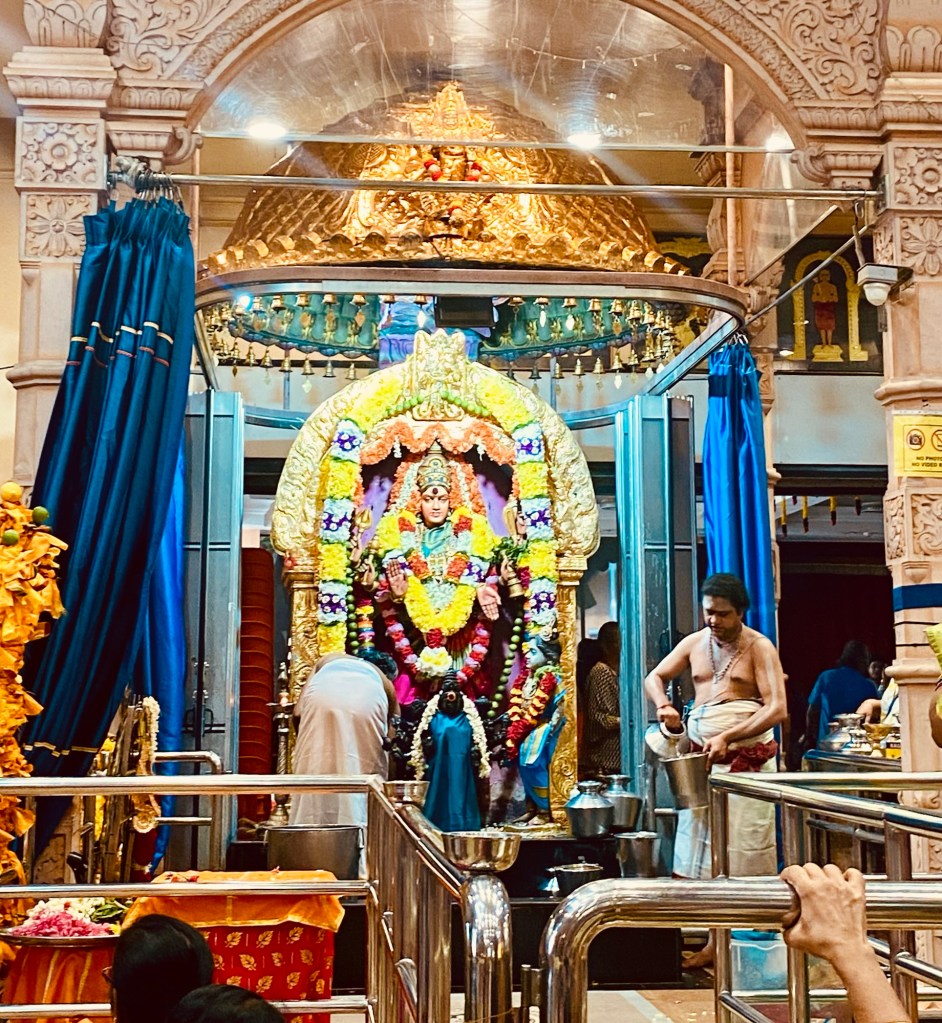
Nobody explained Rahu Kalam to me. I first noticed it at the temples where Mother Durga is worshipped. A particular quality of activity descended at a certain hour as certain activities were quietly set aside and the priests began moving differently. The air simply changed its instructions. No announcement. No explanation. You simply understood, in the way you understand things at temples, that something was being observed and that you should observe it, too, even if you don’t understand it.
It’s only much later that I’ve found myself returning to it, not as inherited practice, but as something I’ve chosen to explore again — and in a slightly different direction than perhaps what was initially intended. Rahu Kalam is inauspicious time. That much everyone knows. But inauspicious for what, exactly, and inauspicious by whose reckoning — these are questions worth sitting with rather than taking as settled, done and dusted.
What Rahu Actually Is
Rahu is not a planet. This is easy to forget when it sits in your chart like one. It is the north lunar node — a mathematical point, a shadow, the place where the Moon’s path crosses the Sun’s and eclipses become possible. The ancients named it carefully: Rahu the eclipse-maker, Rahu the obscurer, Rahu who swallows the light and holds it for a while before returning it changed.
The mythology is vivid. Rahu is the severed head of the demon Svarbhānu, who disguised himself among the gods to drink the amrita — the nectar of immortality — before Vishnu’s discus separated head from body. The head became Rahu; the tail became Ketu. Together they form the nodal axis, the shadow planets, the points of perpetual eclipse.
What the mythology encodes is something true about shadow: it is intelligent. It got in by disguise. It wanted something — immortality, no less — and it nearly succeeded. The shadow is not simply the part of us that is broken or bad. It is often the part that wanted something real and learned, early and well, to want it in secret.
The Hours on Tuesday and Friday
Every day has its Rahu Kalam, a window of roughly ninety minutes considered inauspicious for new beginnings. Tuesday’s falls in the late afternoon. Friday’s comes in the morning, that particular hour when the week begins its slow exhale.
Tuesday is Mars’s day — assertion, drive, the will that wants to move forward. When Rahu sits over Mars energy, what tends to surface is not forward movement, but its underside: the frustration that has no clean object, the anger that has been too polite to name itself, the places where something in you has been pressing against a wall for longer than you’ve admitted. It is not a comfortable combination. It is an honest one.
Friday belongs to Venus — desire, beauty, attachment, the whole complicated territory of how we love and what we need from it. Rahu over Venus tends to bring up what longing looks like when it has nowhere to go. The grief underneath the wanting. The pattern beneath the pattern. It is softer than Tuesday but often goes deeper, the way still water does.
Neither of these is accidental. The tradition may not have been thinking about the Jungian unconscious, but it was paying close attention to something.
The Gap in the Old Map
Classical Vedic astrology was largely a map of external life. When to travel, when to marry, when to begin a business, when to approach a king. The inauspicious times were inauspicious for outward action — for things that required the world to cooperate with your intentions. Rahu Kalam was a signal to wait, to not begin, to let the window pass.
There is wisdom in this. To have culturally sanctioned pauses — moments where the tradition itself says not now, not outward — is something most modern lives are severely lacking. The compulsion to produce, to initiate, to always be in forward motion is its own kind of exhaustion, and an old one.
But the map stopped at the threshold of the interior. Not because the interior didn’t matter — the Upanishads would have something to say about that — but because the astrological tradition was concerned with a different domain. The systematic investigation of the unconscious, the deliberate excavation of what we have hidden from ourselves, was not on the itinerary.
Jung arrived at this from the other direction entirely. The shadow, in his framework, is not ‘malefic’ in the way Rahu is malefic. It is simply the unlit portion of the self — everything that didn’t make the cut for the official story we tell about who we are. Qualities exiled in childhood. Emotions that were too inconvenient to be allowed. Desires that felt dangerous to acknowledge and so were filed away somewhere below the floorboards, where they continue to influence everything from a position of deniability.
What you don’t look at doesn’t disappear. It just operates without your supervision.
Borrowed Time, Repurposed
The invitation I’ve found in Rahu Kalam — particularly on Tuesdays and Fridays — is to deliberately go toward what they tend to surface anyway.
If external action is thwarted during this window, then the window belongs to internal action. Not journaling as productivity, not self-reflection as self-improvement project, but something quieter and less goal-oriented than that. Sitting with what’s present. Following the thread of whatever emotional residue the day has left. Asking the question you’ve been too busy to ask.
The Rahu Kalam becomes a container, which is what all ritual essentially is. The form holds the content. The designated time creates a threshold and thresholds matter — they signal to the deeper parts of the self that something different is happening now, that a different quality of attention is being offered.
What I witnessed at the temple was, I think, already a form of this — though no one there would have called it shadow work, and the phrase would probably have landed strangely. But the quality of it — that turning away from outward business toward something more interior — that the tradition had always understood. It built the pause in. The rest is simply a question of what you do inside it.
Obscuration
Rahu is genuinely associated with obscuration, with what cannot be seen clearly, with the eclipse-making quality that distorts direct perception. Beginning things under that influence is genuinely risky — not because the universe is punishing you but because your own clarity is compromised, and compromised clarity makes for poor decisions.
All of that holds. What I’m adding is a direction rather than a correction: if clarity is compromised, if the shadow-energy is active, if this is not the time for clear outward sight — then perhaps it is exactly the time for the kind of looking that happens in low light. The shadow, after all, is more visible in the dark.
The tradition gestured toward this. Rahu is shadow. The Kalam is his hour. The pause from external action was already there, built into the structure of the day by people who understood that not all time is the same, that different hours have different qualities, and that moving against those qualities costs something.
There is precedent for this within the tradition itself. Rahu Kalam on Tuesdays and Fridays is considered an auspicious time to worship Goddess Durga — and this is not incidental. Durga is the one who goes into the darkness armed and clear-eyed, who faces what has been allowed to grow monstrous precisely because no one would look at it directly. She doesn’t wait for better conditions. She enters the difficult hour because that is where the work is. To invoke her during Rahu Kalam is already an acknowledgment that this time belongs not to avoidance but to confrontation — the kind that requires the ferocity of Divine Courage.



 Twinn Swan
Leave a comment