
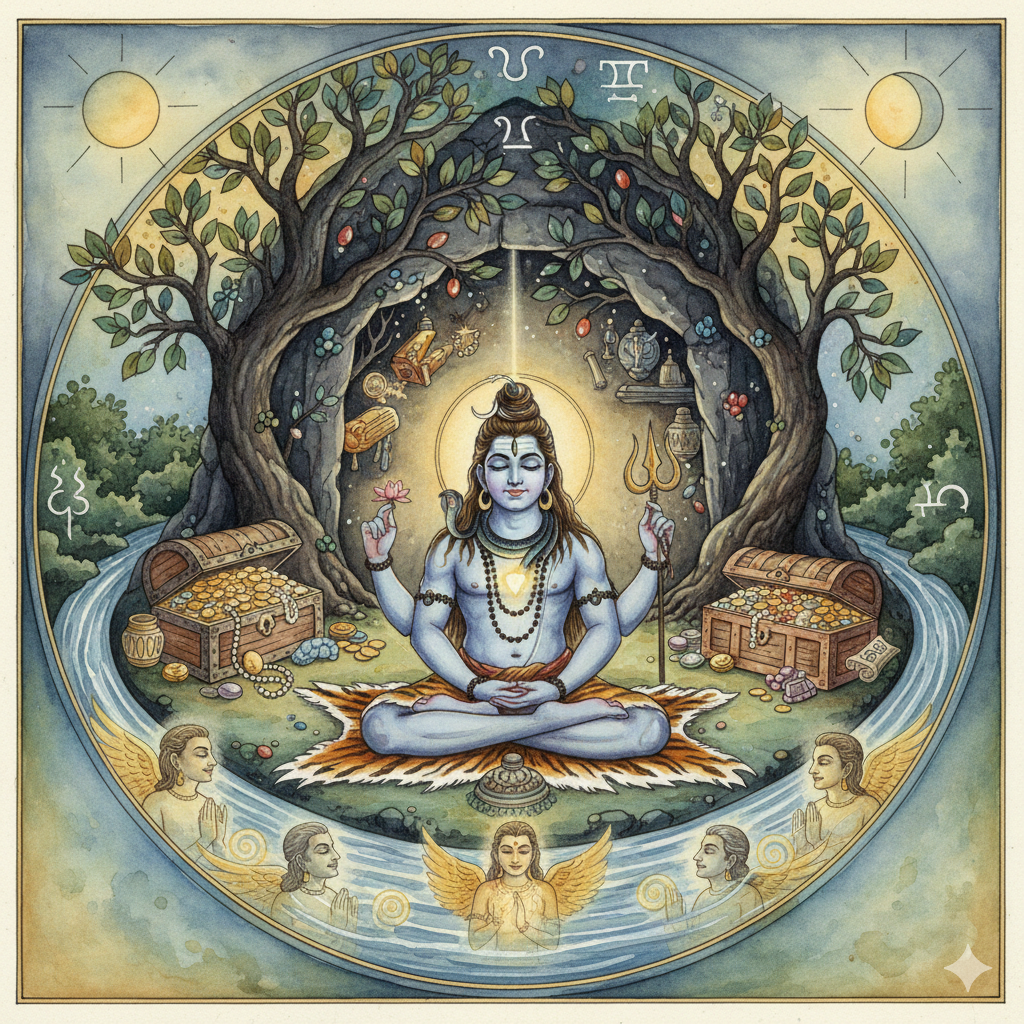
In the sacred geography of a birth chart, the Eighth House—known as Ayur Bhava or Randhra Bhava—is a realm of shadows, secrets, and the transformations that occur at the edges of life and death. When Venus, the planet of beauty, pleasure, and prosperity (known in Sanskrit as Shukra or Bhargava), descends into this mysterious cave, the native’s relationship with wealth and vitality undergoes a radical shift. This placement does not promise the obvious, sunny prosperity of the Lakshmi-ruled houses; instead, it offers buried treasure. It suggests a life where wealth is often unearned, inherited, or discovered through the ending of one cycle and the beginning of another.
The Alchemy of Shared Assets and In-Laws
Venus in the Eighth House is a primary indicator of wealth through marriage and the spouse’s family. Because the Eighth House represents the wealth of the partner (being the second from the seventh), the presence of the Karaka of luxury here suggests that the spouse brings significant financial resources or that the native benefits immensely from the assets of the in-laws.
This relationship with the in-laws is often defined by a refined, yet intense, exchange. While there may be an outward appearance of grace and harmony, the Eighth House demand for depth means that the native often acts as a financial or emotional anchor for the spouse’s family.
Wealth here is rarely liquid at the start of life; it flows through legacies, insurance settlements, or the management of joint estates. The native often finds themselves in a position where they must navigate the complex aesthetic and financial expectations of their partner’s lineage, finding that their own comfort is inextricably tied to the prosperity of their extended family.
The Delay in Progeny: A Karmic Sabbatical
One of the more complex manifestations of Venus in the Eighth House involves the delay in having children. In Vedic astrology, Venus represents the Shukra Dhatu (vital seed or reproductive essence). When this essence is placed in the Eighth House—a Dusthana or difficult house associated with obstacles—it can lead to a “burning off” or “sequestration” of reproductive vitality. The Eighth House is the house of Nija internal struggles and chronic delays. From a karmic perspective, this placement often signifies that the native needs to undergo a personal transformation or stabilise their own inner child before physical progeny can manifest.
Furthermore, because Venus aspects the Second House of family lineage from its position in the Eighth, there is an inherent tension between the desire to expand the family and the pressures of the Eighth House. The delay is rarely a denial, but rather a cosmic pause intended to ensure that the child is born into a more spiritually mature environment.
Often, the native finds that parenthood arrives only after a significant “death and rebirth” event in their personal life, or after they have achieved a level of psychological depth that allows them to nurture a soul without the interference of unhealed ancestral shadows.

Prosperity through the Occult and the Unknown
Beyond the material wealth of in-laws, Venus here grants a peculiar form of intellectual and spiritual wealth derived from the hidden side of life. These individuals often possess an eye for the unseen, allowing them to profit from industries related to research, archaeology, mining, or the occult sciences.
There is an aesthetic appreciation for the mysterious. Wealth may come through the beautiful death of things—such as restoring antiques, managing estates of the deceased or working in high-stakes financial environments where others see only risk. Shukra’s presence here softens the harshness of the Eighth House, acting as a lamp in a dark room. It provides the native with the grace to navigate crises that would break others, often turning a moment of total loss into a surprising financial gain.
The Afterlife and the Grace of the Transition
Perhaps the most esoteric gift of Venus in the Eighth House is its influence on the Preta Loka and the transition into the afterlife. In Jyotisha, the Eighth House governs the manner of death and the state of the soul immediately following its departure from the physical vessel. Venus is the Guru of the Asuras, the teacher who knows the Mrit-Sanjivani Vidya—the secret of bringing the dead back to life. When Venus resides in the Eighth, it suggests a peaceful end (Sukha-Mrityu), often in a comfortable or aesthetically pleasing environment.
More importantly, it indicates a soul that carries a high degree of merit into the post-death state. The native is likely to have a refined experience in the bardo or intermediate realms, guided by the “Sanjivani” energy of Venus. This placement suggests that the native’s prayers and rituals for their ancestors (Pitru-Tarpan) are particularly effective, creating a bridge of beauty and light between the living and the dead. The wealth they accumulate in this life is often seen as a provision for the soul’s journey, ensuring that their transition is not one of fear, but of an elegant surrender into the cosmic mystery.


 Twinn Swan
Leave a comment