
The story of Samson’s birth in the Book of Judges presents a rich tapestry of spiritual symbolism, particularly with the dramatic conclusion of the divine encounter. While the surface narrative describes a literal event—a heavenly messenger appearing to Manoah and his wife—an esoteric interpretation delves into the deeper, concealed meanings, treating the events as a process of spiritual communication.

The story of the barren wife conceiving a special child is not merely a repeated biblical motif; it represents the triumph of divine will over natural limitation. The barrenness signifies a state of spiritual potentiality, a vessel waiting to be filled directly by a heavenly source rather than through a mundane, procreative channel. Samson, therefore, is not a child of human effort alone but a vessel for a specific divine purpose, a “Nazarite to God from the womb.”
The climax of the encounter—Manoah’s offering of the young goat and grain—is the key to unlocking the esoteric meaning. The act of a burnt offering is a supreme form of spiritual ascent. The term olah itself comes from the Hebrew root meaning “to ascend,” defining its very purpose.
In this context, the sacrifice is a ritual to elevate matter and unify it with the divine. Unlike other offerings, the olah was a whole burnt offering, signifying a complete and total dedication, leaving nothing for human consumption.
The young goat represents the material realm, the physical form that is to be sanctified and brought closer to its spiritual root. The grain offering, representing human labour and sustenance, is offered alongside the goat, signifying the consecration of all aspects of one’s material existence—our work, our sustenance, and our everyday life. The offering is made on a rock, an unadulterated and foundational part of the earth, symbolising a pure, unchanging base for the spiritual ascent.
When the flame esh blazes up from the rock, it is more than just an ordinary fire. The flame is a metaphor for the divine presence Shekhinah, a force that consumes the physical to reveal the spiritual. It is the same fire that appeared in the burning bush to Moses and descended upon Mount Sinai. This flame acts as a spiritual conduit.
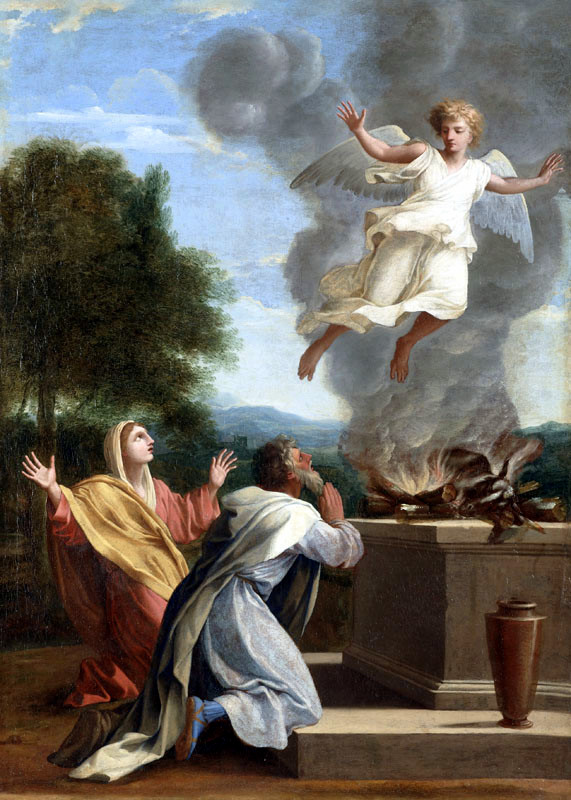
The angel’s ascent in this flame is the central esoteric act. This is the physical manifestation of the messenger returning to its source. The angel is not a separate being in this context, but an emanation of the divine. Its descent was to deliver a message, and its ascent in the smoke and fire of the sacrifice signifies the successful completion of its mission and the elevation of the physical offering into the spiritual.
It is a visual representation of the concept of tikkun, the rectification and elevation of the material world back to a state of spiritual wholeness. The sacrifice, through the divine flame, has created a perfect union between the earthly and the heavenly, a bridge upon which the divine messenger can return home.
Manoah and his wife’s reaction—”we have seen God”—is a crucial part of the esoteric lesson. They mistook the angelic manifestation for God Himself, showing their lack of understanding of the spiritual dimension of life. The experience was a direct, visual confirmation of the spiritual reality that undergirds their world, but it also highlighted the vast difference between an emanation and the divine essence.
Ultimately, the event is a profound lesson on the nature of divine revelation and the power of sacrifice. It shows that the physical world, when used with proper intention and ritual, can become a vehicle for a direct, mystical experience and a path for the integration of the spiritual into our mundane reality.




 Twinn Swan
Leave a comment