
In the worldview shaped by Shiva’s teachings and the broader umbrella of Indian spiritual philosophy, chronic illness is never just a physical condition. It is a profound intersection of time (kāla), karma, and divine will. The soul’s encounter with persistent affliction becomes a revealing mirror, reflecting layers of action and meaning that transcend any medical diagnosis.

Time: The Unfolding Canvas
Time, in this tradition, is not linear but cyclical—a rhythm of birth, decay, death, and renewal governed by cosmic order. Chronic illness emerges, in part, because its roots are entwined with duration: the slow ripening of karma across lifetimes.
While acute illness might be mere happenstance, chronic ailments announce the arrival of something deeper—a karmic pattern meeting its moment in the current of time. The Bhagavad Gita offers the formula: Karma (actions) + Daiva (destiny) + Kāla (time) = Phala (results), making clear that some consequences gestate for years, even across reincarnations, before their fruit appears in the body.
Karma: The Unseen Architect
Karma is the sum of all actions—physical, mental, and emotional—rippling outward with inevitable results. Lord Shiva teaches that every action sows a seed; what we nurture through repeated patterns, attachments, or unresolved suffering eventually becomes our field of experience.
According to the Shiva Purana, karma is divided into three currents: Sanchita, which is the accumulated karma from all past lives and forms a vast reservoir of actions yet to bear fruit; Prarabdha, the portion of that accumulated karma which has ripened and is being experienced in the current life, shaping one’s present circumstances, including birth, body, and major life events; and Agami (also known as Kriyamana or Vartamana), which refers to the new karma being created by current actions, thoughts, and intentions, and which will yield results in future lifetimes.
This threefold division illuminates how past deeds, present experiences, and future consequences are all interwoven across the cycles of birth and rebirth, making one’s spiritual journey both a product of past actions and ongoing choices.
Chronic illnesses are often seen as manifestations of prarabdha karma—the portion of your karmic backlog that must be resolved in this incarnation. When a condition defies easy remedy, its power often springs not just from genes or environment, but from a deep spiritual necessity.
This vision is not fatalistic. In the Shiva tradition, even the most painful fate is an invitation—not merely to suffer, but to awaken. Shiva’s laws of karma teach responsibility, humility, and transformation: “You are the creator of your reality. Every action, thought, and decision sets the foundation for your future”.
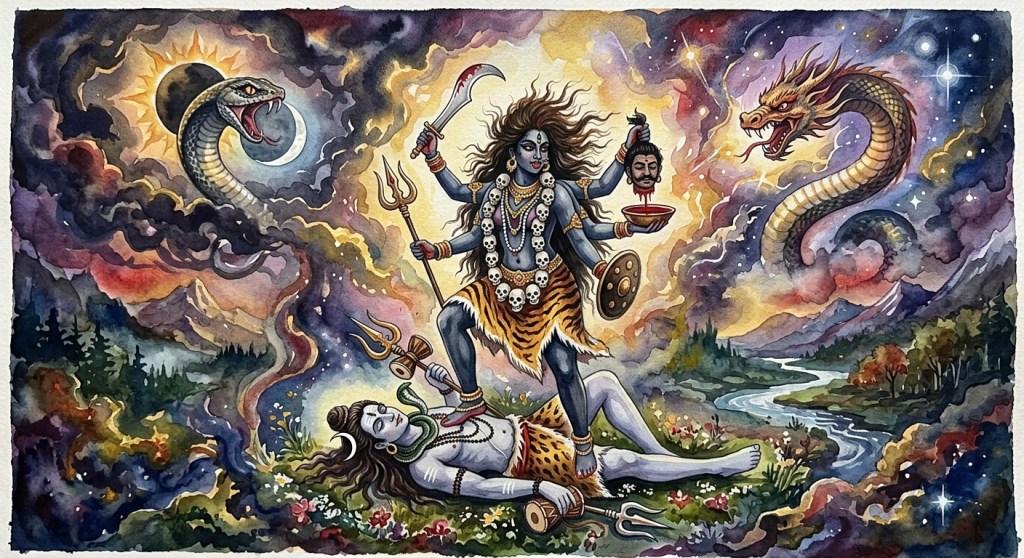
The worship of Kaal Bhairava, Shiva’s fierce emanation, reveals this dynamic: When karmic debts are too deeply rooted for ordinary remedies, Bhairava—the Lord of Time—surgically severs the bonds of the past, sometimes through pain, always through necessity. Chronic disease is thus understood, in the deepest terms, as a kind of cosmic surgery: a process, however harrowing, that strips away illusion and pride, leaving the soul bare and open to grace.
The Holistic Path
Healing, then, is not just about eradicating symptoms. Under the gaze of Shiva, it is a journey through cyclical time, an unraveling of karmic knots, the turning of adversity into spiritual power. The practice of non-attachment (performing karma without thirst for results) and surrender to the divine alters one’s relationship to pain—shifting it from meaningless suffering to purposeful purification.
In this light, chronic illness is not simply endured or cured; it is understood—as a message from the soul’s deeper journey through time. Through ritual, inner inquiry, and alignment with Shiva’s wisdom, the devotee learns to see illness not just as a problem, but as a portal: a transformative intersection of body, fate, time, and the soul’s pursuit of wholeness.



 Twinn Swan

Leave a comment