
The arrival of Goddess Saraswati‘s longstanding influence in Japan can be traced back to the 6th-8th centuries. Buddhist texts like the “Sutra of Golden Light,” which were translated from Sanskrit into Chinese, played a key role in incorporating the worship of Saraswati into Japanese culture. These texts expounded upon the veneration of “Sarasvatî Devî”, which translates to flowing water.
Saraswati’s association with the Saraswati River is reflected in Benzaiten’s connection to water. In the Japanese tradition, Benzaiten also holds dominion over wealth, good fortune, and even dragons, which are not associated with Goddess Saraswati in Indian Hinduism. The association of Benzaiten with snakes and dragons adds a unique layer to her worship and veneration.
Understanding the connection–the similarities and differences–between Saraswati and Benzaiten offer a fascinating glimpse into the interconnectedness of religious traditions across Asia.

Snakes and Dragons
In Japan, snakes are often seen as symbols of transformation, rebirth, wisdom and even immortality. They’re associated with the underworld and the chthonic (earth) energies. The link between Benzaiten and snakes possibly has its roots in indigenous Japanese beliefs where snake spirits were revered as guardians and protectors. In some depictions, Benzaiten is shown with white snakes entwined around her arms or shoulders. These white snakes represent purity, transformation and good fortune.
Dragons in Japan are majestic creatures symbolising power, wisdom, good luck and control over water. They are guardians and bringers of rain. The concept of dragons possibly arrived in Japan from China, where they play a prominent role in mythology. However, Japanese dragons tend to be less fierce and more serpentine compared to their Chinese counterparts. There are stories where Benzaiten tames a dragon, showcasing her power and control. This could symbolise her ability to harness powerful forces and channel them for good.
The presence of both snakes and dragons together with Benzaiten emphasizes her connection to the natural world, particularly water and the earth. It highlights her dominion over powerful forces and her ability to mediate between different realms (earth and water, physical and spiritual).
The combination of snakes (chthonic) and dragons (associated with water and the heavens) represents Benzaiten’s role in maintaining balance within the natural world. Both snakes and dragons are creatures associated with transformation. Their presence with Benzaiten reinforces her connection to knowledge, learning and the flow of wisdom.
The inclusion of snakes and dragons in Benzaiten’s iconography enriches her character and deepens her connection to the natural world and powerful forces. It adds another dimension to her role as a protector, benefactor and a goddess of knowledge and transformation.
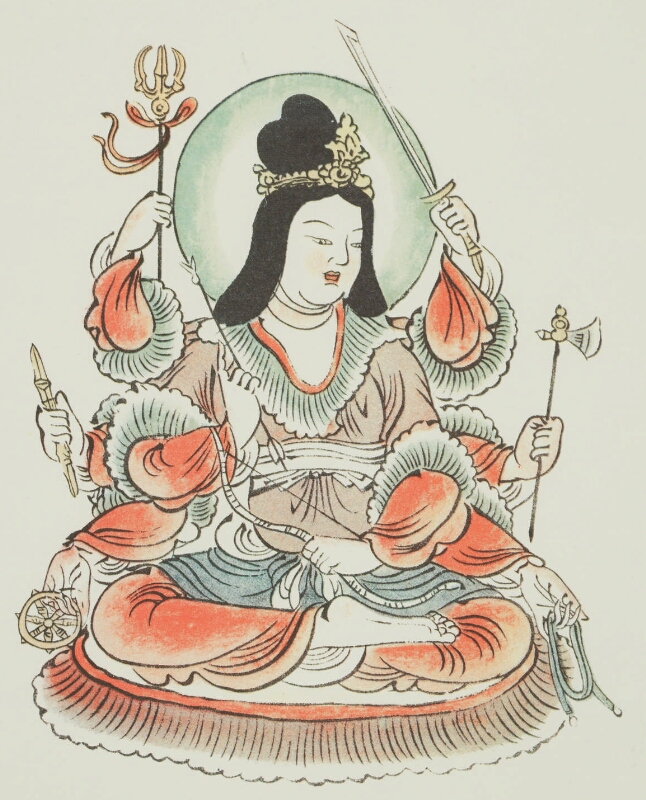
Fertility and Harvest
Benzaiten, though usually associated with Buddhist traditions, has been incorporated into Shinto practices over time. In some Shinto shrines, specific forms or manifestations of Benzaiten embody characteristics linked to harvest and fertility. These variations reflect the adaptation of the goddess to local beliefs and agricultural practices.
Benzaiten’s strong association with water is a key link. Water is essential for agriculture and seen as a source of life and nourishment. After all, a bountiful harvest is necessary to sustain a community. Particularly for those traveling by water, Benzaiten is invoked for protection. Her association with water and her role as a protector make her a natural choice for those seeking safe passage across oceans, rivers and lakes.
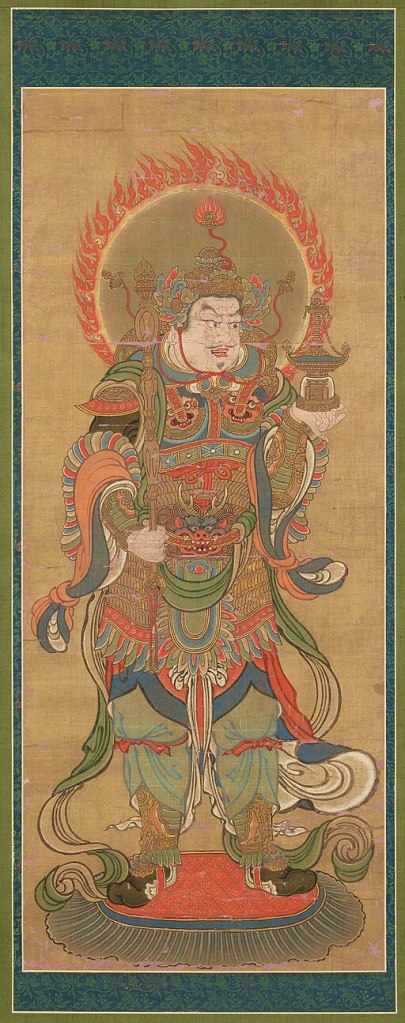
Through her Buddhist associations, Benzaiten is sometimes linked to Bishamon, the Japanese god of wealth and fortune. They are seen as complementary figures, with Bishamon representing material wealth and Benzaiten symbolising the knowledge and skills needed to acquire and maintain it. The connection between Bishamon and Benzaiten, however, goes beyond a pairing of wealth and knowledge.
In some regions, Bishamon (the Hindu equivalent of Kubera) might be the more prominent deity, with Benzaiten playing a supporting role. This could reflect the historical emphasis on warriors and protectors in those specific areas. Conversely, in regions with a strong artistic tradition, Benzaiten might take precedence, with Bishamon seen as a provider of the resources needed for artistic pursuits.





 Twinn Swan
Leave a comment