
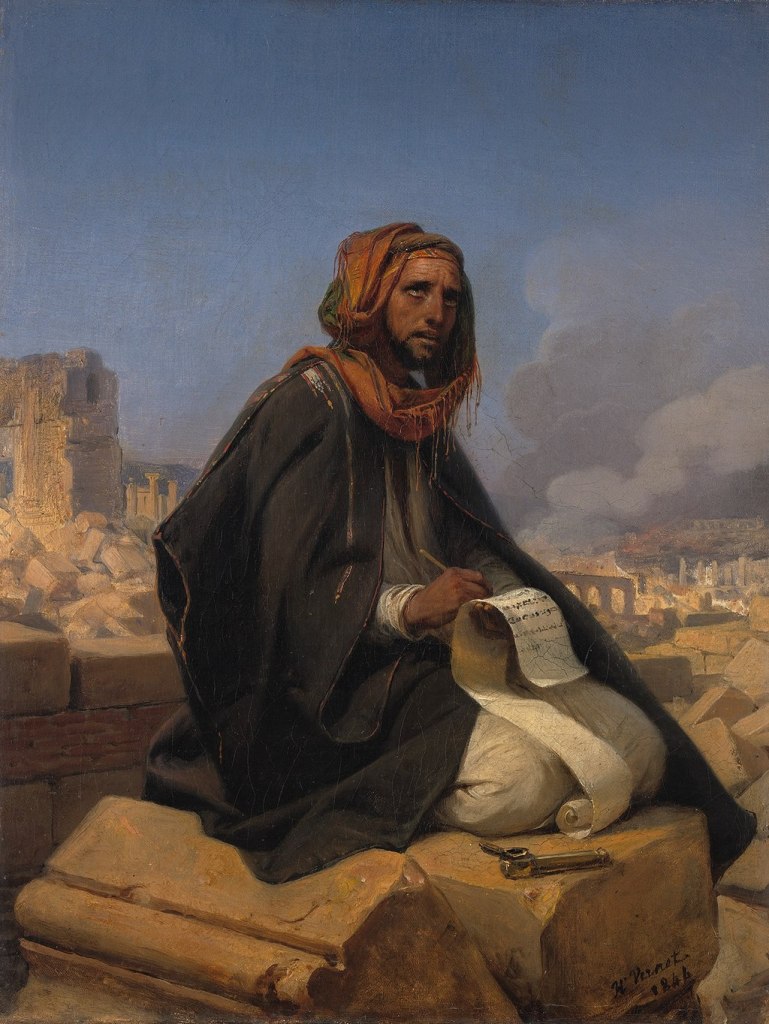
In the shadow of a crumbling Jerusalem lived Jeremiah, a youth burdened with a heavy destiny. God’s plan for Jeremiah as a prophet existed even before his birth. ‘Anathoth’, the name of Jeremiah’s hometown, means ‘answers’ in Hebrew. The location of his birth foreshadows Jeremiah’s role as a prophet who will provide answers, even if they are difficult ones. The name of his hometown is symbolic of the message he is destined to share. It is Jeremiah who will provide answers; even if they are difficult truths about the people’s disobedience and the divine judgment that was awaiting them.

YOUTH
When God calls Jeremiah into his sacred and predestined calling, Jeremiah cries out, “Ah, Lord GOD! behold, I cannot speak; for I am a child.” His straightforward declaration reveals, not only his discomfort, but also his sense of inadequacy. The use of yeled the Hebrew word for ‘child’ emphasises not only his youth, but also his lack of knowledge and experience.
Jeremiah elaborates on his many perceived limitations. He says he doesn’t know how to speak because he is young. This highlights his self-doubt. He feels ill-equipped to deliver God’s message, especially considering its seriousness and its potential audience: the Kings and the Nations of his time.
God, however, remains undeterred, even in the face of Jeremiah’s seemingly valid concerns and protests. Despite Jeremiah’s understandable anxieties, God’s response is one of reassurance. He tells him, “Do not say, ‘I am only a youth’; for to all to whom I send you, you shall go, and whatever I command you, you shall speak.” God diminishes the importance of Jeremiah’s age, implying that God will equip him for the task which lays ahead. The passage shifts the focus from Jeremiah’s limitations to his sacredness of his calling. God is in control and Jeremiah’s age is irrelevant compared to God’s will.
The contrasting ideas of a young, inexperienced Jeremiah and the vastness of his calling (“to the nations”) emphasise his struggle. “I cannot speak” can be interpreted as a metaphor for feeling overwhelmed by the task. This passage highlights the tension between God’s plan and the limitations that his chosen instruments believe that they have. Jeremiah joins a long line of biblical figures who initially resist God’s call, such as Moses and Jonah.
Jeremiah’s initial and early resistance is a powerful reminder that God’s plans cannot be changed, no matter what limitation we feel we are grappling with when we are called to it. Jeremiah’s story offers encouragement to those who feel unqualified but are called–and you could even say predestined–to serve a higher purpose.
God, himself, had chosen Jeremiah as his prophet. It was a destiny that Jeremiah could neither diminish nor deny.

UNHEEDED WARNING
Once God had initiated him, Jeremiah’s heart ached as he walked the familiar streets. The once vibrant city pulsed with the worship of false gods. The people were obsessed with wealth, power and pleasure in a way that completely overshadowed the spiritual dimension of their lives. Jeremiah’s voice echoed pronouncements of coming judgment. He spoke of a boiling pot overflowing, a metaphor for the Babylonian army that would soon sweep through Judah. His warnings, however, fell on deaf ears. Kings scoffed and priests dismissed him as the people continued to cling to their vices and false gods.
As the Babylonian siege tightened its grip, despair hung heavy in the air, choking the life out of Jerusalem. Jeremiah, a lone voice crying out in the wilderness, delivered a message as bitter as the dwindling rations. He warned the people of Judah that their turning away from God had brought impending punishment, urging them to turn back before it was too late.
Unheeded, Jeremiah’s message – a beacon of truth in a storm of denial – fell on deaf ears. Labeled a traitor and madman, Jeremiah was ostracised and imprisoned. Yet, even in the depths of despair, his voice wouldn’t be silenced. Even as Jerusalem burned, God’s prediction continued to be shared. Through symbolic acts like wearing a broken yoke, Jeremiah spoke of the futility of trusting in foreign powers. His message remained constant: true hope comes from trusting in God, not earthly solutions. Despite Jerusalem’s destruction, God’s message, delivered through Jeremiah, offered a glimpse of future restoration.
Jeremiah became a figure of ridicule, mocked for his pronouncements of doom. Yet, amidst the scorn, there were flickers of hope. Young Baruch, a loyal scribe, became his confidant, meticulously recording Jeremiah’s fiery words on scrolls. These would become a testament, a reminder of God’s message even in the darkest hours.
RESTORATION
The city fell, its walls breached, its temple reduced to smouldering ruins. The people were dragged into exile, their hearts heavy with the weight of their folly. Yet, Jeremiah, though filled with grief, remained a beacon of hope. He prophesied of a day when they would return, a new Jerusalem rebuilt, not on the foundations of disobedience, but on the bedrock of faithfulness.
The Book of Jeremiah is a story of broken promises and shattered dreams, but also of unwavering hope. It’s a testament to God’s enduring love, even in the face of human rebellion, and a promise that even from the ashes of destruction, redemption can rise.
Jeremiah’s pronouncements were not all warnings and condemnations. He spoke of a future restoration, a New Covenant etched not on tablets of stone, but on the hearts of the people. A time when God would again dwell among them, a promise that flickered like a distant light.
“For I know the plans I have for you,” declares the LORD, “plans to prosper you and not to harm you, plans to give you hope and a future.”
Jeremiah 29:11
Throughout the biblical narrative, Jeremiah emphasises the importance of individual repentance and returning to God. This repentance offers the possibility of personal redemption and a restored relationship with God. The concept of restoration is not simply about restoring a previous state. It involves addressing structural injustices that led to the downfall in the first place.
Prophetic calls for social justice and ethical living can be seen as necessary steps towards a more just and equitable restoration. While restoration is ultimately God’s work, the Bible emphasises the important role of human action. Repentance, walking in the light of God and striving for justice are all seen as contributing factors towards restoration. This multifaceted concept offers hope for a transformed future, both for individuals and for humanity as a whole.





 Twinn Swan
Leave a reply to Anonymous Cancel reply