
Go, son. Go and suffer for your actions.
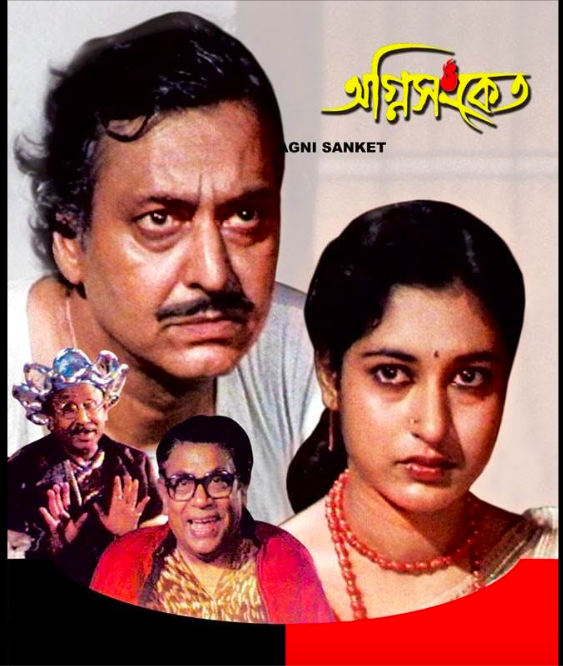
Lord Yama in the Bengali Film Agni Sanket
The 1988 Bengali-language film Agni Sanket tells the tale of a famous, wealthy and powerful politician by the name of Sulolit Sen. While giving a speech at a farmers’ gathering, Sen suddenly dies of a heart attack. After he dies, the politician arrives in Lord Yama’s realm for judgment. Instead of being sent straight to hell, Lord Yama sends him back to earth to suffer; for earth had become more deplorable than hell due to the deeds and the activities of men.
Sulolit Sen, despite being a ‘successful’ politician, is forced to face the truth of the society that he’s created. When he returns to earth, it is not as a politician, but rather as a common man. Through that journey, Sen is forced to face the burdens that he has created for others through his policies, his acts of corruption and his selfish decision-making.
Thieves can’t run an administration.
The Common Man in Agni Sanket

The Ego
Birds leave no footprints as they move across the sky. Like birds, actions that we take that are not motivated by the ego, leave no trail. They do not cause or create vasanas. It is our ego-centric actions, motivated by our selfish needs and desires, that leave their scars in our minds and in our hearts. And when we have enough power and enough influence, we are even able to scar minds and hearts that we have neither met nor known.
In the film, while Sen suffers in the beginning, he slowly begins to adjust to his life as an ordinary man. Accustomed to living a life of luxury, Sen must now face how the average man that was under his care lives his life. As he eats humble pie, Sen realises the truth of life under his political rule. He can no longer hide his misdeeds behind his oratory abilities and PR spin. He can no longer use deception to fool the masses for he has to live in the very hell that he, himself, has created through his actions.
In Hinduism, each mind comes into this world already conditioned with the vasanas that it received from its previous incarnations and from its ancestors. The Self, as Pure Consciousness, illumines the vasanas and lends them the capacity to project themselves outwards. This could be for higher purposes or lower purposes.
In the context of the Bhagavad Gita, the term guna indicates the attitude with which the mind functions. The psychological being in everyone comes under the influence of three climatic conditions. These are: harmony (sattva), activity (rajas) and inactivity (tamas).
Gunas are born of Prakriti. In the Hindu canon, gunas are associated with the corresponding colours of: light (sattva), red (rajas) and darkness (tamas). An alternative translation for the word guna is rope; that by which we are tied down. Gunas, therefore, are the three different influences under which each human mind has to play in an endless variety at different moments of its changing environments.
While all three are present in every individual, the proportion of each guna varies. These three forces of sattva, rajas and tamas are present within us at all times. They manifest in our reactions to certain situations and experiences. A particular guna is likely to be dominant in each individual. This, in turn, leads to the distinct personality–the character, the conduct and the behaviour–of each person. The rajasic mind is full of agitations and the tamasic mind is filled with murkiness.
Purity, passion, and inertia–these “GUNAS”, qualities, O mighty-armed, born of “PRAKRITI”, bind fast in the body the Embodied, the Indestructible.
The Holy Geeta by Swami Chinmayananda
Since these gunas are functioning, at all times, within each one of us; each seeker must learn and understand the art of subjectively diagnosing them in him or herself. Once we identify which tendency is the most powerful within us, we become aware of the most powerful traits that rule our mental life. Once a person becomes sensitive to the constitution of his own mind, he will be able to discard all wrong impulses, misguided tendencies, unethical behaviour and keep himself safely protected and balanced.
As Sulolit Sen is forced to live the life of an ordinary man, he can no longer hide behind his manipulativeness. He has to face, head on, what it means to be powerless to circumstances that are beyond one’s own control. He finally realises that the burning hell he, himself, created is on earth.


 Twinn Swan
Leave a reply to The Ethics of Our Desires | A Story of the Begging Bowl – The Mercantile Cancel reply