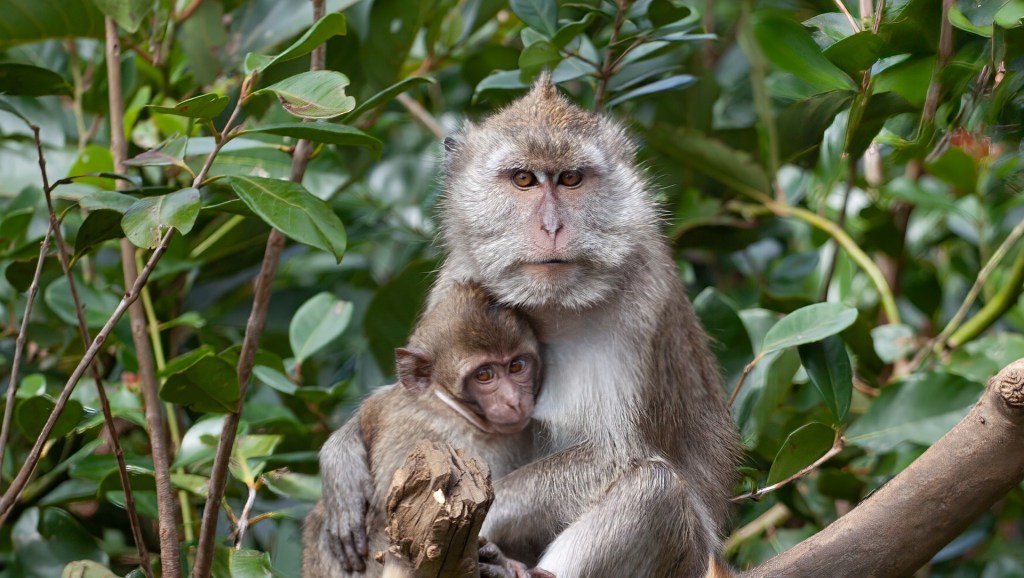
The long-tailed macaque–also known as the crab-eating macaque–is the most commonly seen species among the simians of Singapore. According to National Parks, there are some 1,500 macaques; most of which reside in the rainforest nature reserves.

Growing up, I often sighted them at MacRitchie Reservoir whenever we had school excursions. In addition to its main abode in the Central Water Catchment region of Singapore, the macaque also dwells in Bukit Batok Nature Park, Yishun and Admiralty Parks, as well as offshore on Sisters Islands and Pulau Ubin.
Macaques are mainly vegetarian, although some species have been observed feeding on insects. The reason why the long-tailed macaque is also called the crab-eating macaque is because it sometimes forages the beach for crabs.
Despite its name, the crab-eating macaque does not usually consume crabs. Rather, as an opportunistic omnivore, it eats a variety of animals and plants. A majority of the macaque’s diet comprises of fruits and seeds, but it also eats leaves, flowers, roots, and bark. In Singapore, the macaque is said to have a special fondness for eggs.
Research has found that the long-tailed macaque of Singapore is unique. It is smaller, has different facial features and a larger tail-body ratio than others found in the neighbouring regions of Southeast Asia.
Different species of monkeys have a different social order and the crab-eating macaque is a social animal that lives in matrilineal social groups that can contain between 3 to 20 members. A clear dominance hierarchy exists among females and these ranks not only remain stable throughout the female’s lifetime; the hierarchy is also sustained through the generations.


 Twinn Swan
Leave a reply to When Anjaneya Consumed the Sun | A Story of Hanuman – The Sanatan Chronicle Cancel reply