
The desert landscape of Ancient Egypt was never merely a backdrop; it was a living, lethal force. In a civilisation built upon the narrow, fertile banks of the Nile, the constant threat from venomous scorpions and vipers was an existential reality. Survival required more than just faith; it demanded a precise, empirical, and specialised field of study. What emerged was a sophisticated “serpent science,” practiced by a group of healers distinct from the traditional state priests: the Kherep Serqet.
The Practitioners: Healers Beyond the Temple
While the Egyptian temple system was highly hierarchical and focused on the maintenance of cosmic order (Ma’at), the serpent healers operated in a more pragmatic, immediate realm. The traditional high priests, the Hem-Netjer, were occupied with the daily rituals required to sustain the gods within their sacred walls. In contrast, the Kherep Serqet—the Controllers of Serqet—were mobile, clinical specialists.
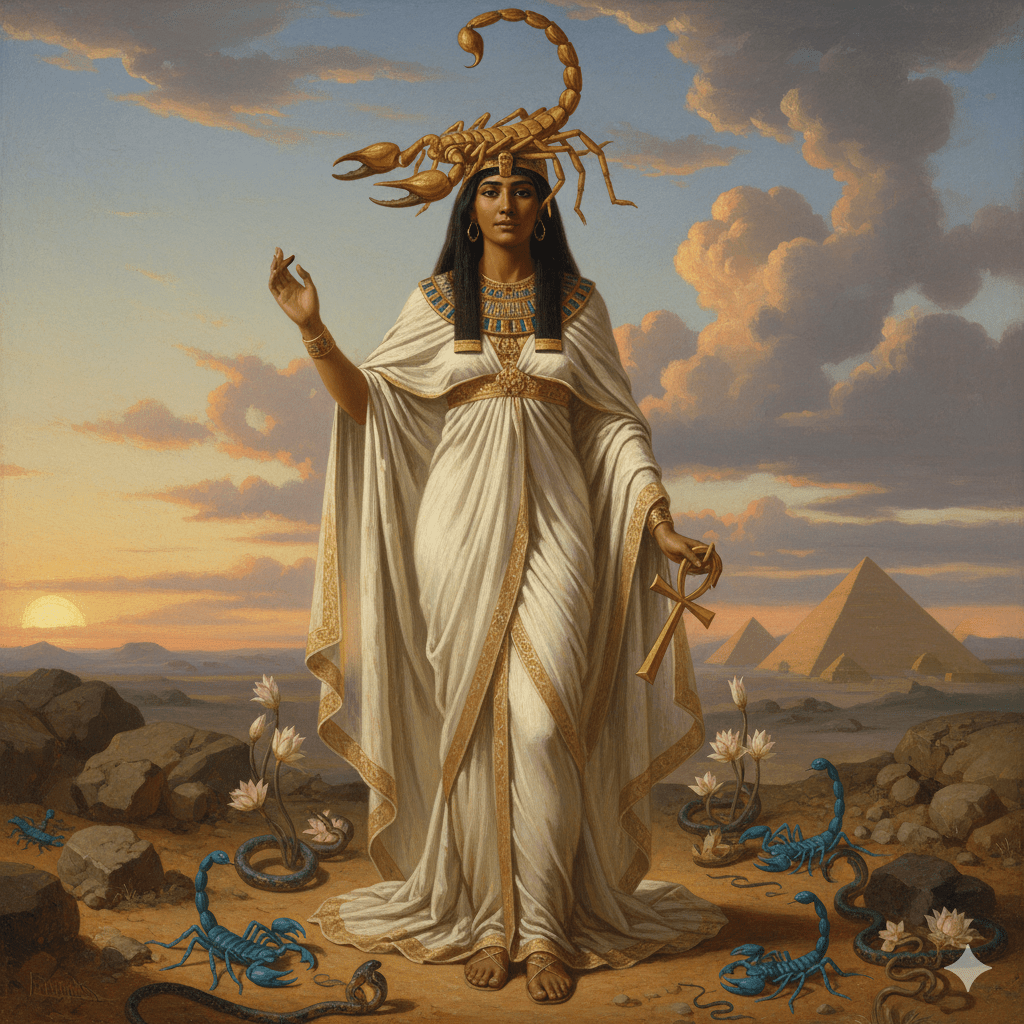
Their title was derived from the goddess Serqet, a deity usually depicted with a scorpion atop her head. Her nature was inherently dualistic; she governed the poison, meaning she was the source of both the lethal sting and the protection from it. A Kherep Serqet was not a ritual chanter in the traditional sense, but a trained expert who walked the line between what we would consider a doctor, a toxicologist, and an exorcist. They were called upon when the generalist healers (Sunu) or the temple rituals reached their limits.
The Taxonomy of Venom: The Brooklyn Papyrus
The scientific depth of their work is preserved in the Brooklyn Papyrus, one of the oldest medical treatises in existence. Unlike a simple book of spells, this document catalogs the serpents of the Nile with remarkable zoological detail. It identifies thirty-eight different types of snakes and vipers, categorising them based on physical characteristics, behaviour and the specific biological nature of their bite.
This was the foundation of Egyptian toxicology. The Kherep Serqet understood that different venoms required different interventions. They identified the Horned Viper (Cerastes cerastes) and the Egyptian Cobra (Naja haje), documenting the progression of symptoms from local swelling to systemic collapse. This cataloging suggests a tradition of long-term empirical observation, where the results of bites were recorded and analysed over generations to refine the healer’s response.
Heka: The Technology of Creation
The effectiveness of the Kherep Serqet rested on the Egyptian concept of Heka. Often loosely translated as “magic,” Heka was understood by the Egyptians as the primordial energy that bound the universe together. It was the “software” of creation. In the context of serpent science, medicine and Heka were inseparable. While a standard wound might be treated with bandages and honey, a snake bite was viewed as the introduction of a hostile, spiritual-biological force into the body.
The treatment protocol was a sophisticated synthesis of the physical and the linguistic. A healer would begin with clinical intervention, such as lancing the wound to encourage the expulsion of venom or applying poultices made of ingredients like onions, salt, and natron—substances known for their antiseptic properties.
Simultaneously, the healer would employ “linguistic medicine.” These were not mere prayers but were considered therapeutic technologies. By reciting specific myths—such as the healing of the infant Horus from a scorpion’s sting—the Kherep Serqet attempted to create a metaphysical bridge, transferring the power of the mythic healing into the physical body of the patient.
The Specialist’s Legacy
The Kherep Serqet represented the most pragmatic arm of Egyptian belief. They were the masters of the “fringe,” operating in the dangerous space where the wild desert met the civilised valley. Their science was one of active command rather than passive observation. They did not seek to appease the serpent so much as they sought to control the energy it carried.
By combining botanical knowledge, a rigorous taxonomy of venom, and the application of Heka as a practical tool, these healers formed a guild of specialists whose primary loyalty was to the survival of the sufferer. They remain a testament to a time when science, language, and nature were woven into a single, potent discipline: the art of controlling the sting.

 Twinn Swan
Leave a comment