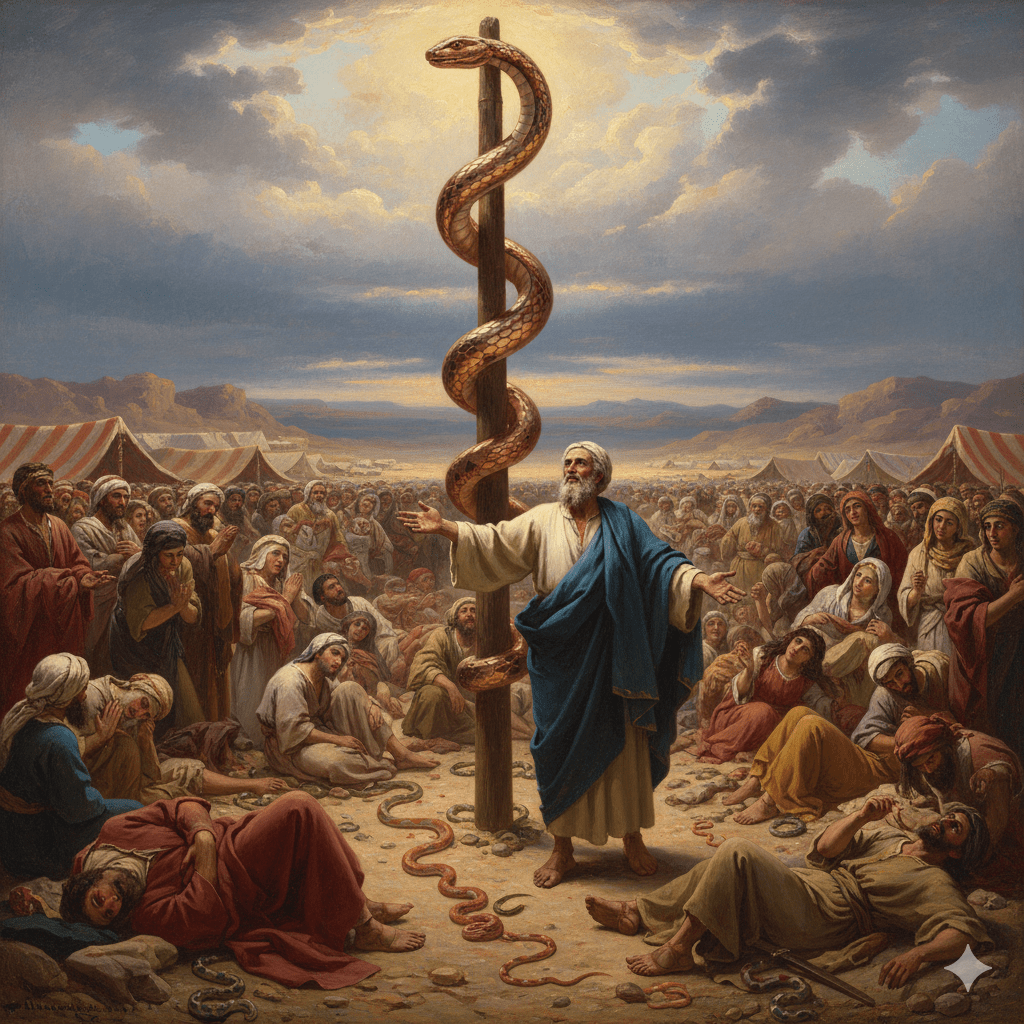
In the desert, symbols are not mere metaphors. They are the symbolic language of the soul. Among the most enigmatic of these is the Nehushtan—the Copper Serpent. While typically understood as a miraculous cure, the deeper mechanics of the Hebrew language suggest a sophisticated psychological intervention. Moses does not simply provide a remedy; he constructs a mirror that forces a nation to confront the architecture of its own destruction.
The Linguistic Mirror: Nachash and Nechoshet
To grasp the depth of this moment, we must turn to the Hebrew root. The words for “snake” (Nachash) and “copper” (Nechoshet) are inextricably linked. This is more than a pun; it is an ontological statement. In the Torah, the Nachash is the primordial whisperer—the one who introduces doubt and division. Nechoshet, however, is a base metal that must be refined by fire to reveal its lustre.
By casting the serpent in copper, Moses was performing a form of material alchemy. He took the “snake”—the symbol of the erratic, biting impulse—and “froze” it into a static, refined form. Copper is unique for its reflective properties; before the invention of glass mirrors, copper was the primary material used for reflection. When the Israelites looked up at the pole, they were looking at a reflection of their own nature, cast in a metal that represents the refinement of the base self.
The Venom of Speech: The Echo of Eden
The crisis began with a rebellion of the tongue (Numbers 21). The Israelites “spoke against God and against Moses,” returning to the original sin of the Garden. In Jewish thought, the serpent’s primary tool was Lashon Hara (evil speech)—the use of language to create a rift between reality and perception.
When the “fiery serpents” began to bite the people, the punishment was an externalization of an internal state. The “poison” of the snakes was the physical manifestation of the cynicism the people had released into the camp. Moses’ intervention was not to remove the snakes—God notably leaves the serpents in the camp—but to change how the people interacted with them. The healing was predicated on a fundamental shift: moving from the subjective experience of being bitten to the objective observation of the bite.
The Vertical Shift: The Exposure of the Throat
The Mishnah asks the pivotal question: “Does a serpent kill, or does a serpent give life?” The answer points toward the “subjugation of the heart.” This is often read as a simple religious platitude, but the mechanics are deeper.
By placing the serpent on a high pole, Moses forced a “vertical shift.” A society focused on “the bread” and the “miserable way” is a horizontal society—it is reactive, driven by immediate biological needs and grievances. To look up is a physical act of defiance against one’s own survival instincts. It requires the sufferer to stop looking at the wound on their leg and instead tilt their head back, exposing their throat—the most vulnerable part of the body. This posture is the physical embodiment of Bitachon (trust). To heal, one had to stop fighting the snake and start looking through it.
The Silence of the Nehushtan
There is a stark contrast between the “fiery” (hissing, moving, biting) snakes on the ground and the silent, cold copper snake on the pole. The copper serpent represents the “Observation of the Ego.” When an Israelite looked at the pole, they were observing the source of their death in a state of absolute stillness.
This represents the mastery over the Yetzer Hara (the base inclination). We do not kill the inclination; we “freeze” it. We observe it so clearly that it loses its power to bite. Moses was teaching the people a form of spiritual mindfulness: if you can look at your impulse (the snake) without blinking, if you can see it for what it is—a base metal that can be polished—the poison ceases to act on you.
The Staff and the Snake: The Paradox of Power
This episode serves as the final movement in Moses’ lifelong symphony with the serpent. At the Burning Bush, Moses ran away from the snake. God commanded him to “grab it by the tail,” transforming the threat back into a staff (a support).
By the time we reach the Nehushtan, Moses is no longer running. He has mastered the “serpent energy.” He understands that the difference between a staff that leads and a snake that bites is simply the hand that holds it and the eye that perceives it. He does not ask God to take the snakes away; he asks for the tools to help the people survive the snakes.
The Homeopathy of Presence
Ultimately, the Copper Serpent is the Torah’s most profound lesson on trauma. We are often told that to heal, we must look away from what hurts us. Moses suggests the opposite: stand in the centre of the camp, find the thing that bit you, and look at it until you see through it.
The Nehushtan teaches that the “poison” of our lives—our failures, our resentments, our history—is only lethal as long as it remains in the “horizontal” plane of our ego. Once elevated, once looked at with the “gaze of heaven,” the snake becomes the staff. The healing wasn’t in the copper; it was in the courage to look at the copper and see the possibility of a refined self.


 Twinn Swan
Leave a comment