
Why the Mala is Traditionally Kept Hidden in Public Practice
In many Hindu, Buddhist, and yogic traditions, the japa mala is a vessel of accumulated spiritual energy. Each time a practitioner moves through a mala, the beads absorb the vibrations of the mantra being repeated. Over time, a well-used mala becomes charged with samskaras spiritual impressions, making it a deeply personal and energetically sensitive object.
The tradition of concealing the mala during public practice — most commonly by using a cloth bag called a gomukhi (literally “cow’s mouth”) that slips over the hand — stems from several intersecting beliefs. The most fundamental is the protection of sankalpa, the sacred intention behind the practice. When a sadhaka spiritual aspirant recites a mantra openly, the energy of the practice can be diluted or disturbed by the gaze and attention of others, even when those observers mean no harm. In classical texts, this is sometimes described as the eyes of others carrying drishti, a form of energetic influence that can interrupt the subtle inner work being done.
Underlying this custom is something more socially pointed than it first appears. Priestly classes and religious communities have always had a stake in keeping spiritual practice elaborate, mediated, and dependent on their involvement — the right ritual, the right officiant, the right offering at the right hour, for the appropriate consideration.
Many practitioners came to japa not by philosophical choice but by circumstance — unable to afford the priest, excluded from the temple, or simply exhausted by a system that seemed to place God perpetually out of reach. What they discovered, often quietly and without guidance, was that sitting alone with a mantra and a string of beads worked — and worked profoundly. In the classical framework, they had stumbled away from karma yoga, the path of prescribed ritual action, into something closer to raja yoga, the direct inner path that requires nothing external at all.
What they discovered, often quietly and without external guidance, was that sitting alone with a mantra and a string of beads worked — and worked profoundly. No intermediary, no prescribed form, no one to collect a fee at the end of it. The relationship was direct. This is perhaps the most subversive thing the mala represents: that the sacred is not dispensed by institutions, but accessed by individuals, and that the only qualification required is the sincerity to show up and repeat the name.
The Meditation Shawl
Another method of concealment is the use of a meditation shawl — drawn over the head and hands so that the entire act of japa is enveloped within a private, tented space. This practice serves the same protective function as the gomukhi but extends it further, creating a kind of portable sanctuary that shields the whole body and breath as much as the mala itself.
In many lineages, the shawl used for this purpose is not an ordinary piece of cloth but one that has been specifically blessed — consecrated by a guru, kept exclusively for sadhana, and never worn for secular purposes. Such a shawl accumulates its own spiritual charge over years of consistent practice; it begins to carry the fragrance of the practice, so to speak, and wrapping oneself within it at the start of a session becomes an act that almost immediately signals the mind to withdraw from the outer world. For practitioners who sit outdoors or in semi-public settings, a blessed shawl can function as both a physical screen and an energetic seal, making it in some ways a more complete solution than the gomukhi alone.
Wool — particularly unbleached or naturally dyed wool — is traditionally favoured for its insulating properties, both physical and subtle, as it is believed to contain and amplify prana rather than dissipate it. In tropical or warm climates, wool gives way to more appropriate natural fibres — unbleached cotton, raw silk, and fine linen are all traditionally recognised, each considered breathable and energetically receptive in their own way.
Colour carries significance too: white for purity and clarity, saffron or ochre for renunciation, red for devotional intensity, yellow for auspiciousness. Darker shades such as black and deep indigo carry their own legitimate place in the tradition — black is specifically associated with deities such as Kali, Bhairava, and Shani, and a shawl in these tones is entirely appropriate when the practice is directed toward them. But the tradition is careful not to let the shawl become a preoccupation in itself — the material and colour matter less than the intention behind the choice. The practitioner is simply encouraged to select what feels most aligned with the nature of their spiritual work and then to forget about it entirely.
There is also a quietly practical dimension to this. A practitioner genuinely absorbed in japa enters a state of progressive inward withdrawal — what the yogic tradition calls pratyahara, the drawing back of the senses from the outer world. In this state, awareness of one’s surroundings naturally diminishes, and the meditator becomes less equipped to manage unexpected social interactions, unwanted attention, or even simple interruptions.
Concealing the mala — and by extension, making the practice less visually legible to passersby — is thus a form of self-protection in the most ordinary sense: it reduces the likelihood of the practice being disturbed at precisely the moment when the practitioner is least able to defend against disturbance.
Should the Mala Still Be Concealed During Private Practice?
The short answer across most traditions is: no, concealment is not required in private. The gomukhi or covering is principally a social and energetic boundary measure — it exists to create a protected space when the external environment is unpredictable. In the privacy of one’s own home or dedicated meditation space, that external interference is absent, and the practitioner can hold the mala openly, feeling the texture of each bead as a tactile anchor to the practice.
That said, some teachers do recommend maintaining consistent habits regardless of setting, arguing that the discipline of always handling the mala in the same way — with the same intentionality, the same posture, the same discretion — strengthens the neural and spiritual grooves of the practice. There is wisdom in this view. Ritual consistency trains the nervous system; when every element of the practice environment is the same, the mind drops into meditative states more readily.
What most traditions agree on, however, is that the mala should always be handled with care and reverence, whether in public or private. It should not be left on the floor, worn casually as jewellery during mundane activities (unless it is specifically a wearing mala blessed for that purpose), or handled with the left hand in traditions that observe that distinction. The underlying principle is the same in both settings: treat the mala as a living instrument of practice, not a decorative object.
The Difference Between a 108-Bead and a 27-Bead Mala
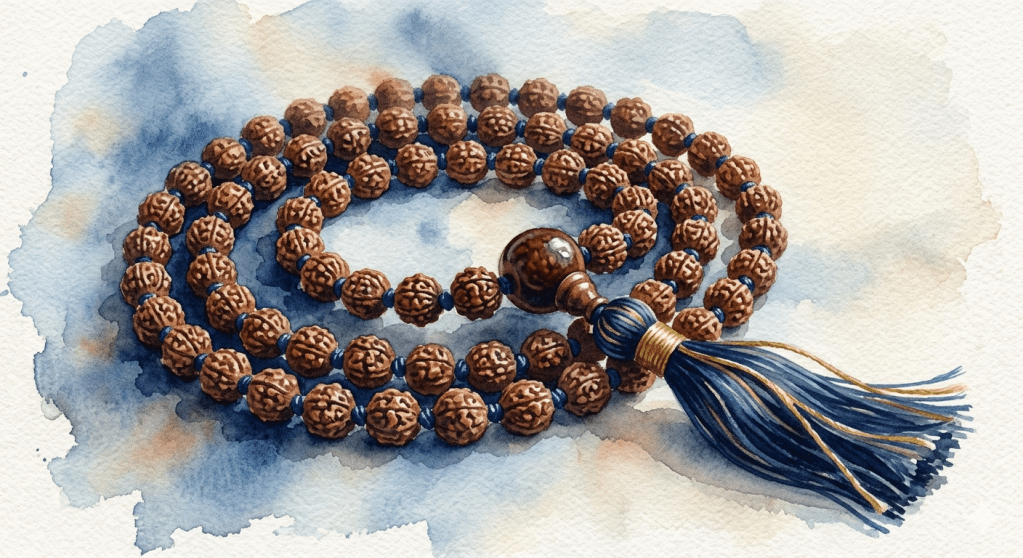
A full mala round of 108 repetitions is considered one complete mala, and serious practitioners may do several rounds — 3, 7, or 108 full malas — in a single sitting. The sumeru bead (also called the guru bead or meru), the single large bead at the top of the mala, marks the beginning and end of each round and is never passed over during counting. When a practitioner reaches the sumeru, they turn the mala around and begin again in the opposite direction rather than crossing it, as the sumeru represents the teacher, the threshold, and the sacred centre of the practice.
The 27-bead mala is exactly one quarter of the full mala, and its use is primarily practical. It is more compact, easier to carry discreetly, and better suited to shorter practice sessions or to practitioners who are newer to japa and working toward the full 108. Four rounds on a 27-bead mala equal one complete traditional mala, and many practitioners use a finger count or a separate tally to track their rounds.
Beyond convenience, some teachers attribute a specific energetic quality to the 27-bead mala, linking it to the 27 nakshatras — the lunar mansions of Vedic astrology — which govern time, destiny, and the cyclical nature of spiritual development. In this reading, using a 27-bead mala is not a shortcut but a distinct form of the practice with its own cosmological resonance.
A Note on Bead Material
The material of the mala also carries significance that intersects with how and where it is used. Rudraksha beads, from the seeds of the Elaeocarpus ganitrus tree, are considered especially potent for Shaivite practice and are said to have protective and grounding properties. Tulsi (holy basil) beads are associated with Vaishnava traditions and devotion to Vishnu and Krishna. Crystal, sandalwood, lotus seed, and bone malas each carry different energetic qualities suited to different practices and deities. Understanding the material of one’s mala is part of understanding how to care for and use it — another dimension of the discretion and intentionality that the tradition asks of the practitioner.
The mala is ultimately a mirror of the practice itself — what it asks of the hands and eyes outwardly reflects what it asks of the mind inwardly: quietness, consistency, and a turning away from distraction toward the still centre of the self.



 Twinn Swan
Leave a comment