
From sacred flames to healing hands, one of humanity’s oldest oils carries the weight of the divine
Before the age of electricity, before the wax candle, before the tallow rush-light, there was sesame oil. In clay lamps no bigger than a cupped hand, its quiet flame held back the dark in temples, shrines, homes, and burial chambers across the ancient world. It fed the sacred fires of India, the votive lamps of Mesopotamia, the oil lamps of the Hebrew tabernacle, and the ritual torches of China. That same oil was rubbed into newborns and the newly dead, poured over stone idols, and worked into the skin of kings before their coronation. Sesame oil’s journey through human spirituality is not a footnote — it is a central, shimmering thread.
Few substances on earth have accumulated such a density of sacred meaning. The sesame plant itself, Sesamum indicum, is among the oldest oilseed crops domesticated by human beings, cultivated as early as 3,500 BCE in the Harappan civilisation of the Indus Valley. Its tiny, white or golden seeds carry a fat content of nearly fifty percent, yielding an oil of extraordinary stability — one that resists rancidity far longer than almost any other plant oil. In a world without refrigeration, this was nothing short of miraculous. And what does not decay so easily begins to seem, to the spiritual imagination, imperishable.
The Seed that Opens: Origins in the Ancient World
The phrase “open sesame,” so familiar from the Arabian Nights, is not merely a fairy-tale password. Scholars have long suggested it refers to the actual behaviour of the sesame pod, which bursts open sharply when ripe, scattering its seeds with a small, decisive crack. That sudden opening — a closed thing revealing its hidden treasure — resonated so deeply with ancient peoples that it became a metaphor for revelation itself, for the opening of locked doors both literal and metaphysical. To possess sesame was, in a way, to possess a key.
In ancient Mesopotamia, sesame oil was the oil of the gods. Sumerian and Babylonian texts record its use in the anointing of sacred statues, in libations poured to deities of the underworld, and in the lighting of temple lamps that were never permitted to go dark. The Assyrians believed sesame wine was drunk by the gods on the night before creation, a cosmological act that lent the plant an aura of primordial significance. It was not simply food or medicine — it was a substance that existed at the threshold where the human and divine worlds met.
Further east, in the Vedic texts of ancient India, sesame appears repeatedly as a boundary substance — something that belongs simultaneously to the living and the dead, to the present moment and eternity. The Sanskrit word for sesame, tila, appears more frequently in ritual contexts than almost any other foodstuff. It was offered in ancestral rites called Shraddha, cast into sacrificial fires, mixed with water for funerary libations, and pressed into oil for the lamps of temples dedicated to Vishnu, Shiva, and the great Goddess. The seed’s dark form, particularly the black sesame variety, was associated with Saturn, death, and the underworld — yet also with purification and the safe passage of the soul.
Feeding the Flame: Sesame Oil in Sacred Lamps
The act of lighting an oil lamp — a deepam in Sanskrit — is among the most universal of all human spiritual gestures. But not all oils are equal in the devotional imagination, and sesame oil holds a privileged place in this ancient practice, particularly across the Hindu, Jain, and certain Buddhist traditions of the Indian subcontinent.
In South Indian temple worship, sesame oil lamps — often cast in bronze or carved from stone — are lit before the murti, the consecrated image of the deity, at dawn and at dusk. The flame is understood as an actual awakening of the deity’s presence, a calling of divine attention.
The oil that feeds the flame matters because the offering must be pure, untainted by impurity in its production or handling. Sesame oil, cold-pressed by traditional wooden presses called ghanis, is prized for this purpose because the grain itself is considered spiritually neutral or even auspicious — not heated by the violent chemistry of chemical extraction, not tainted by the animal-derived oils that might offend certain traditions.
Saturday, the day of Saturn (Shani), holds particular ritual significance in this regard. Devotees across India traditionally light sesame oil lamps before a Shani idol on Saturday evenings, offering the dark oil as a propitiatory gesture to a planet-deity associated with hardship, karma, and ultimate justice. The smoke that rises from the lamp is understood as carrying prayers upward; the light it casts is understood as dispelling malefic influences. That a single small flame fed by a few drops of oil could accomplish so much is testament to the depth of meaning concentrated within the substance itself.
In Jain tradition, oil lamps have a more complex relationship to doctrine. The ahimsa principle, the commitment to non-violence, technically proscribes the destruction of even single-celled organisms, and a burning flame destroys what lives within the air around it. Yet the lamp has been retained in practice, often with sesame oil as the recommended fuel, because the light it gives is understood as a symbol of the jiva — the individual soul — seeking its way through the darkness of samsara toward moksha, liberation. The oil is the accumulated karma being consumed, the flame the consciousness that burns through it and ascends.
Even in Japanese Buddhism, sesame oil carried a sacred charge. The famous oil lamps of Nara’s Tōdai-ji temple, home of the Great Buddha, were among the earliest recorded uses of sesame oil for religious lighting in Japan. The oil arrived through the Silk Road, via China and Korea, carrying with it the devotional associations it had accumulated across the whole breadth of Asia. There is something moving in this image: the same small seed, first pressed in the Indus Valley millennia ago, lighting sacred fires from Mesopotamia to Japan, its smoke and fragrance recognised as holy across wildly different religions and cultures.
Anointing the Body, Consecrating the Person
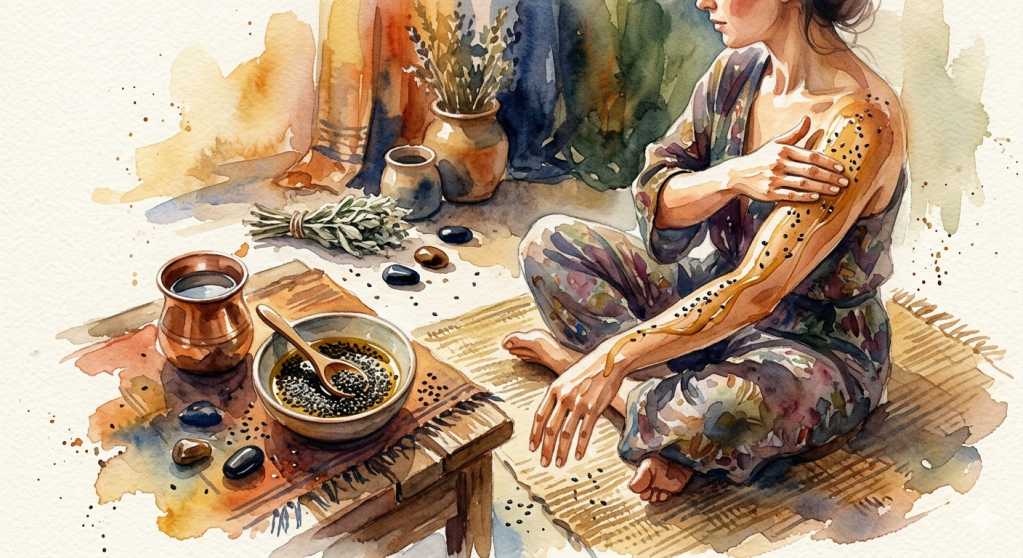
If the lamp represents the outward, communal dimension of sesame oil’s spiritual life, then the anointing and massage traditions represent its inward, embodied one. Here the oil moves from the temple to the skin, from the public ritual to the intimate and the personal. The spiritual logic, once understood, is surprisingly consistent across traditions: the body is a temple, and to anoint it is to consecrate it.
The Sanskrit term abhyanga refers to the practice of self-massage with warm oil, a practice described in the foundational texts of Ayurveda as one of the most important daily rituals a person can perform. Sesame oil is the recommended oil in most classical formulations, particularly for Vata constitution, the airy, mobile, cold quality that benefits most from the grounding warmth of sesame’s heavy, sweet, heating properties. But the practice is never purely medical. Abhyanga imparts strength, good vision, longevity, sleep, and skin quality — but it is also as a practice that confers the protection of the divine. The body anointed with oil is a body attended to by the gods.
This consecrating logic — the idea that oil applied to the body transforms the person who receives it — is not unique to India. In ancient Egypt, priests and pharaohs were anointed with oil mixtures that included sesame as a base, their bodies marked as belonging to the divine sphere. In ancient Israel, the anointing of kings, priests, and prophets with oil was the ritual act that conferred sacred office upon them; the very word “messiah” derives from the Hebrew mashiach, meaning “anointed one.” While the biblical anointing oils were formulated with olive oil and aromatic spices, sesame oil was in common use throughout the ancient Near East and almost certainly present in the broader culture of sacred anointing.
In classical Indian ritual, the relationship between oil and the body takes on cosmological dimensions during the rite of death. Sesame oil was applied to the body before cremation, the seeds scattered around the pyre and offered with water to the ancestors. The oil’s ability to burn, to transform matter into flame and smoke, made it a fitting companion for the soul’s final transition. The body slicked with sesame oil on the cremation ground was a body prepared not merely for fire but for liberation.
At the other end of life, birth, sesame oil was equally present. In many South and Southeast Asian cultures, newborns were massaged with sesame oil as their first introduction to the material world, a practice simultaneously hygienic and spiritual. The oil’s warmth was understood to seal the baby’s skin against malign influences, to ground a soul newly arrived from the spirit world into the weight and warmth of a body. Oil was the first thing the skin knew, and it was sesame oil that stood at that threshold.
Oil, Touch, and the Subtle Body
The spiritual significance of sesame oil in massage traditions is inseparable from ancient understandings of the body as a site of both gross and subtle energies. In Ayurvedic philosophy, the body contains not only organs and tissues but channels called nadis through which prana — life force — moves. These channels can become blocked, depleted, or agitated. The warm application of sesame oil, particularly when combined with the pressure and direction of skilled hands, is understood to act upon these subtle channels directly, lubricating not only the physical tissues but the energetic pathways beneath them.
Sesame oil’s particular quality of penetration is noted across traditions. Unlike heavier oils that sit on the surface of the skin, sesame is permeating, moving through the tissues rapidly. This quality was understood spiritually as well as physiologically. An oil that penetrates is an oil that reaches the interior, that does not only decorate the surface of a person but enters into them. In ritual terms, this made sesame oil uniquely capable of carrying blessings, prayers, or intentions into the body of the person receiving it.
The practice of oil-pulling — swishing sesame oil in the mouth for several minutes as a cleansing ritual — extends this logic inward. Described in Ayurvedic texts and practised widely across India today, oil-pulling is understood not only to draw toxins from the gums and tissues of the mouth, but to cleanse the energetic field associated with speech, with the spoken word, with the sacred syllables of mantra and prayer. To purify the mouth with sesame oil before meditation or ritual recitation is to prepare the instrument of divine communication.
Saturn, the Shadow, and the Oil that Appeases
No discussion of sesame oil’s spiritual life can omit the extraordinary density of association between sesame and Saturn — Shani in the Hindu astrological tradition — and through Saturn, with the energies of time, karmic consequence, and the shadow self. Shani is among the most feared and most propitiated of Hindu planetary deities, a figure of severe visage and slow movement, whose seven-and-a-half-year transit (known as sade sati) through sensitive positions in the natal chart is believed to bring hardship, delay, loss, and enforced lessons.
The traditional remedy for Shani’s afflictions involves sesame in almost every form. Black sesame seeds are offered with water. Sesame oil is poured over a Shani idol or over the statue of a crow, the bird associated with the deity. Sesame sweets called tilgul are shared at the festival of Makar Sankranti with the words “tilgul ghya, god god bola” — take sesame and speak sweetly — an act of communal reconciliation timed to the sun’s movement into Capricorn, Saturn’s own sign. The lighting of sesame oil lamps on Saturday evenings before a Shani shrine is among the most widely practised devotional rituals across Maharashtra, Andhra Pradesh, Karnataka, and Tamil Nadu.
Why sesame for Saturn? The correspondences are multiple and mutually reinforcing. Saturn’s colour is black, and black sesame seeds are the traditional offering. Saturn rules the element of air and the tissues of the nerves and bones; sesame’s warmth and oiliness are understood to pacify these cold, dry Saturnine qualities in the body. Saturn governs longevity and old age; sesame, which does not spoil, speaks to endurance. Saturn is associated with service to the marginalised, with workers, the poor, and the forgotten; sesame is the seed of the poor, the humble crop that has fed the world’s labourers for millennia.
There is, in all of this, a spiritual teaching embedded within the ritual: that the difficulties represented by Saturn — the karmic lessons, the enforced slowing down, the confrontation with one’s own shadow — are not to be escaped but met with humility, warmth, and a generous pouring-out of something precious. The lamp lit with sesame oil before the stern face of Shani is an act of willing surrender, of saying: I see the lesson. I will not resist it. I will offer light into the darkness.
A Living Tradition in a Disenchanted World
It would be tempting to frame the spiritual history of sesame oil as something belonging to the past — to a world before chemistry explained fat molecules, before electric lights made oil lamps obsolete, before wellness culture turned abhyanga into a spa treatment stripped of its devotional context. It is true that the thick weave of ritual meaning that once surrounded sesame oil has thinned considerably in many parts of the world.
Yet the practice persists, in ways both formal and informal. In tens of thousands of Hindu temples across India and its diaspora, sesame oil lamps burn before the deity every morning and evening, as they have for thousands of years. On Saturdays, the queues at Shani shrines grow long with people carrying small bottles of sesame oil and handfuls of black sesame seeds. In Kerala, families still commission traditional Ayurvedic oil massages for sick relatives, for new mothers, for the elderly and the grieving. And in the quiet of a thousand ordinary homes, grandmothers still warm sesame oil in their palms before pressing it into the scalps and limbs of children, murmuring prayers, transmitting protection through touch.
Perhaps what sesame oil carries, beyond its chemical properties, is the accumulated weight of all this intention. There is a concept in several traditions — sometimes called mantra-shakthi, or the power of repeated sacred attention — that suggests substances used over long periods for spiritual purposes acquire a kind of charge, a residue of all the prayers and offerings and loving hands that have passed through them. Whether or not one accepts this metaphysical claim, it points to something phenomenologically real: when we light a sesame oil lamp or warm a few drops in our palms before touching someone we love, we are doing what humans have done across an extraordinary span of time and geography. We are briefly part of that long chain.
The sesame seed bursts open. It reveals what it has been holding. In the lamp, that hidden energy becomes flame and light. On the skin, it becomes warmth and protection. In the ritual offering, it becomes a bridge between the human world and something larger. That this small seed, this humble crop of hot, dry climates, should have played such a role in humanity’s long conversation with the sacred is perhaps not surprising at all. The most profound things are often hidden in the plainest vessels, waiting for the right moment, the right pressure, to open.





 Twinn Swan
Leave a comment