
There is a reason the cedar appears so persistently in the sacred literature of the ancient world. It is not simply that the tree is large, though it is — the great cedars of Lebanon can live for a thousand years and rise forty meters into the sky. Nor is it merely that the wood is fragrant and resistant to decay, though these qualities have made it precious to builders and embalmers alike.
The cedar endures in the human spiritual imagination because it seems, in its very nature, to embody something about the relationship between the earthly and the divine: rooted deep in stony ground, ascending toward heaven, and smelling — always — of something older than memory.
A Tree Between Worlds
In many of the world’s oldest spiritual traditions, the cedar occupies a threshold position. It is neither fully of this world nor of the next. The Sumerians placed the cedar forest at the dwelling place of the gods, and in the Epic of Gilgamesh — one of humanity’s earliest surviving narratives — the great cedar forest is the home of the divine guardian Humbaba, a terrifying and sacred presence that must be confronted before the hero can claim his destiny. To enter the cedar forest was to step out of the human world and into something older and more powerful.
In the Hebrew Bible, the cedar is the wood of the holy. King Solomon’s Temple — the earthly dwelling place of God — was built from the cedars of Lebanon. The wood was not chosen for mere practicality, though its durability made it practical enough. Cedar was chosen because it was understood as a living bridge between the sacred and the mundane. To build a house of God from cedar was to construct it from a material already touched by the divine, already hallowed by its great age and its proximity to the heavens.
The Psalms return to the cedar again and again as an image of spiritual vitality and righteousness. The righteous shall grow like the cedar of Lebanon, one psalm promises — not merely tall, but deep-rooted, enduring through generations, fragrant in their presence, and resistant to the rot that claims lesser things.
Purification and the Ancient Rite of Smoke
The use of cedar in smoke-based ritual purification is ancient. In the Torah, cedar wood is prescribed as an ingredient in the purification rites for skin diseases and for those who had come into contact with death — two of the most contaminating conditions in ancient Israelite law. The combination of cedar, hyssop, and scarlet thread was understood to carry away impurity when burned, the smoke rising as a kind of spiritual carrier, lifting defilement upward and away from the afflicted person.
Among the Indigenous peoples of North America, cedar holds a position of similar sacred authority. In many traditions, cedar is considered one of the four sacred medicines, alongside sage, sweetgrass, and tobacco.
It is used in smudging ceremonies — the burning of sacred plant material to cleanse a person, a space, or an object — and is associated with healing, protection, and the calling of good spirits. The smoke is understood as a living spiritual presence capable of driving away negative energies and drawing in protective forces. Cedar boughs are placed in sweat lodge ceremonies, used to line the floors of healing spaces, and burned to honour the dead and ease their passage.
In the Shinto tradition of Japan, the sugi — the Japanese cedar — is one of the most sacred trees, often planted around shrines and understood as a dwelling place of the kami, the divine spirits that animate the natural world. Forests of these great, ancient trees surround Japan’s most important sacred sites, their towering presence a physical reminder that the sacred is near.
What Burns in Cedar Smoke
To understand why cedar incense carries such spiritual weight, it helps to consider what it was understood to do. Across traditions separated by vast distances of geography and time, certain properties were attributed to cedar smoke with remarkable consistency.
First, there is purification. Cedar smoke was believed to cleanse both physical and spiritual contamination, whether that contamination came from illness, death, moral transgression, or the accumulated psychic weight of everyday life. Before entering sacred spaces, before ceremony, before prayer, the burning of cedar cleared the air in a way understood to be more than merely atmospheric.
Second, there is protection. In many traditions, cedar is understood as actively repelling hostile spiritual forces. This is not unrelated to the empirical observation that cedar does in fact repel certain insects and resist decay — the physical properties of the tree seem to have been extrapolated into spiritual ones. The same quality that keeps moths from wool and rot from timber was understood, metaphorically and literally, to keep darkness from the soul.
Third, there is the drawing of positive presences. If purification clears and protection wards, cedar smoke was also understood to invite. In Indigenous American ceremony, it draws good spirits. In ancient temple practice, it was the fragrance appropriate to divine presence. The incense burned in the Holy of Holies, the inner sanctum of Solomon’s Temple, was understood to create an environment fit for God to inhabit. Cedar was part of that preparation.
Fourth, and perhaps most subtly, there is grounding. The scent of cedar — that deep, earthy, resinous fragrance — is experienced almost universally as anchoring. It calls the mind downward, into the body, into the present moment. In spiritual practice, this is no small thing. Many traditions speak of the need to be fully present before the sacred can be approached, and the dense, ancient smell of cedar smoke is a powerful cue to the nervous system that something important is happening, that the ordinary flow of time and thought has been interrupted.
The Benefits of Cedar Incense in Practice
Contemporary practitioners who burn cedar incense — whether for spiritual purposes or simply for the experience of it — tend to report effects that map surprisingly well onto these ancient understandings.
The scent of cedar has been observed to have a calming, grounding influence on the mind. It reduces a particular kind of anxious mental chatter, the kind associated with excessive future-orientation or rumination. This may be partly neurochemical — cedarwood oil contains compounds like cedrol and alpha-cedrene, which interact with the olfactory system and have documented mild sedative and anxiolytic effects. But it may also be partly cultural and associative, the long history of cedar’s use in sacred contexts giving the scent a kind of resonance that operates below conscious thought.
For meditation practice, cedar smoke serves as what practitioners sometimes call an anchor — a sensory cue that the time for ordinary thinking is suspended and the time for inward attention has begun. The ritual of lighting cedar incense can function as a transition marker, a way of telling the mind and body that something different is about to happen. Over time, this association deepens; the smell of cedar becomes inseparable from the quality of attention associated with meditation or prayer.
In the context of grief or loss — a context in which many traditions have specifically prescribed cedar — the smoke offers something that is difficult to name. It is both purifying and comforting, both an acknowledgment that something has ended and a reminder that the world continues, that ancient things persist, that death and loss are not the final word. The oldest cedars alive today were growing before most of recorded history began. To burn cedar is to invoke that longevity, to situate personal loss within a larger and more enduring frame.
For those who work with spaces — who want to clear a room of accumulated tension, mark the beginning of a creative or spiritual project, or simply create an atmosphere of focused attention — cedar is perhaps the most consistently effective of the traditionally used incenses. It lacks the sometimes-overwhelming sweetness of sandalwood and the sharpness of sage, occupying a middle register that most people find immediately accessible. It says: slow down. Breathe. You are somewhere that matters.
The Living Presence
There is something about the cedar that resists reduction to symbol. It is not merely a metaphor for spiritual persistence or divine proximity; it is, in many traditions, itself a spiritual presence. The great cedar groves of Lebanon that Solomon’s builders harvested are largely gone now, reduced by centuries of use and climate change to a few protected remnants. The loss is mourned in a way that goes beyond ecology — it is felt as a spiritual diminishment, as if something irreplaceable has been lost from the world’s capacity to mediate between heaven and earth.
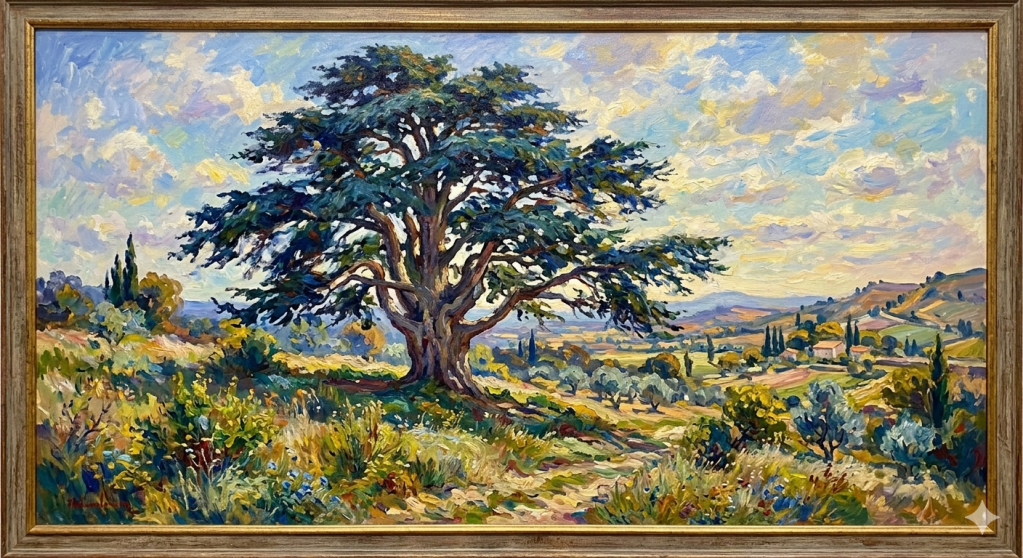
To encounter a great cedar — to sit beneath one of the ancient survivors, or to smell the smoke of its incense rising in a quiet room — is to touch something that has been sacred to human beings across almost every culture that encountered it. That persistent recognition suggests it is not arbitrary.
The cedar, with its impossible longevity, its reaching form, its cleansing fragrance, and its capacity to endure, seems to answer something in the human spirit that is looking for exactly those qualities: endurance, reach, clarity, and the smell of something older and truer than the noise of daily life.




 Twinn Swan
Leave a comment