
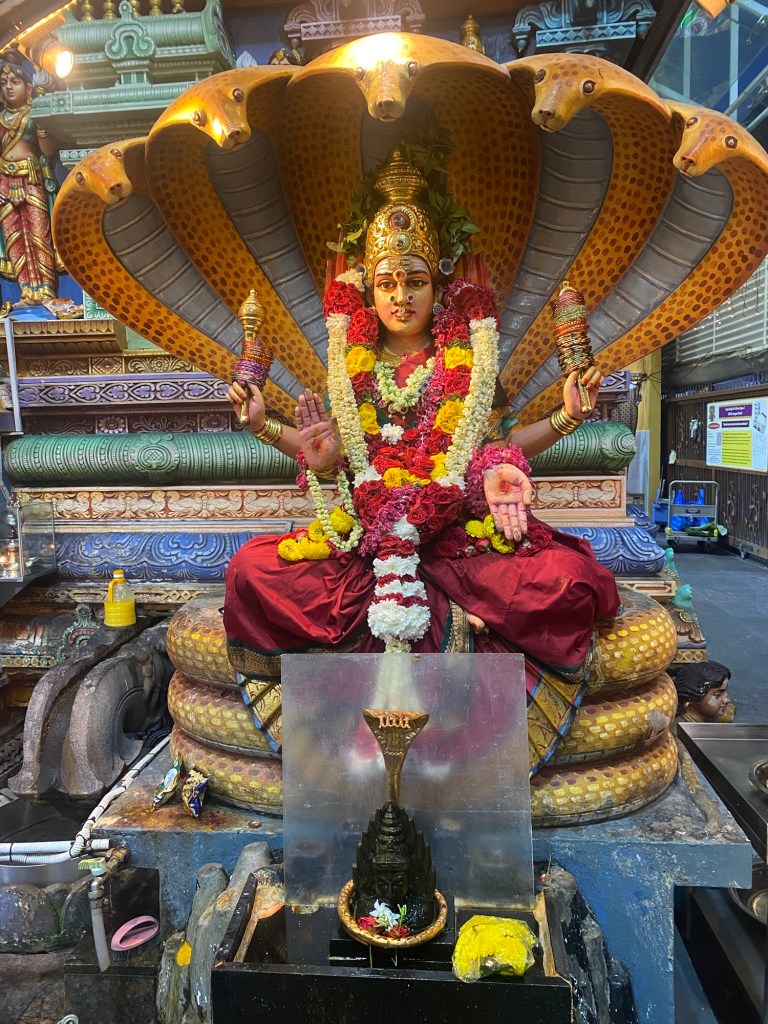
To approach a Nageshwari shrine is to step into the domain of the subconscious, where the primordial serpent-self resides. While popular piety views the abishekam as a request for protection, the esoteric practitioner understands it as a sophisticated technology for the transmutation of Visha poison into Amrita nectar. This ritual is an intervention into the practitioner’s energetic anatomy.
The Iconography of the Subterranean Mind
Nageshwari exists at the threshold of the Patala Loka the lower realms and the earthly plane. In the human psyche, this represents the “Deep Mind”—the reservoir of ancestral memory, repressed trauma, and raw instinctual power. Unlike celestial deities who reside in the light of the Akasha, Nageshwari is found in the damp, dark, and rooted spaces of the earth.
Performing abishekam at her shrine is an act of descent. The serpent does not move in straight lines; it undulates, representing the non-linear, often paradoxical movement of spiritual progress. By pouring sacred substances over her form, the devotee is effectively anointing the darkest parts of their own shadow, acknowledging that the path to liberation does not bypass the subterranean but leads directly through it.
The Alchemy of the Flow: Substantive Transmutation
The specific materials used in the abishekam serve as vibrational keys that unlock different layers of the Annamaya and Pranamaya Koshas (the physical and energetic sheaths).
Turmeric and the Bio-Electric Field: Turmeric is not merely an antiseptic; in the tantric context, its vibrant yellow frequency is a stabiliser for the Manipura Chakra the solar plexus. As the turmeric-water flows over the serpent, it grounds the erratic bio-electricity often associated with serpent-fear or anxiety, turning raw survival instinct into disciplined willpower.
Milk and the Dissolution of the Ego-Shell: The pouring of milk represents the cooling of the Krodha anger that arises when the ego is challenged. Metaphysically, it signifies the return of the soul to its pristine, undifferentiated state. For the Nageshwari devotee, this specific flow targets the poison of the intellect—the rigid logic that prevents one from experiencing the fluid reality of the Divine.
Honey and the Extraction of Sweetness from Struggle: Honey, a substance that never decays, is the symbol of the Essential Self. Its viscosity mirrors the slow, deliberate movement of a cobra. It teaches the seeker that even the most venomous life experiences contain a hidden sweetness if processed with patience and devotion.
The Rahu-Ketu Nexus: Negotiating the Karmic Knot
In the subtle body, the serpent is the knot of Granthis—the psychic blockages that prevent energy from rising. The Nageshwari shrine is the metaphysical laboratory where the Kala Sarpa (the time-serpent) is uncoiled.
Astrologically, this is the negotiation of the Rahu-Ketu axis. Rahu is the head of the serpent, representing insatiable craving and the future; Ketu is the tail, representing the weight of the past and the finality of moksha. Most human suffering stems from being pulled apart by these two poles.
The abishekam acts as a bridge, harmonising these opposing forces. By bathing the Goddess, the practitioner is washing their own timeline, neutralising the obsessive grip of future desires and the paralysing guilt of past actions.
The Poison-to-Nectar Transmutation (Visha to Amrita)
The ultimate significance of the Nageshwari ritual lies in the concept of Halahala—the primordial poison. The serpent is the only creature that carries poison within itself without being consumed by it. The “poison” of life—betrayal, loss, sickness, and the inevitable decay of the body—is offered to the Goddess.
During the abishekam, the practitioner visualises these toxins leaving their system and being absorbed by the stone icon, which has the capacity to hold and neutralise them. In return, the Goddess radiates the Prasadam of resilience. This is the “Shedding of the Skin”—not just a physical renewal, but a total psychological rebirth where the practitioner emerges no longer a victim of their circumstances, but a master of their internal alchemy.
Conclusion: The Resurrected Serpent
The conclusion of the ritual is marked by the Alankara decoration, where the deity is draped in silk and adorned with flowers. This represents the “Resurrected Serpent”—the Kundalini that has been purified by the waters of devotion and is now ready to rise.
The deeper significance of the Nageshwari shrine is found in this final silence. The devotee leaves the grove not having “conquered” the serpent, but having made peace with it. They carry with them the realisation that the power to heal is located in the same place as the power to harm, and that under the grace of Nageshwari, every poison in one’s life is merely a nectar that has not yet been refined.


 Twinn Swan
Leave a comment