
Of all the plants that move through Japanese ritual and religious imagination, few carry as much layered meaning as the yuzu — Citrus junos, a small, frost-hardy citrus fruit native to East Asia that has been cultivated in Japan for over a thousand years. To most who have recently encountered it, yuzu is primarily a culinary novelty: a trendy, complex-smelling ingredient in high-end cuisine. But in Japan, the fruit has never been just food. It exists at the intersection of Shinto purification, Buddhist cosmology, seasonal observance, and the folk belief systems that run quietly underneath both. To understand what yuzu means spiritually is to understand something essential about the way the Japanese sacred imagination works — the way it locates the numinous not in grand theological proclamations but in sensory, seasonal, embodied life.
The Fruit That Arrived from Elsewhere
Yuzu is thought to have originated in the upper Yangtze River region of China and entered Japan during the Tang Dynasty period, roughly between the 7th and 10th centuries CE. This matters for its spiritual meaning. Believed to have originated in China thousands of years ago, this small citrus fruit made its way to Japan during the Tang Dynasty (618-907 AD), where the Japanese embraced it for its distinct aroma and flavour, incorporating it into traditional rituals and cuisine. That Chinese origin situates yuzu at the very centre of Japan’s great cultural and religious importation from the continent — the same era during which Buddhism arrived and began its long, complex negotiation with native Shinto belief. The fruit came wrapped, so to speak, in the same intellectual world that brought yin-yang cosmology, the concept of seasonal energy, and the idea that certain foods and scents could mediate between human beings and larger cosmic forces.
This origin should not be treated only as a historical footnote. Japanese spiritual life has always been characterised by a remarkable openness to foreign influence followed by a gradual, thorough domestication of that influence. Yuzu underwent exactly this process. A fruit from China became, over centuries, one of the most distinctively Japanese ritual objects — present at the winter solstice, present at New Year, present in the tea tradition, present in the medicine chest of the Buddhist temple pharmacy. The foreignness was absorbed and the fruit became native.
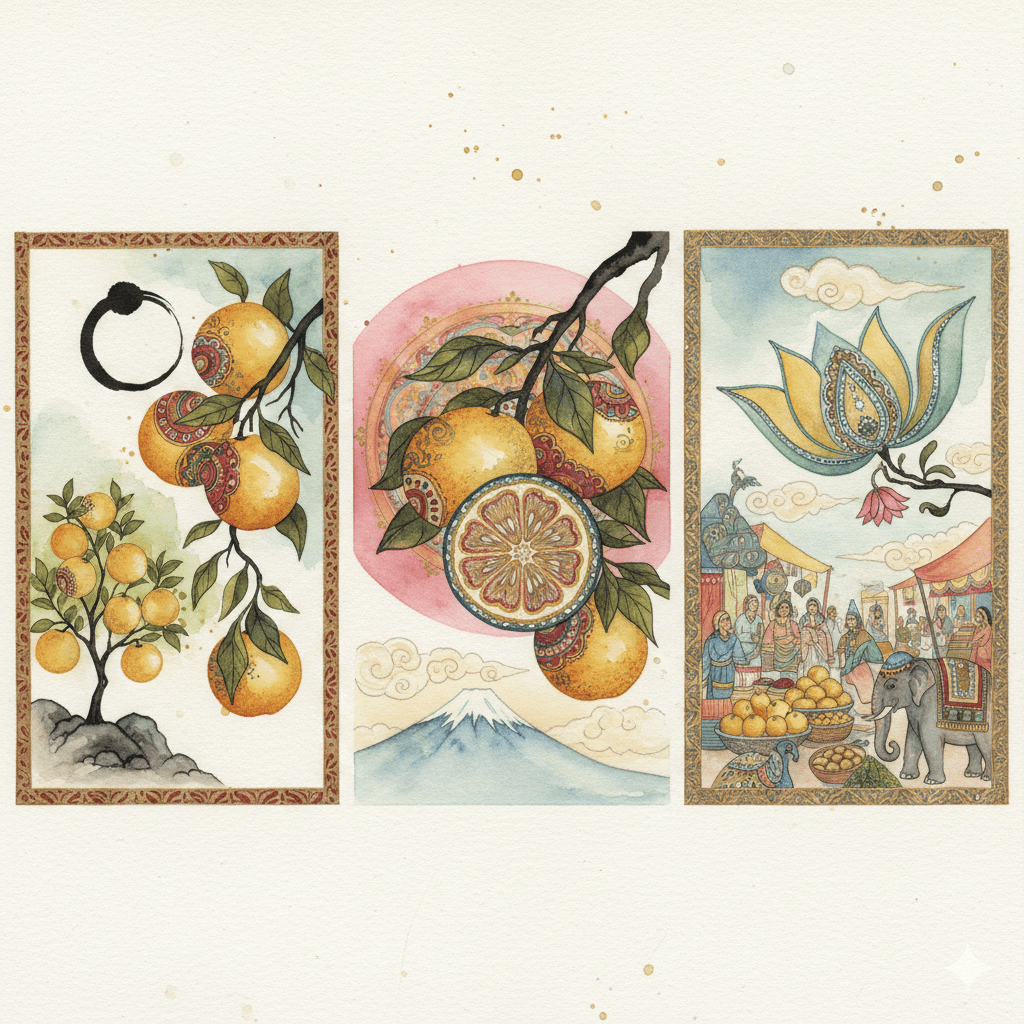
The Yellow Threshold: Color, Light, and Luck
Before engaging with any specific ritual, it is worth pausing on what the yuzu looks and smells like, because in Japanese symbolic culture, the sensory properties of an object are never arbitrary — they are the foundation of its meaning. The ripe yuzu is intensely yellow, rough-skinned, asymmetrical, and deeply aromatic. It reaches full yellow ripeness in late autumn and early winter, precisely as the natural world darkens and cold closes in.
Its vibrant yellow color symbolizes luck and good fortune. This association between yellow or gold and fortune is ancient and widespread in East Asian culture, but in the yuzu’s case, it carries a specific resonance: the fruit turns golden just as daylight is shortest, offering a small blaze of colour and warmth at the moment of maximum darkness.
In Shinto cosmology, purity and vitality are linked to brightness, light, and clarity. The sun goddess Amaterasu, the highest deity of the Shinto pantheon, represents the principle of radiant illumination. A yellow fruit that ripens in winter darkness occupies a symbolically charged position — it is, in a quiet, vegetable way, an analog to the sun asserting itself.
The aroma of yuzu carries its own symbolic weight. Scent in Japanese religious culture is never merely pleasant — it is understood as having efficacious spiritual properties. In Buddhist temple practice, incense smoke is believed to carry prayers and purify the atmosphere. The fragrance of certain plants and flowers marks the boundary between the sacred and the profane. Yuzu’s essential oils, intensely fragrant and distinctive enough to be unmistakable once encountered, participate in this logic.
One belief was that the fruit’s fragrance would ward off evil spirits, whilst also strengthening the body’s resilience against winter colds. This dual effect — spiritual protection and physical fortification — is typical of how Japanese religious culture refuses to separate the sacred from the somatic. The body is not a vessel housing an immaterial soul; it is itself a spiritual entity whose health is a religious matter.

Tōji and the Cosmology of the Turning Year
The ritual context in which yuzu plays its most celebrated role is Tōji, the winter solstice, which falls around December 21st or 22nd. To understand what yuzu means here, one must first understand what Tōji means cosmologically.
Tōji is not only the year’s shortest day, but also the time when the sun’s power begins to return, symbolising a shift from yin to yang or cold to warmth. This cosmological framework — drawn from Chinese yin-yang philosophy, which Japan absorbed through Buddhism and Confucianism — understands the year not as a neutral passage of time but as a living energy cycle.
At the winter solstice, yin energy reaches its maximum saturation; the world is at its most cold, dark, and potentially dangerous. But rather than being a moment of defeat, it is simultaneously the turning point: from here, the yang returns, the sun regains its power, and life reasserts itself. The Japanese expression for this is Ichiyō Raifuku (一陽来復) — the return of positive energy after a long period of recession. This concept perfectly reflects the Japanese relationship with time: not sudden breakthroughs, but gradual rebalancing.
Into this cosmological drama enters yuzu. The practice of taking a yuzu bath began as a purification ritual and to attract good fortune, resonating with the concept of Ichiyou Raifuku. The yuzu-yu (柚子湯) — the yuzu bath, in which whole fruits float in steaming hot water — is the central ritual expression of the solstice’s spiritual meaning. In the past, it was believed that soaking in a yuzu bath on the winter solstice invited health and fortune for the new year. Some even said the powerful aroma from the fruit could ward off bad luck and exorcize evil spirits.
The purification logic here is thoroughly Shinto in character. In Shinto, the concept of kegare (pollution or ritual impurity) describes a kind of spiritual contamination that accumulates through the experiences of ordinary life — through illness, death, the passage of time, contact with suffering. The antidote to kegare is harae, purification, which can be accomplished through water, salt, prayer, fire, and various ritual actions.
The yuzu bath is, among other things, a harae ritual enacted through fragrant water. The combined effect of heat, immersion, and the essential oils released from the yuzu peel creates an experience that is simultaneously physical therapy and spiritual cleansing — a washing away of the accumulated impurity of the year that is ending, in preparation for the new energy that the returning sun will bring.
There is also a remarkable linguistic dimension to this ritual. The wordplay between “solstice” (toji) and “hot-spring cure” (toji), which happens to be the same word in Japanese, made people believe that the aromatic citrus could bring a variety of benefits if used on this day. This kind of phonetic correspondence — goroawase in Japanese — is taken with great seriousness in Japanese symbolic culture.
Language is not a representational system but itself a vehicle of spiritual force. The coincidence of sound between the winter solstice and a healing bath is understood not as an accident but as evidence of deep cosmological ordering. By bathing with yuzu on the day called toji, one is literally enacting the curative meaning that the day’s name contains.
But there is a further and more philosophically sophisticated linguistic connection. In Japanese, yuzu sounds similar to the verb yuzuru (譲る), meaning to let go or to yield. Bathing with yuzu on the winter solstice symbolically represents letting go of misfortune, bad luck, and accumulated negativity from the past year. It is a gentle act of release — no drama, no spectacle, just warm water, scent, and intention.
This is extraordinarily telling. The ritual bath becomes, through this sonic association, a meditation on non-attachment and release — themes at the very heart of Buddhist practice. One surrenders the year, lets go of its griefs and accumulations, and enters the returning light unburdened. The fruit does not only clean the body; it teaches the spirit something about how to move through time.
Yuzu, Purification, and the Shinto Logic of Smell
The Shinto worldview, as practiced over millennia, understands smell as a primary vector of spiritual reality. This is not metaphor — it is theology. Certain scents announce the presence of kami (divine spirits). Other scents signal pollution or danger. The aromatic properties of ritually significant plants — the evergreen sakaki tree used in shrine offerings, the cedar of sacred groves, the incense burned at Buddhist altars — are inseparable from their sacred function.
It is said that the strong smell of yuzu can remove evil from the body and purify it. This olfactory purification has roots in an ancient understanding that evil spirits — oni, tatari (divine curse), malignant influences of various kinds — are sensitive to specific scents and can be driven away by them.
Yuzu’s particularly pungent, sharp, and distinctive aroma made it a natural candidate for this apotropaic function. It is not merely pleasant; it is assertive, almost aggressive in its fragrance. It announces itself. In ritual logic, this very forcefulness of scent becomes spiritual power — the ability to clear a space, mark a boundary and make hostile presences uncomfortable.
This dimension of yuzu’s use connects it to broader traditions of using citrus and aromatic plants in Japanese protective ritual. The bitter orange (daidai) is placed atop the kagami mochi (the sacred New Year’s rice-cake offering), not only for its auspicious name but for its fragrance. The objects of the New Year’s festivity display are for individual senses — everything is for sight; the mochi is for taste; the kick-ball is for touch; the bell is for hearing; the fragrant daidai citrus fruit is for smell — nose.
This extraordinary correspondence, in which each sense is ritually addressed through a specific offering, reveals how thoroughgoing the Japanese ritual imagination is in its understanding of the human being as a sensory creature requiring complete sensory engagement with the sacred. Yuzu and its citrus relatives hold the olfactory position — they are, in a precise sense, the nose’s offering to the gods.
The New Year and the Threshold Between Times
Beyond Tōji, yuzu appears in the broader landscape of Japanese New Year ritual, which in the traditional calendar represented the most spiritually charged time of year — a moment when the boundary between the ordinary world and the world of kami and ancestors was thin, when toshigami (the deity of the New Year) would descend into households to bless them, and when the accumulated pollution of the old year had to be thoroughly cleansed before the new could be properly welcomed.
Yuzu also plays a role in celebrations and festivals. The fruit is often used as a decorative element during the New Year’s celebrations. More specifically, yuzu peel (yuzu kawa) appears as a garnish in ozōni, the traditional New Year’s soup eaten on the first days of January in which kagami mochi is simmered. This may seem like mere flavouring, but in the context of New Year ritual food, every ingredient carries intentional symbolic weight. Ozōni is a clear soup made with konbu, katsuo-bushi, mochi, ninjin, kamaboko, mitsuba, and yuzu peel, which may have originally been daidai. The soup itself is a ritual meal eaten in the presence of the newly arrived toshigami, and the yuzu in it brings its purifying fragrance into this sacred domestic space.
Tōji also marks the informal beginning of Ōsōji (大掃除), the great year-end cleaning. Homes, offices, and schools undergo thorough cleaning to purify spaces, remove dust and negativity, and welcome the New Year with clarity. This is a cultural practice rooted in Shinto beliefs around cleanliness as a sacred act, not just hygiene. The yuzu bath and the great cleaning occupy the same spiritual space: both are acts of purification that prepare the self and the home to receive new divine energy. The fruit and the broom are, in this sense, ritual equivalents.

Tea Ceremony and the Seasonal Placement of Yuzu
One of the more refined and philosophically sophisticated contexts in which yuzu appears is the Japanese tea ceremony (chadō or sadō), the Way of Tea. It is here that the fruit’s role becomes part of a deeply considered aesthetic and spiritual system rather than folk protective magic.
The tea ceremony as formalized by Sen no Rikyū in the 16th century operates on the principle of radical seasonal attentiveness. Every element of a tea gathering — the scroll in the alcove, the flowers in the vase, the choice of utensils, the wagashi sweets served before the bowl of matcha — must be in precise harmony with the season, the time of day, and even the weather outside.
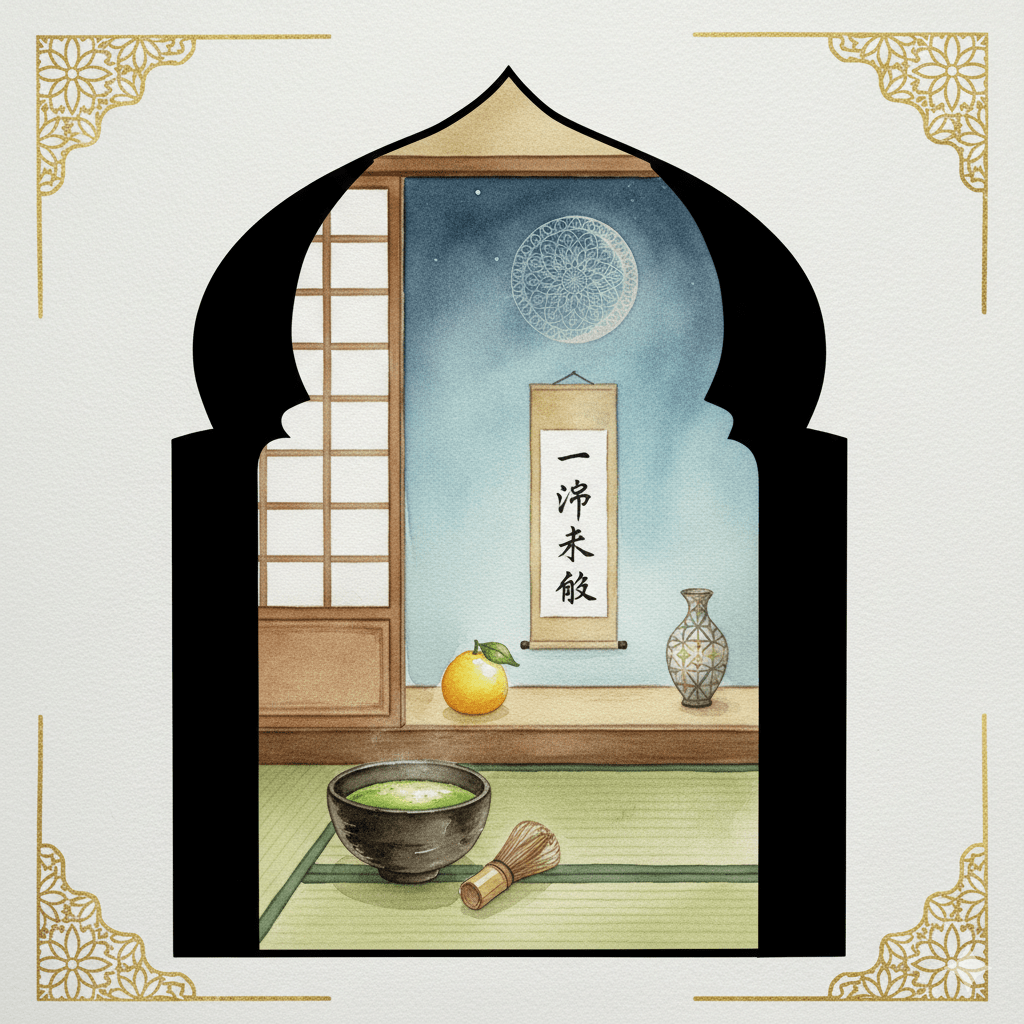
This principle, called kisetsukan (seasonal feeling), is not merely decorative: it is a form of spiritual practice, a training in the kind of mindful presence that Zen Buddhism teaches as the path to insight. To be fully attentive to this particular moment, in this season, with these guests, drinking this tea — this is ichi-go ichi-e (一期一会), one time, one meeting, never to be repeated.
Rikyū said that the ro (the winter hearth sunken into the tatami floor of the tea room) should be opened when the yuzu turned yellow. This is a detail of enormous significance. The opening of the ro — typically in late October or November — is one of the two most important transitions in the tea ceremony year, marking the shift from the warmer months’ portable brazier to the sunken winter hearth. It is a ritual threshold, a small new year within the tea world. And the signal for this transition, the natural clock that the tea master consults, is the yellowing of the yuzu fruit. The fruit becomes a seasonal marker in the most spiritual sense: it tells the practitioner when the world has shifted, when a new phase of ritual time has begun.
In the tea room in winter, yuzu may appear in various forms — as a garnish on a seasonal sweet, as peel floating in a bowl of hot citrus water served before the tea, or as a scent note in the incense selected for the gathering. In each case, it functions not merely as flavor or decoration but as a kind of temporal anchor, a reminder of where in the great seasonal cycle this particular irreplaceable moment falls.
The Deeper Logic: Nature, Purity, and the Sacred Ordinary
Stepping back from these specific ritual contexts, a pattern emerges. Yuzu’s spiritual significance in Japan is not incidental or arbitrary; it flows from several fundamental principles of Japanese religious culture.
The first is the Shinto understanding that all of nature is animated by kami — that the natural world is not a backdrop to human spiritual life but is itself alive with sacred presence. It is believed that every living thing in nature — trees, rocks, flowers, animals, even sounds — contains kami.
Consequently Shinto principles can be seen throughout Japanese culture, where nature and the turning of the seasons are cherished. Within this framework, yuzu is not a fruit that has been assigned spiritual meaning from the outside; it carries that meaning by virtue of being a living thing, part of the sacred natural order, and especially by virtue of ripening at the cosmologically significant moment of the winter solstice.
The second is the Buddhist understanding of impermanence and seasonal attentiveness. The yuzu does not last. It ripens in autumn and winter, fills the air with its fragrance, and passes. To encounter it in a bowl of steaming bath water or floating in ozōni soup on New Year’s morning is to encounter a teaching about the preciousness and ephemerality of each moment. This is entirely consonant with the Zen aesthetic of mono no aware (物の哀れ) — the pathos of things, the bittersweet recognition that beauty is inseparable from transience.
The third is the integration of body and spirit that characterizes Japanese religious practice at its most distinctive. The yuzu bath is perhaps the clearest expression of this integration: it is medicine, it is ritual, it is spiritual practice, and it is pleasure all at once. There is no separation between healing the body and purifying the spirit. The warmth of the water, the release of citrus oils, the fragrance filling the bathroom — these are not concessions to bodily comfort granted alongside the real spiritual work. They are the spiritual work. As the tea master’s saying has it, the thirst the Way of Tea quenches is not physical thirst but the dryness of the heart.
In this, yuzu participates in something central to Japanese religiosity: the sacralization of the everyday. Unlike religious traditions that locate the sacred in extraordinary events, separate institutions, or purely interior states, Japanese Shinto and Buddhist practice continuously reenchants ordinary life. Tōji is not a national holiday. There are no festivals or official ceremonies. And yet the deepest traditions do not need to be announced — they simply continue to exist.
A person floating a few yuzu fruits in hot bathwater on a December evening is, whether they think of it this way or not, participating in a practice that stretches back through Edo-period public bathhouses, through the courts of medieval Japan, back to the ancient folk understanding that the winter solstice is a moment requiring special ritual attention.
The yellow fruit bobbing in hot water is a small sun. Its scent clears the accumulated shadow of the year. Its presence in the bath connects the bather to everyone who has performed this act before them and everyone who will perform it after. In the Japanese religious imagination, this is not a minor or peripheral kind of spirituality. It is, in its quietness and its sensory concreteness and its rootedness in the turning of the natural year, as serious as any other.




 Twinn Swan
Leave a comment