
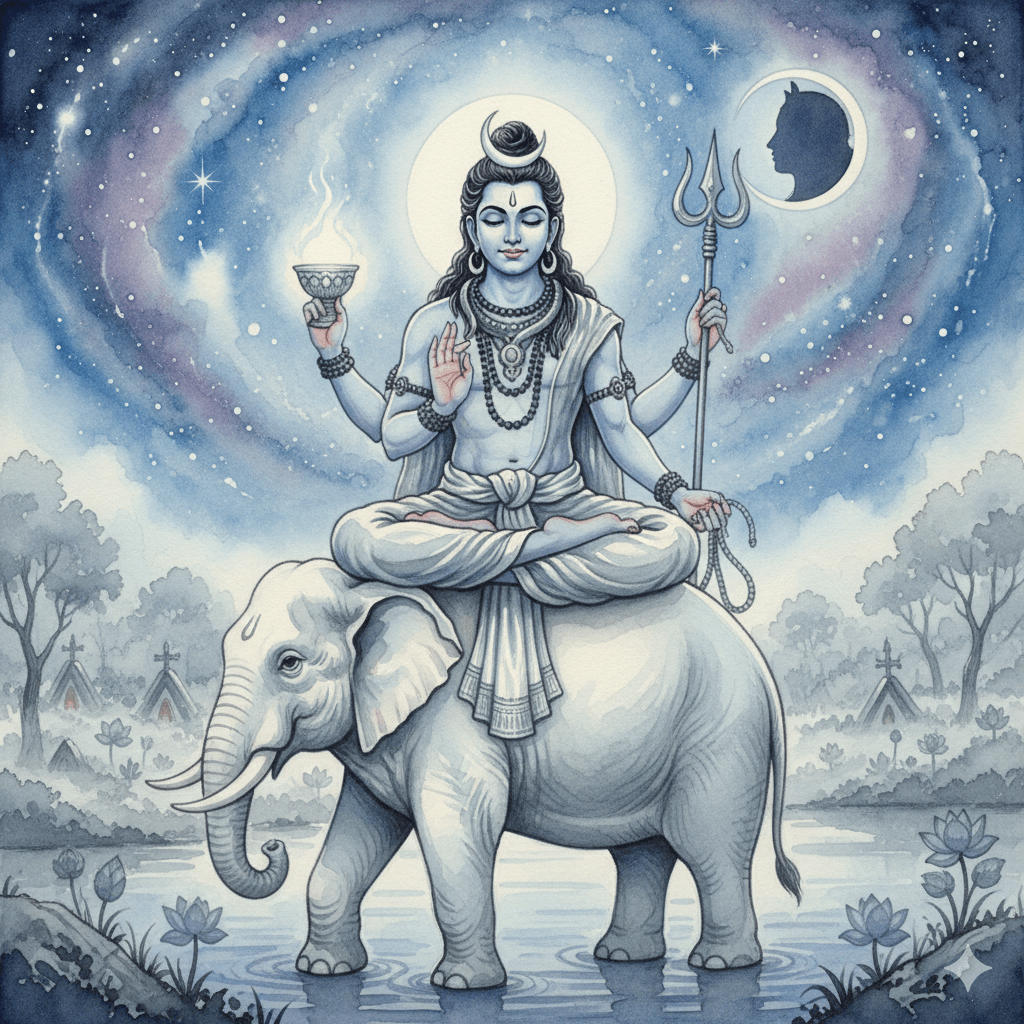
Kapala Bhairava represents the most enigmatic intersection of lunar grace and chaotic shadow within the Shaivite tradition. His essence is defined by a paradoxical relationship between the cooling radiance of the Moon and the obsessive, consuming hunger of Rahu, making him the divinity of choice for those seeking to navigate the deepest recesses of the subconscious. In addition to his role as the guardian of the northwest, he is the metaphysical embodiment of the eclipsed mind.
The Silver Skin
The silver complexion of Kapala Bhairava is the result of a spiritual calcination. In the internal laboratory of the spiritual practitioner, the heat of Bhairava’s fierce presence burns away the dross of the egoic personality, leaving behind a pure, reflective surface. This silver hue represents the moon of wisdom that has survived the fire.
While other forms of Bhairava may be dark as the night sky, Kapala’s silver light signifies the amrita nectar that has been distilled from the poison of worldly existence. It is a reflection that does not cast shadows because it is the light of the Atman reflecting off the Skull of the Universe. This radiance allows the seeker to see through the illusions of the material world, turning the terrifying reality of death into a mirror of eternal life.
The Rahu Influence: The Eclipse of the Mundane
Kapala Bhairava operates at the frequency of Rahu: the North Node of the Moon. Rahu is the shadow planet that eclipses the sun and moon, representing unquenchable desire, sudden transformation, and the breaking of orthodox boundaries. Kapala Bhairava is the master of this ‘eclipsing energy’.
In the realm of consciousness, Rahu often manifests as anxiety, obsession, or the feeling of being possessed by one’s own desires. Kapala Bhairava provides the Kapala the skull cup as the only vessel strong enough to contain this Rahu-energy. He consumes the chaotic influence of Rahu and transmutes it into the focused intensity required for liberation. He is the deity one calls upon when the demons of the mind are too loud to be silenced by standard meditation.
The Elephant Vahana: The Weight of the Subconscious
The choice of the elephant as Kapala Bhairava’s vehicle is a key to his power. In most traditions, the elephant is a symbol of memory and royalty, but in the fierce path of Bhairava, the elephant represents the massive subconscious.
The subconscious mind is like a wild elephant—unstoppable, heavy with the weight of past-life impressions samskaras and prone to destructive madness. Kapala Bhairava sitting atop the elephant signifies the absolute taming of this primal force. The goal of his sadhana is to direct its massive, ancestral weight toward a single point of spiritual breakthrough.
The Rahu Eclipse
In the context of the metaphysics surrounding Kapala Bhairava, coming under the influence of Rahu is rarely seen as a random occurrence or a stroke of bad luck. Instead, it is viewed as a karmic appointment with one’s own unfulfilled desires and the shadow self.
1. The Call to Address Deep-Seated Desires (Karmic Hunger)
Rahu represents the head without a body; it is pure, unquenchable hunger. From a spiritual perspective, you come under Rahu’s influence when your soul has reached a point where it can no longer ignore its unmet desires from previous cycles of existence. This influence forces these latent cravings to the surface of the conscious mind—often through obsessions or intense drives—so they can finally be recognised, experienced, and eventually offered into the Kapala (skull cup) for transformation.
2. The Dissolution of “Normal” Reality
When a person has become too comfortable in the matrix of social norms, intellectual logic, or material security, Rahu intervenes to break these boundaries. Someone comes under this influence when their spiritual path requires a shattering of the mundane. Rahu acts as the catalyst that introduces chaos, sudden changes, or unconventional thoughts, effectively eclipsing the sunlight of the mind to reveal the starry, silver void of the deeper self.
3. The Activation of Shadow Work
In the path of Kapala Bhairava, the Rahu influence is a signal that the practitioner is ready for shadow work. If you have suppressed parts of your personality—fears, rage, or primal instincts—Rahu will magnify them until they are impossible to ignore. This isn’t a punishment; it is the subconscious mind of the elephant coming to a head. It happens when the soul is strong enough to finally sit atop that massive mental weight and tame it, rather than being crushed by it.
4. Navigating the “In-Between” (Twilight States)
Those who are naturally inclined toward the “Northwest” path—the realms of occultism, deep psychology, or radical spiritual paths—frequently find themselves under Rahu. This influence occurs because Rahu is the master of the Sandhya (twilight/threshold). If you are transitioning from one state of being to another, Rahu provides the necessary eclipse to hide the old path while the new, silver path of the Moon begins to emerge.
5. Genetic or Ancestral “Samskaras”
The mention of the Elephant Vahana is key here. Someone might come under Rahu’s influence because of heavy ancestral or past-life imprints samskaras. When these heavy memories become active, Rahu acts as the force that brings them to the forefront. It is a period of intense purging where the weight of the elephant is felt most strongly, requiring the intervention of Kapala Bhairava to turn that weight into the steady power of the prana.
The Kapala as the Portal of Transition
The skull cup held by Kapala Bhairava is the ultimate symbol of the emptied self. In the influence of Rahu and the Moon, the Kapala serves as the boundary between the nectar” and the shadow. It is the site of the Great Dissolution.
For the seeker, the Kapala is the mind turned upside down—emptied of thoughts, labels, and history, and held open to receive the silver light of the Moon. It represents the realisation that the “head” (the ego and intellect) must be severed from the “heart” (the seat of the soul) so that the soul can act without the interference of the self-serving mind. Under the gaze of Kapala Bhairava, the skull is no longer a symbol of death, but the holy grail of the ascetic, containing the fermented essence of a life lived without fear.
The Lunar Master of the Northwest
Presiding over the Northwest, the direction where the sun sets and the moon begins its ascent, Kapala Bhairava stands at the threshold of the “In-Between.” He is the lord of twilight. In this space, the boundaries between the physical and the astral are thin. His presence in this directional quadrant ensures that the winds of the mind do not blow the seeker off course during the dark night of the soul. He is the anchor of silver light in the churning sea of Rahu’s shadows, guiding the practitioner toward the New Moon—the point of absolute stillness and divine union.


 Twinn Swan
Leave a comment