In the celestial architecture of Vedic astrology, Ketu is known as the South Node of the Moon—a mathematical point that holds the weight of our cumulative past. Often depicted as a headless body, Ketu represents the wisdom we have already mastered and the attachments we are meant to relinquish.
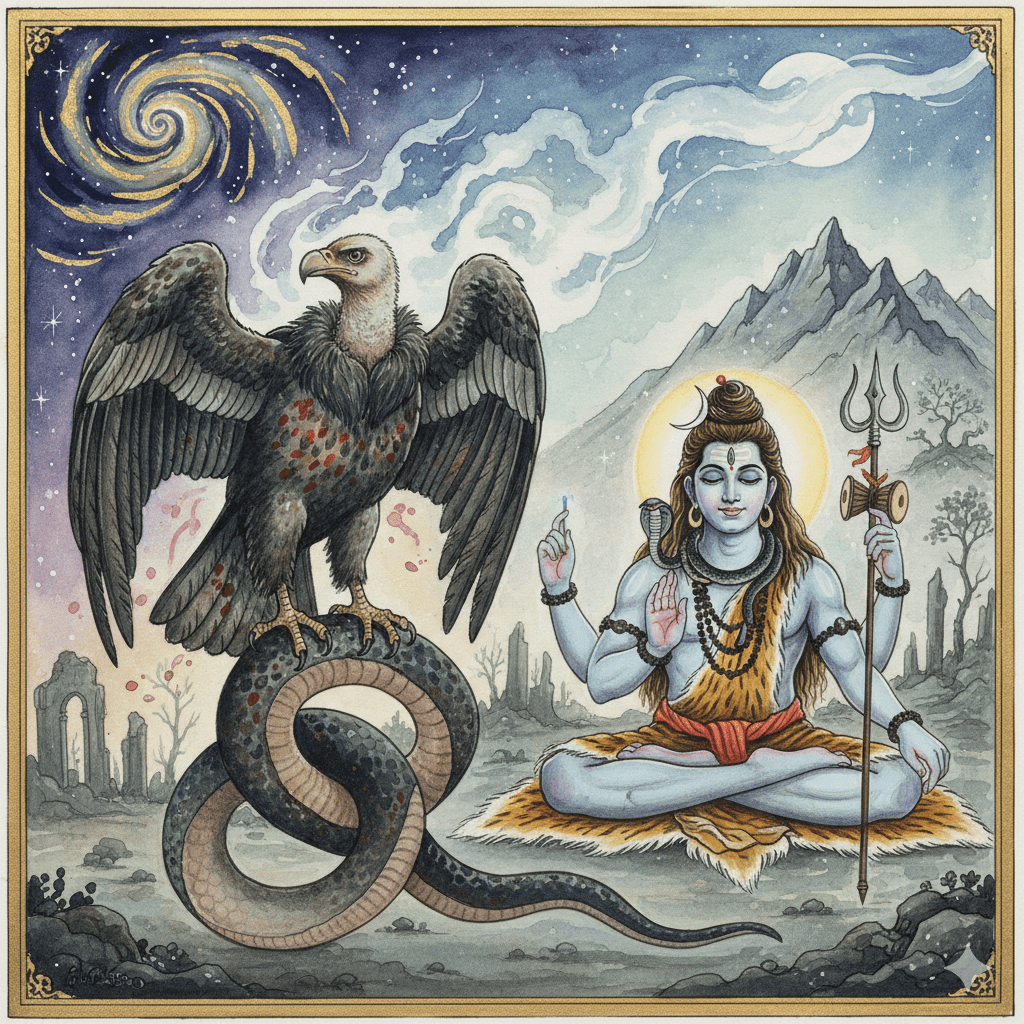
The vulture is a powerful vahana for this lunar node. While the vulture is often maligned as a harbinger of death, its spiritual essence is one of purification. Like Ketu, the vulture does not hunt; it consumes what is already dead, effectively cleaning the earth and preventing the spread of decay. This symbiotic relationship between the vulture and Ketu offers a lens through which we can view the necessity of our past lives in the context of our present evolution.
The Scavenger
The vulture occupies a unique ecological and spiritual niche. It possesses the uncanny ability to transform rot into life-sustaining energy, possessing a digestive system so potent it neutralises toxins that would kill any other creature. This is the precise function of Ketu in the natal chart. Ketu acts as a spiritual scavenger, identifying the “dead” parts of our psyche—outdated identities, exhausted desires, and karmic debts—and breaking them down.
When we look at our past lives through the symbolism of the vulture, we see that our previous incarnations are not just stories; they are the raw material that must be processed for the soul to remain light enough for ascent. The vulture reminds us that nothing is truly wasted; even our greatest failures in past lives serve as the carrion that fuels our current spiritual immunity.
The Weight of Unfinished Business
To understand the present incarnation, one must recognise that the soul does not enter the world as a blank slate. Ketu acts as the storehouse of the Sanchita Karma, the vast reservoir of past actions. The reason many individuals feel an inexplicable pull toward certain places, or an irrational fear of specific scenarios, lies in the headless nature of Ketu.
Because Ketu lacks a head, it operates through instinct and cellular memory rather than logic. This is where the importance of past lives becomes undeniable. If we ignore the Ketu influence, we find ourselves repeating patterns without knowing why, driven by the momentum of a ghost-self that no longer exists. The vulture’s keen eyesight allows it to spot its prize from miles away; similarly, acknowledging our past lives allows us to spot the repetitive loops in our behaviour before we fall into them once more.
Death as a Prerequisite for Birth
The presence of Ketu in a specific house of the birth chart indicates where we have already “been there, done that.” It is an area of innate talent but also of profound boredom or detachment. This detachment is necessary because the soul must “die” to its past achievements to focus on the North Node, or Rahu, which represents the current life’s purpose.
The vulture’s role in the sky is a constant reminder that for new life to flourish, the old must be efficiently cleared away. We are born into this specific body, at this specific time, because there is a very particular set of karmic residues that only this environment can trigger and resolve. The present incarnation is not a random event but a surgical strike by the universe to settle the accounts identified by Ketu.
Integration and Liberation
The ultimate significance of the Ketu-Vulture connection lies in the realisation that we are not here to renounce our past, but to finally metabolise it. The present incarnation acts as a containment field, a specific set of limitations designed to force the soul to confront the carrion it has carried across centuries. While Ketu represents the wisdom we’ve gained, it also represents the heavy, undigested baggage that prevents further ascent.
The vulture does not soar simply for the sake of flight; it soars to gain the perspective necessary to find what needs to be cleared. Similarly, our life today is the vital “feeding ground” where we identify the specific habits, debts, and fears that have reached their expiration date.
We are here because the soul recognised that it could no longer carry the weight of its previous identities. By understanding our past lives, we stop viewing our current struggles as random misfortunes and start seeing them as the precise tools required to strip away the dead layers of the self. In this light, the present incarnation is the most important moment in the soul’s history—it is the point where the cycle of repetition ends and the process of true, purified integration begins.



 Twinn Swan
Leave a comment