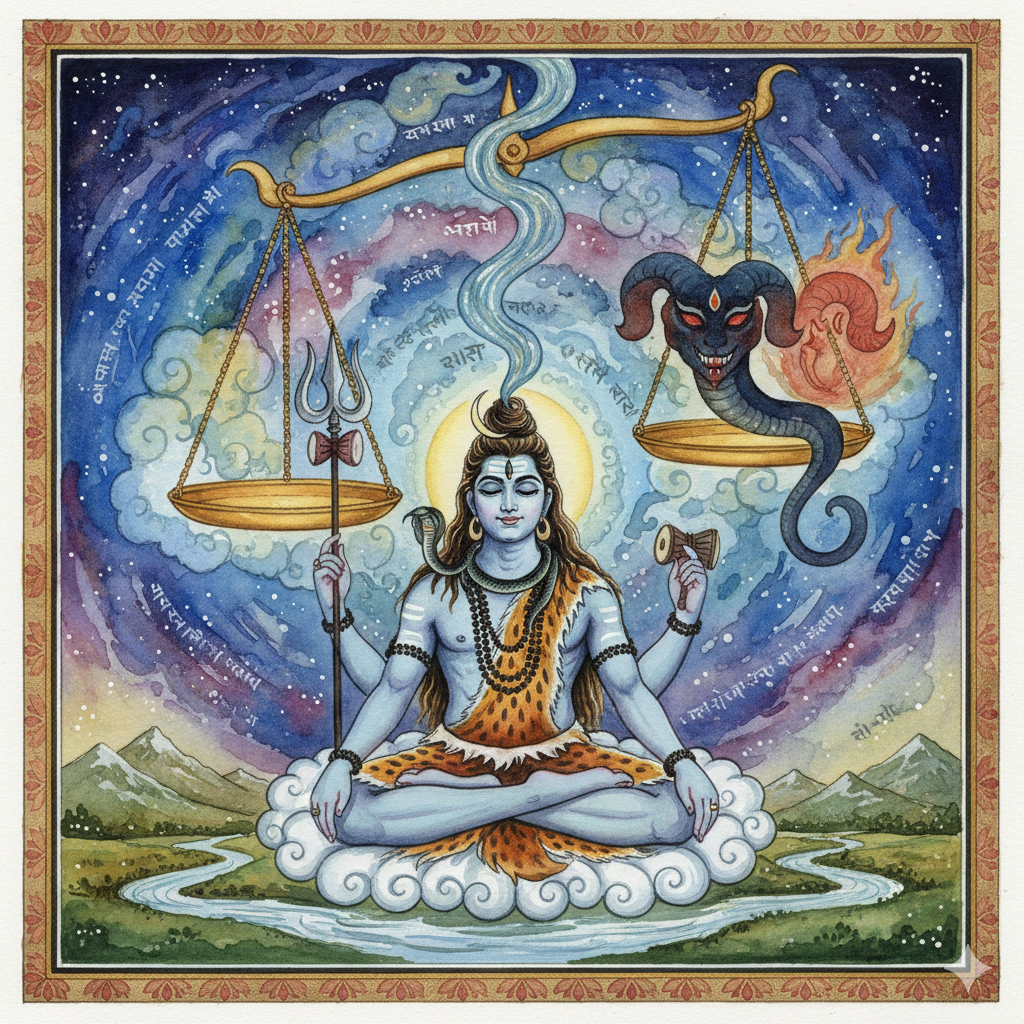
In Vedic astrology, the north and south nodes are the shadow planets that hold the keys to our obsessive desires and our deepest phobias. When Rahu and Ketu fall on the Aries-Libra axis, they trigger the fundamental conflict between the survival of the individual (Aries) and the sanctity of the union (Libra).
Sarpa Dosha adds a layer of constriction to this, suggesting that the souls involved are tied together by a karmic knot that is mentally and emotionally difficult to untangle. This is not a relationship of choice, but one of compulsion, where the serpent’s coil forces two people into a mirror-dance to settle an ancient account.
The Paradox of the Nodal Reverse Synastry
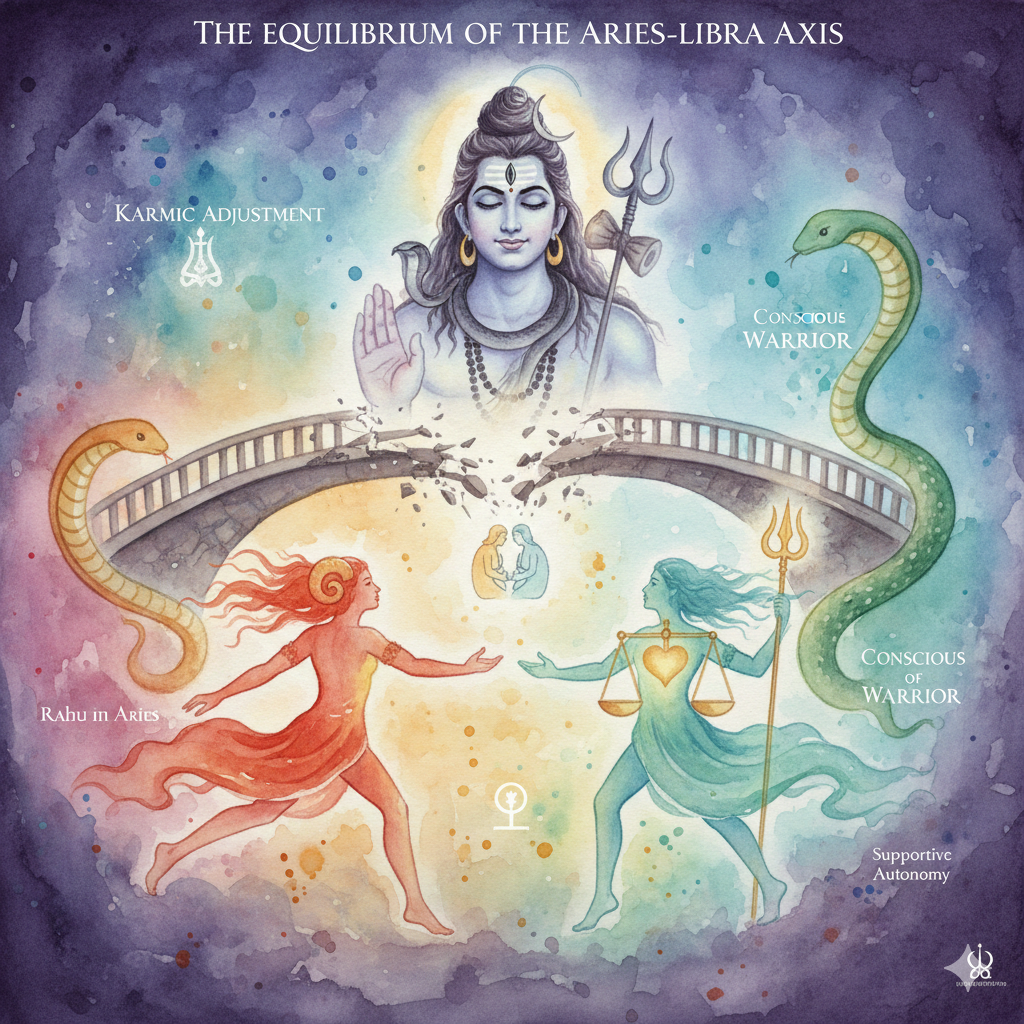
The most intense form of this interaction occurs when one person’s Rahu is conjunct the other’s Ketu. This is often called a Nodal Swap or Reverse Synastry. It is a volatile configuration because it creates a closed loop of energy. Person A is moving toward a future (Rahu) that Person B is desperately trying to purge (Ketu).
In the Aries-Libra signs, this means one partner is learning to find their “I Am” while the other is exhausted by the “I Am” and wants to find “We.” They are moving in opposite directions on the same path. This creates a powerful initial magnetism that feels like destiny, but it is actually a collision of two opposing spiritual trajectories.
Why the Relationship is Designed to Dissolve
The reason these relationships often dissolve or fail to achieve long-term stability is that their primary function is karmic balancing. In Vedic astrology’s Aries-Libra axis, the nodal swap (Rahu in Libra, Ketu in Aries) triggers release of anava mala egoic contraction manifesting as past-life extremes of isolated self-assertion or relational dilution.
Aries and Libra energies on the karmic axis collaborate to refine deep-seated imbalances from past lives, with Mars-driven Aries transforming raw, self-focused instincts like aggression, conquest without compassion, or lone-wolf isolation into balanced assertion that integrates inner fire (tejas) with restraint.
Venus-ruled Libra heals relational excesses such as over-accommodation, suppressed personal duty (svadharma), endless diplomacy, or loss of identity in partnerships by dissolving people-pleasing tendencies and reclaiming individual essence within unity, where beauty serves truth rather than mere appeasement.
The failure of the relationship is actually its success. The Ketu person provides the Rahu person with the shortcut to their destiny, and in return, the Rahu person helps the Ketu person finally let go of a past-life obsession. Once this exchange is complete, the magnetic pull vanishes because the karmas are balanced.
Releasing the Ghost of the Other
The Aries-Libra axis triggers the karma of “Right Action vs. Right Relation.” Often, the synastry is trying to release the soul from a history of being swallowed by others or devouring others. The Sarpa Dosha implies that in the past, this power dynamic was handled through manipulation or betrayal.
In this life, the reverse synastry forces both partners to see these patterns in high definition. The relationship ends because the souls have finally reached a point of “Nodal Equilibrium.” They have used each other to find their centre, and once that centre is found, the external mirror of the partner becomes a distraction from their individual evolution.
The Path of Learning
The pain of being left in a Rahu-in-Libra (with Ketu-in-Aries) relationship hits hard because it exposes a hidden self-focus that undermines the very partnership they crave. The Rahu-in-Libra person desperately wants perfect relationships and harmony, but their subconscious Ketu-in-Aries wiring keeps them secretly self-centred—prioritising their own needs, independence or emotional distance without them realising it.
They act like a team player on the surface (“we’re in this together”) while operating from “me first” underneath, which creates imbalance. The partner (often Ketu-in-Libra or similar) eventually leaves for someone who truly offers consistent emotional support, stability or presence—qualities the Rahu person failed to provide due to their unacknowledged selfishness.
This “dumping” feels brutal, like a public failure or replacement, but it’s the universe’s tough-love wake-up call. No gentle talk works; only the sharp sting of loss forces them to face their relational shortcomings head-on. They learn the hard way that real partnership demands giving up lone-wolf habits: showing up reliably, sharing vulnerability, and putting “we” above “I.”
Being replaced pays a sliver of debt by amplifying the void, but full surrender eludes; the soul’s Rahu hunger wars eternally with Ketu’s entrenched autonomy. Future ties echo the pattern—glimmers of growth drowned in recurrence—turning evolution into a grinding, incomplete forge where pain teaches awareness. It’s divine insistence against a broken past-life anchor.
The Natural Exhaustion of the Karmic Bond
The dissolution of this axis occurs because the relationship is built on ‘repayment’ rather than ‘creation’. Once the Sarpa Dosha has been triggered and the specific karmic debt on the Aries-Libra line is settled, the connection naturally loses its life force. In a nodal swap, the partners are essentially cleansing one another’s energy fields.
Once the Rahu of one has finished pulling the necessary lessons from the Ketu of the other, the spiritual contract is void. There is no longer a shared path forward because the very reason they were brought together—to settle a past-life account and untangle the serpent’s coil—has been achieved. The ending is a manifestation of the soul’s freedom from a cycle that has finally run its course.

 Twinn Swan
Leave a comment