
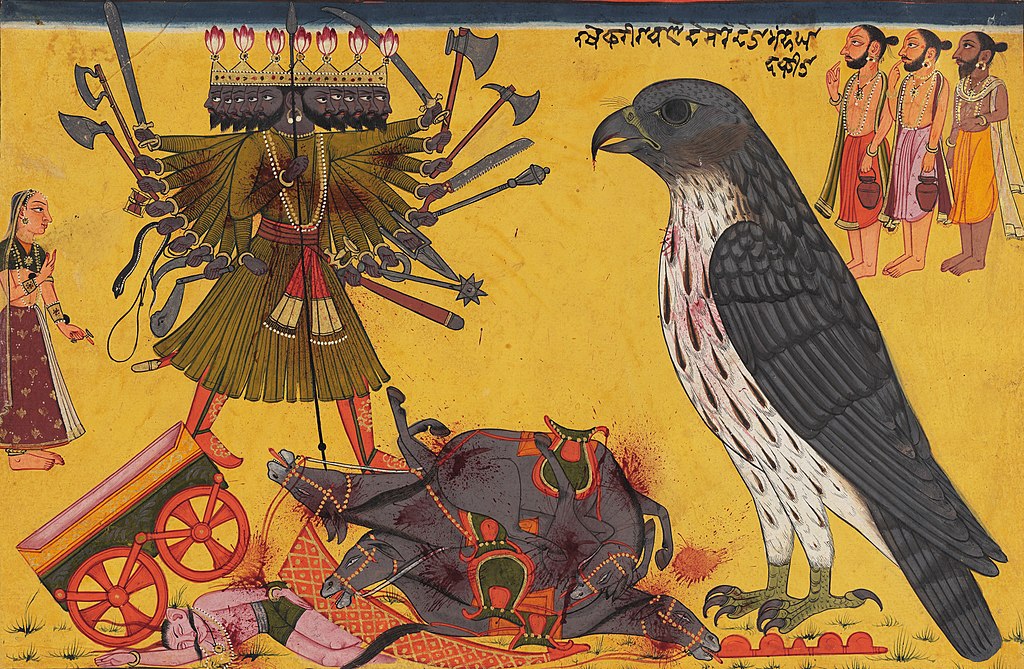
Ravana, the formidable ten-headed Asura King of Lanka, is primarily known in Hindu mythology as the villain of the Ramayana and the one who abducted Sita. Yet, to understand his true character, one must look beyond his acts of adharma unrighteousness to his unwavering and intense devotion bhakti towards Lord Shiva. This deep piety creates one of the most compelling paradoxes in the epic narrative: a demon who was simultaneously one of the greatest devotees.
The Origin of the Ardent Bhakti
Ravana’s devotion was forged through a powerful encounter of profound self-sacrifice. According to the legends, Ravana once traveled to Mount Kailash, Shiva’s celestial abode, intending to forcefully take it to Lanka.
Angered when Shiva’s attendants tried to bar his way, Ravana used his immense strength to lift the entire mountain. In response, Shiva calmly pressed down on Kailash with his big toe, trapping Ravana underneath for a thousand years.
During this agonising period, Ravana continuously sang the praises of the Lord. Impressed by this relentless display of commitment despite his pain, Shiva eventually freed Ravana, bestowed upon him the name Ravana (meaning “one who cries out loudly”), and granted him powerful boons, including his signature invincible sword, the Chandrahas.
The Shiva Tandava Stotram
The most celebrated testament to Ravana’s devotion is the Shiva Tandava Stotram, a powerful and rhythmic hymn he composed during his entrapment under Kailash. This poetic masterpiece describes Shiva’s immense power and beautiful form, often depicting him as the Cosmic Dancer Tandava.
The Stotram is still recited by millions of Hindus today and is revered for its intricate meter and spiritual intensity. It serves as concrete evidence of Ravana’s deep theological knowledge and his ability to channel profound spiritual emotion, cementing his status not just as a king or a demon, but as a poet and a siddha.
The Paradox of Devotion and Destruction
The ultimate question posed by Ravana’s life is why such pure devotion to Shiva did not redeem him from his unrighteous deeds. Hindu philosophy teaches that devotion to a deity does not negate the karmic consequences of one’s actions.
While Shiva, as a symbol of detachment, rewarded Ravana for his Bhakti and penance, he did not intervene in the cosmic balance of Dharma. Ravana’s pride, arrogance, and lust—manifestations of his unchecked ego—became too powerful, leading him to abuse the very boons he received and ultimately ensuring his downfall at the hands of Vishnu’s avatar, Rama. His life illustrates that spiritual achievement does not grant immunity from the laws of morality and consequence.
Legacy
Ravana’s story endures as a powerful lesson: true devotion is not just an act of worship, but a continuous commitment to Dharma. He stands as a towering, contradictory figure—a brilliant scholar, a powerful king, a dedicated Shiva worshipper, and yet, a destructive tyrant—reminding us that the path to spiritual liberation requires balancing immense power and piety with righteousness and humility.
My Book
In The Heart of Shiva Tara’s encounter with Ravana is a confrontation with the shadow side of the masculine. The narrative holds space for contradiction: power and fragility, possession and release, pride and surrender. It is in this tension that Tara begins to unravel what love must shed—the hardened scripts of another’s ego—to emerge anew. Her quest, then, reveals how the deepest liberation demands facing what the ego obscures. In my book, Shiva’s grace is an intimate force awakening Tara to a love unfettered by repetition or escape.





 Twinn Swan
Leave a comment