
When I began writing Divinely Destined, I was drawn to the subtleties of karma not as cosmic ledger, but as vibration—an intelligent movement through which consciousness experiences itself. I wanted to speak about karma as living texture, not theory: a structure that shapes destiny from beneath the visible, while still allowing the will its quiet revolutions.
Karma, in its truest sense, is not punitive. It is recursive awareness—responses echoing through time, translated into circumstance so that consciousness may expand. I became interested in the way that awareness transforms repetition into revelation: how patterns, once perceived, cease to command. The novel is built around that idea—the moment consciousness enters the loop, the loop becomes transparent.
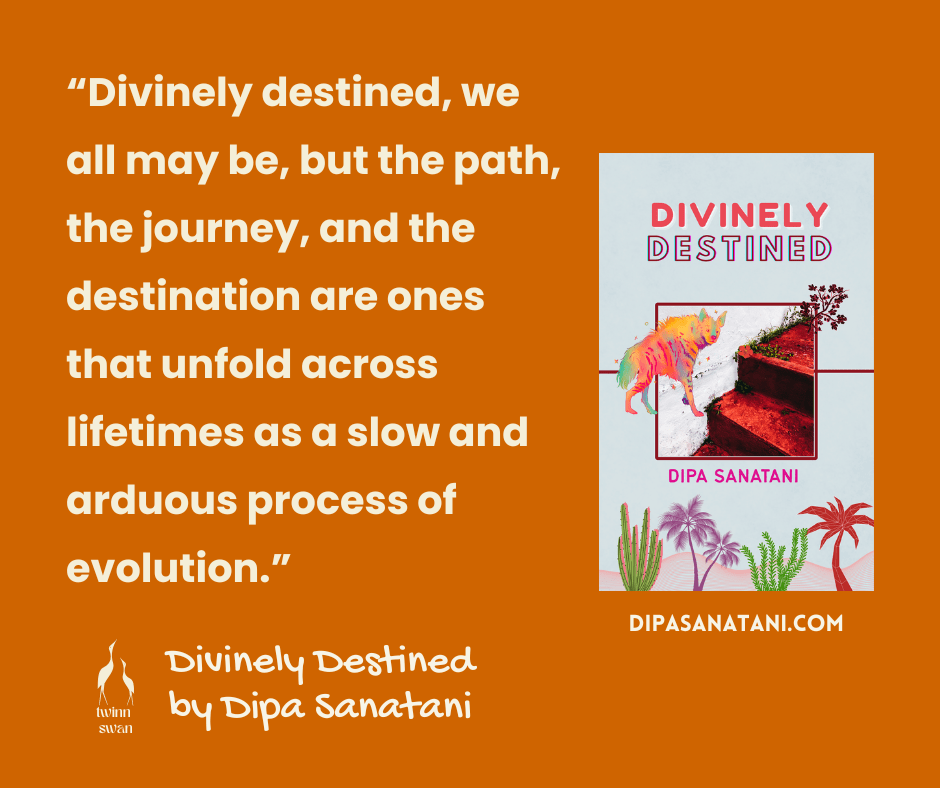
The characters do not suffer for morality’s sake, nor are they redeemed through convenient atonement. Their evolution lies in their capacity to see—to sense the energetic continuity between their intentions and their unfolding realities. In that recognition, karma loses its abstraction and becomes visceral, immediate, embodied.
Writing Divinely Destined required the same attention. Each line carried consequence. Each cadence became an act of alignment between will and awareness. In that sense, the task of writing mirrored the very field it sought to describe: the crafting of experience within the unseen laws that bind us.
What remains, for me, is not moral instruction but inquiry—the deep, unending question of how consciousness shapes its own fate, moment to moment, through the invisible gesture of intention.




 Twinn Swan
Leave a comment