
The Devadasi tradition, a complex and misunderstood aspect of Indian temple history, is deeply interwoven with the worship of Hindu deities, particularly Lord Shiva. While the institution underwent significant transformations and faced eventual abolition, its origins lie in a profound spiritual connection where women dedicated their lives to serving the divine through ritual, music, and dance. At the heart of this sacred offering stood Shiva, the cosmic dancer, the supreme ascetic, and the patron of all arts.

Shiva: The Lord of Dance and Divine Inspiration
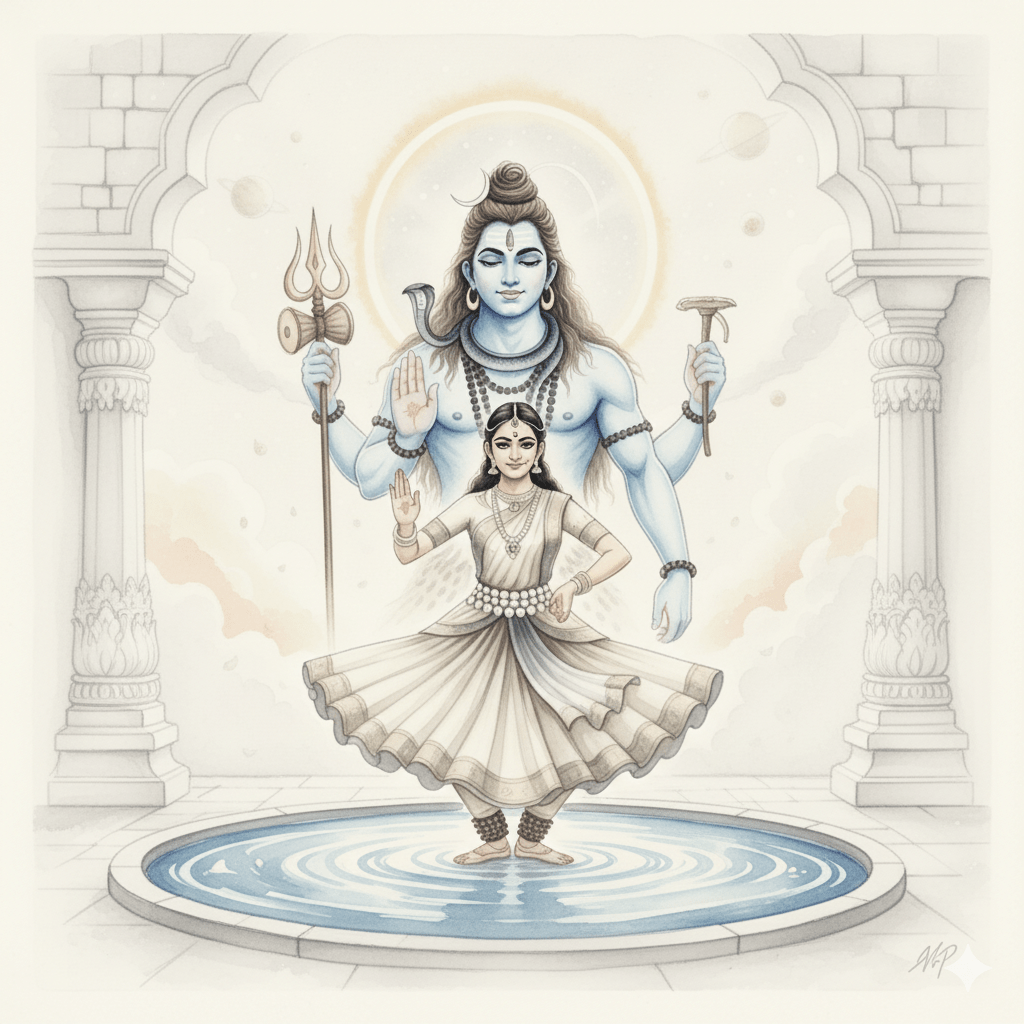
To understand the Devadasi’s association with Shiva, one must first recognise Shiva’s multifaceted nature. As Nataraja, the Lord of Dance, Shiva embodies the cosmic rhythm of creation and destruction, movement and stillness. His Tandava, the vigorous and powerful dance, represents the universe’s ceaseless activity. It is this divine dance that serves as the ultimate inspiration for all forms of classical Indian dance.
For the Devadasis, their dance was a devotional practice, a form of seva service offered directly to the deity. They were the earthly manifestations of the celestial apsaras and gandharvas, performing for the gods and bringing divine energy into the temple space. In many Shiva temples, the Devadasis were integral to daily rituals and festivals, their performances believed to invoke the deity’s presence and bless the devotees.
The Temple as a Sacred Stage
The temple was the Devadasi’s home and her stage. Within the sacred architecture, often adorned with intricate carvings depicting Shiva’s cosmic dance and various divine beings, the Devadasis would perform for the residing Shiva idol.
Their art was a living liturgy, transforming abstract theological concepts into tangible, emotional experiences for the worshippers. The mudras hand gestures, abhinaya expressions, and rhythmic footwork were all dedicated to narrating stories of Shiva’s exploits, his love for Parvati, his ascetic penance, and his ultimate power.
A Spiritual Union
The relationship was often seen as a spiritual marriage. The Devadasi, whose name literally means “servant of god,” was considered nityasumangali – eternally auspicious – as she was wedded to the deity and therefore could never be widowed.
This symbolic union elevated her status within the religious framework, placing her in a unique position as an intermediary between the human and the divine. Her life, though marked by dedication and discipline, was also understood as a path to spiritual liberation, with Shiva as her ultimate consort and guide.
The Evolution and Decline
Over centuries, the Devadasi tradition evolved. While its initial intent was purely spiritual, various socio-economic and political changes led to its degradation. The patronage system shifted, and the sacred purpose often became overshadowed by exploitation, particularly during colonial times. The British, viewing the institution through a different cultural lens, labeled it as immoral, contributing to its eventual ban in independent India.
A Legacy of Art and Devotion
Despite its complex history and eventual abolition, the Devadasi tradition left an indelible mark on Indian classical arts, particularly Bharatanatyam and Odissi, which draw heavily from the dance forms nurtured within the temple environment. Many of the adavus basic steps and abhinaya techniques can be traced back to the devotional repertoire of the Devadasis, inspired by their devotion to deities like Lord Shiva.
Today, while the institution of the Devadasi no longer exists, its historical association with Lord Shiva serves as a powerful reminder of a time when art, devotion, and spirituality were inextricably linked, and when women played a central role in articulating the divine through their sacred dance.
The echoes of their devotion continue to resonate in the vibrant traditions of Indian classical dance, a testament to the enduring inspiration of Shiva, the cosmic dancer.

 Twinn Swan
Leave a comment