
The Silences of the Palace (Samt al-Qusur, 1994) is a Tunisian film by Moufida Tlatli that uses the intimate, painful relationship between a mother, Khedija, and her daughter, Alia, to explore themes of silence, inherited trauma, and the struggle for female self-determination. Set against the backdrop of a decaying palace — a potent metaphor for colonial, feudal, and patriarchal structures — their bond becomes a lens through which the film examines both personal and political oppression.
The palace is an oppressive character in its own right. Its walls contain generations of women whose voices have been muted by patriarchal control, class hierarchy, and political stagnation. For both Khedija and Alia, the palace is both home and prison — a space imbued with memory, exploitation, and silence. Stepping beyond its gates is not only a physical act, but a symbolic rejection of the patriarchal structure it represents.

Khedija’s Despair: Roots in Exploitation and Silence
Khedija is a palace servant whose life has been shaped by layers of economic servitude, sexual exploitation, and social marginalisation. Bought or bound as a domestic, she becomes a target of the predatory power of the palace’s men, notably suffering a brutal rape by the prince’s brother. This trauma is worsened by the fact that her own survival has, at times, required compliance with the system that oppresses her — an ambivalence that deepens her sense of entrapment and shame.
Her despair stems from several intertwined sources: the inescapable reality of servitude and lack of agency, the humiliation and lasting psychic wound of sexual violence and the fear, almost certainty, that her daughter will inherit her fate.
While she tries to protect Alia — warning her, “If a man touches you, run away” — Khedija is constrained by the same silences that have defined her own life. She cannot fully explain or process her suffering aloud. Instead, her pain seeps into their relationship through unspoken tensions, avoidance, and indirect warnings.

The Intergenerational Transfer of Trauma
Alia is not directly told the details of her mother’s abuse, but she absorbs them through observation, implication, and fragmented memories. One searing image is the moment she inadvertently witnesses her mother’s violation — a childhood trauma that embeds confusion and sorrow deep in her psyche.
Her uncertain paternity, her ambivalent attraction and repulsion toward the palace men, and her own encounters with intimacy and societal judgment carry echoes of her mother’s wounds. Khedija’s attempt at a self-induced abortion late in her life reflects her desperate desire to break the cycle — to prevent another child from being trapped in the same cruel system.
Yet, this act also mirrors her own powerlessness, marking a tragic point where resistance becomes self-harm; revealing the emotional toll her experiences have taken on her maternal role.
Alia’s Struggle: From Inherited Silence to Self-Assertion
As an adult, Alia dreams of independence, her voice — both literal and figurative — embodied in her singing career. Yet her path to freedom is complicated by the inherited silences of her childhood and the systemic constraints on women in postcolonial Tunisian society. The palace’s fading grandeur becomes a symbol of the old power structures that still cast a shadow on her life.
Alia’s formative exposure to her mother’s suffering generates complex feelings of guilt and helplessness. She is tormented by the sense that she could not protect Khedija, just as Khedija is powerless to safeguard her. This mutual, silent suffering breeds a kind of emotional paralysis, making Alia hesitant to trust, love, or inhabit her own desires without fear of consequence.
The relationship between Khedija and Alia embodies the emotional and political complexities of women’s lives in a patriarchal society. Khedija’s despair — born of exploitation and sustained by an enforced silence — seeps into her daughter’s consciousness, shaping Alia’s struggles with identity, trust, and autonomy. Yet the film resists a purely tragic arc; through Alia’s tentative self-assertion, it suggests that the cycle of silence and suffering can, however slowly, be broken.
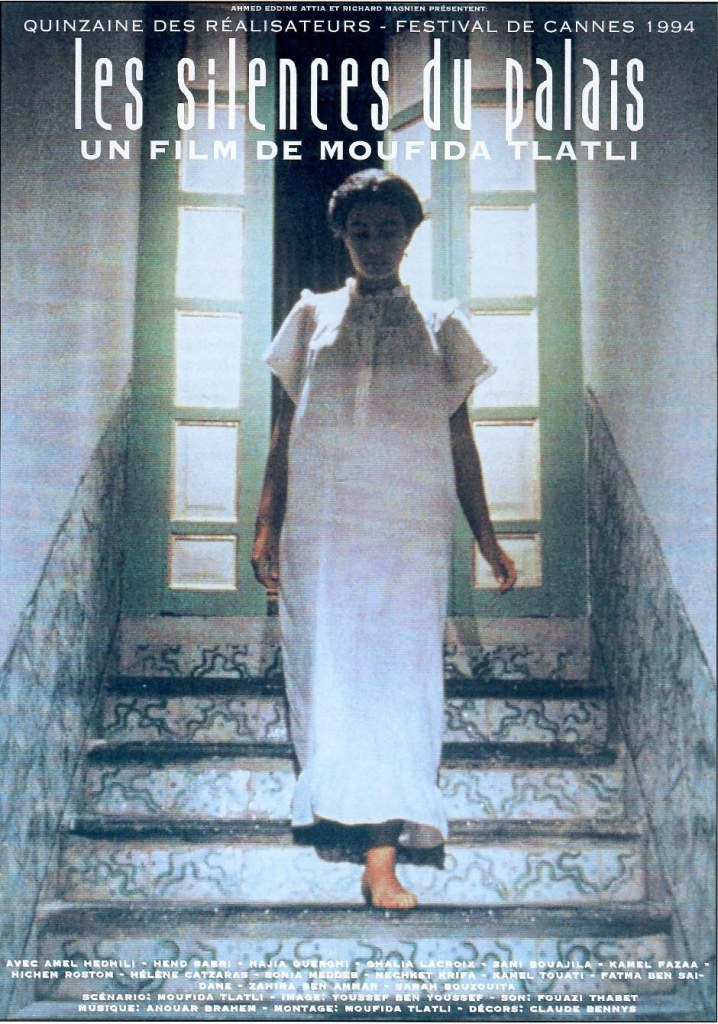
The Delayed Awakening
Alia’s personal awakening parallels Tunisia’s nationalist stirrings: both seek liberation from entrenched authority. Unlike her mother, she begins to articulate her pain and ambitions, suggesting the possibility of a new destiny. Her eventual decision to confront her past and reclaim her voice marks an attempt to transmute inherited trauma into a lasting legacy.
Yet it is precisely through confronting these buried wounds—piecing together the fragments of her childhood memories, facing the traumas that have shaped her—that Alia begins to find a form of resolution, reclaiming her own voice in defiance of the silences that bound her mother.
In its intimate focus on a mother and daughter, The Silences of the Palace offers both a historical reflection on colonial Tunisia and also a universal meditation on how trauma is transmitted — and how courage, voice, and self-understanding might begin to undo its grip. By the end, Alia emerges, not merely as a victim or a passive inheritor of trauma.
By tracing and transmuting the route of her pain—and refusing to accept silence as her only legacy—she embodies the painful process of transcendence. The abuse she witnesses shapes her, but as she grows, she subverts its grip, subtly pointing to the power of memory, confrontation, and self-expression as possible avenues of healing and liberation.


 Twinn Swan
Leave a comment