
I’m delighted to introduce an exceptional artist whose work bridges the world of modern sacred music with the timeless mysteries of Shiva. Merging ancient symbolism and spirituality with contemporary soundscapes, his music invites listeners on a journey of depth and discovery.
Rupesh Jagoria, known as Rupesh Muzic on social media, is an Indian devotional music composer and singer whose heart beats for Lord Shiva. Deeply rooted in bhakti and inspired by the divine energy of Mahadev, Rupesh creates soulful compositions that blend ancient mantras, bhajans, and shlokas with subtle modern soundscapes.
Born in 1992, he grew up immersed in both traditional and contemporary music, which shaped his unique sonic identity. His mission is to bring the timeless energy of Shiva to the modern world — creating music that touches the soul and opens the heart.
For Rupesh, music is not just a form of art — it is sadhana, a spiritual practice. Each song is a personal offering to the divine, meant to inspire peace, transformation, and inner awakening.
Our exchange opens a doorway between two creative worlds—where words meet music, and where both become means of exploring and honouring the mysteries of Shiva. As a writer in dialogue with a musician, I’m energised by how our different crafts spark new interpretations of sacred tradition. United by a shared fascination, we invite readers and listeners alike to experience how Shiva’s presence continues to inspire, challenge, and transform us—across disciplines, and beyond boundaries.
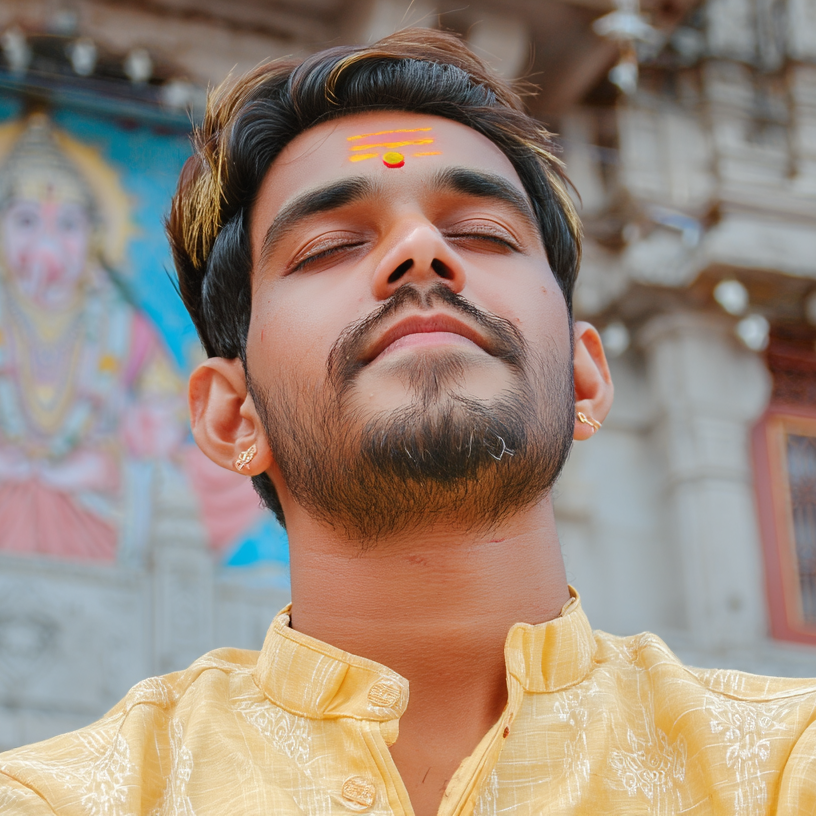
Dipa: Modern sacred music sometimes reinterprets ancient symbols. In your creative process, how do you approach blending traditional Shiva iconography or mythology with contemporary musical styles?
Rupesh: “शिवः एव सर्वं करोति, अहं केवलं निमित्तम्। ( “It is Lord Shiva who does everything — I am merely a vessel through whom He works.) Everything I do is not by my own will — it is Shiva within me who creates, sings, and expresses through me. My entire musical journey is an offering to Him.
Before I compose any mantra, bhajan, shloka, or devotional piece in today’s modern sacred music space, I begin by offering gratitude to the Universe for choosing me as an instrument for this divine work. In blending traditional Shiva iconography with contemporary music, my aim is to create a bridge — where the soul of ancient devotion meets the soundscape of the present generation.
I try to keep a balance between classical Indian instruments like harmonium, tabla, and sitar, and modern elements such as ambient textures or light western instrumentation, so that today’s listeners can connect spiritually through sound.
Since I was born in 1992, I carry the memories of that era’s soulful music while also understanding the pulse of today’s musical world. So, I try to bring both together — creating devotional songs that carry timeless devotion, yet speak to the hearts of today’s audience.
Dipa: Can you share a personal experience or revelation related to Shiva that directly influenced a specific composition or performance? What did that process teach you about your own relationship to the divine?
Rupesh: Although I have felt Lord Shiva’s presence with me everywhere, there was one moment that truly transformed my life — at the sacred Mahakaleshwar Jyotirlinga in Ujjain.
My journey with the Jyotirlingas began at Kashi Vishwanath, followed by Kedarnath, and then Mahakaleshwar. But something was different in Ujjain — something awakened within me. It was here that I experienced a deep realization: Shiva is truly with me.
It happened during my visit to witness the Bhasma Aarti, the sacred ash ritual that begins before dawn. To get a ticket, devotees must stand in line from midnight, even though the counter opens only around 8 a.m. — and the tickets are extremely limited.
I reached the temple area around midnight and joined the long queue after dinner. I waited through the cold night. As the morning approached and the ticket window finally opened, people ahead of me began receiving tickets — some collecting multiple with extra ID cards. There were only about 300 tickets, and the line had over 500 people. My heartbeat started racing as the number of available tickets quickly dropped. I still had many people ahead of me, and I could feel the opportunity slipping away.
With only a few tickets left, I felt helpless. My eyes welled up with tears, and I began to pray silently, calling out to Baba Mahakal from the depth of my heart. At that very moment, a sudden and heavy rain began to pour. Many people ahead left the line to seek shelter — and suddenly, I was just five people away from the counter.
When my turn finally came, I was handed the very last ticket. The counter closed right after me. Overwhelmed with emotion, I broke down in tears. People around me were surprised — but they didn’t know that I wasn’t crying from pain, but from pure divine gratitude. I had never felt so close to Shiva before. I returned to my room holding that ticket as the most precious blessing.
The next day, I attended the Bhasma Aarti, and my soul was filled with divine joy and peace. That day marked a new beginning in my spiritual journey. Since then, I have felt Lord Shiva walking with me — guiding every step I take.
This experience eventually inspired one of my recent compositions:
“Shiva Walks With Me” — a song born from that unforgettable night and my deep devotion to Him.
Dipa: Is there a modern metaphor or object you’d use to capture your sense of Shiva—something outside of traditional iconography?
Rupesh: To me, Shiva is everywhere — in every element, every form, and every breath of existence. But if I were to express Shiva through a modern metaphor, I would say this: Imagine a powerful river, like Maa Ganga, flowing with immense force. In the middle of this mighty current, there lies a single stone, completely still — unmoved by the turbulence around it. Whether the river flows over it, around it, or beneath it — the stone remains grounded, calm, and unaffected.
That still stone is Shiva.
Amidst the chaos of life, He is the unshakable center — pure silence, pure presence.
In my personal language, I refer to this realization as the “internal universe.”
For me, Shiva is not just an external deity but a divine presence seated within this internal universe — the space inside our own body, mind, and soul. If one truly wants to experience Shiva, they must learn to quiet their thoughts, still their breath, and center themselves. Slowly, you begin to feel a shift — a subtle but powerful awakening — and that’s when you realize: Shiva walks not outside, but within.

Dipa: Sometimes, Shiva is seen as the original rebel or outsider. Have you ever channelled these aspects—iconoclasm, wildness, defiance—into your music? How did your audience respond?
Rupesh: When I think of Shiva, one of the first images that comes to mind is from the beautiful verse: “Karpoora Gauram Karunavataram” — “The one who is as fair as camphor, and the embodiment of compassion.”
For me, Shiva is not only the Lord of Lords (Mahadev), but also the most compassionate, merciful being in the universe. He never causes harm to anyone without reason. On the contrary, He accepts all — the gods, the demons, the outcasts — into His refuge without judgment. He is truly the most inclusive divine force.
However, Shiva is also a force of divine justice. When evil becomes excessive — when someone disturbs the balance of the world or causes suffering to others — He opens His third eye, and with that divine fire, restores harmony by removing the source of destruction.
This balance between boundless compassion and righteous wrath is what inspires me deeply. It reminds me that we should strive to live with goodness, never intentionally hurt others, and always walk the path of truth. If we make mistakes — knowingly or unknowingly — we must turn to Shiva, seek forgiveness, and ask for guidance. And I truly believe that He, in His infinite grace, will always bless and lead us back to the right path.
In the coming time, I hope to reflect this deeper understanding of Shiva — both compassionate and powerful — through my music. My goal is to share this divine message with others so they, too, can feel His presence in their hearts.



 Twinn Swan
Leave a comment