
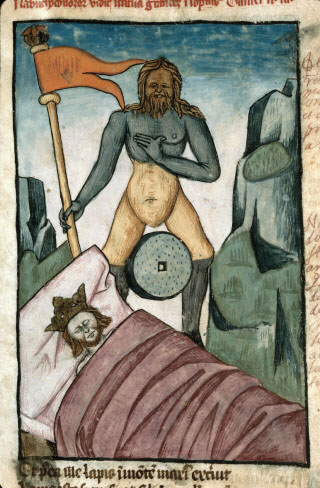
Nebuchadnezzar bolted upright, gasping for air. The silks of his bedchamber clung to him like cobwebs, drenched in a cold sweat. A dream, vivid and terrifying, clung to his mind upon waking. He saw a statue, impossibly tall, dwarfing the palace itself. Its head, a blinding disc of gold, reflected the desert sun. The chest, broad and powerful, shimmered with cool silver. Each descending section was a different metal – bronze, iron, then, to his growing unease, a mix of iron and brittle clay, clinging precariously to each other. But most unsettling of all was a colossal stone hurtling towards the statue’s feet.
With a deafening crash, the stone struck, shattering the chief point of weakness. The once-proud statue crumbled, disintegrating into a heap of dust that swirled with the desert wind. The colossal stone, however, remained, growing larger and larger until it filled the entire horizon.
Nebuchadnezzar summoned his advisors, the astrologers and soothsayers. They listened to the king recount his dream, their brows furrowed in concentration. Finally, after a long pause, a wizened old mage stepped forward. “Great King,” he stammered, “perhaps this dream is a riddle beyond the ken of mere mortals. Perhaps the Divine wishes to speak to you through symbols.”
The words hung heavy in the air. Nebuchadnezzar felt a flicker of unease. He dismissed his advisors, their uselessness in his hour of need a deep source of frustration. Sleep began to evade him as the image of the crumbling statue haunted him.

Days turned into weeks, the weight of the dream a constant burden. Then, a young Hebrew named Daniel, renowned for his wisdom and quiet strength, was brought before the king. Nebuchadnezzar, his pride gnawed away by his helplessness, recounted the dream with a hint of desperation. Daniel listened intently, his calm gaze a stark contrast to the king’s agitation. Finally, a smile spread across his face, a smile that offered both wisdom and reassurance.
“Great King,” he began, his voice clear and unwavering, “your dream is a message from the heavens. The statue represents empires, each more powerful than the last, but ultimately fragile. The stone that destroys it signifies a kingdom unlike any other: a kingdom established by a power far greater than any earthly king, a kingdom that will stand the test of time.”
Nebuchadnezzar stared at Daniel, a glimmer of hope flickering within him. The dream, once a harbinger of doom, now held a promise of a different future. The king realised that even empires as towering as his own were subject to change. Perhaps, there was something greater, something more enduring, waiting for him on the horizon.
The King looked at Daniel, a new respect dawning in his eyes. The key to understanding his dream lay not in the wisdom of ancient priests or the pronouncements of stars, but in the quiet faith of a young man who spoke of a kingdom not built of stone and gold, but of a legacy far more enduring.
The Interpretation
Daniel, through divine revelation, interpreted the king’s dream as a vision of empires. The head of gleaming gold symbolised the Babylonian Empire, the first and most magnificent. Gold represented immense wealth, power, and prestige, reflecting Babylon’s dominant position.
The silver chest represented the subsequent empire, less impressive than the golden head but still significant. Silver, though valuable, held less worth than gold, hinting at a decline in power compared to Babylon.
As the statue descended, the torso transitioned to bronze, a strong and durable metal, signifying a third empire. The legs of iron symbolised another empire, renowned for its military prowess and expansion. However, iron’s brittleness hinted at a weakness in relying solely on military might.
The most crucial element was the statue’s feet, formed from a precarious mix of iron and brittle clay. This unique combination represented a divided empire with internal weaknesses. The iron might symbolise a strong military, while the clay could represent a vulnerable populace or a lack of social cohesion, threatening the empire’s stability.
The Statue
The statue, in its entirety, can be seen as a journey of either ascension or declension. Each material represents a different level of consciousness we must navigate. The dream urges and challenges us to move beyond the allure of the material (gold) and the limitations of the intellect (silver) to integrate our will (bronze), emotions (clay), and logic (iron) to reach a higher state of being symbolised by the crushing stone.
We all grapple with the allure of material possessions and the limitations of the intellect as we struggle to integrate different aspects of ourselves. The dream offers a timeless message: true fulfilment lies in finding balance within and connecting with something greater than ourselves.
Regardless of our specific beliefs, the dream’s message about the limitations of earthly power and the importance of inner harmony remains relevant.
Joseph and Daniel
Both Joseph and Daniel are blessed with the ability to interpret dreams with uncanny accuracy. Their interpretations play pivotal roles in shaping their destinies and impacting those around them. Both men gain favour with powerful figures due to their interpretations.
Joseph becomes a trusted advisor to Pharaoh, while Daniel earns the respect of King Nebuchadnezzar. Both Joseph and Daniel are foreigners rising to positions of power in foreign lands. This emphasises their exceptional talents and God’s guiding hand in their success. Both Joseph and Daniel demonstrate unwavering faith in God despite facing adversity and exile.
Joseph faces challenges within his own family, framed by jealousy and betrayal. Daniel navigates a complex political landscape in a foreign empire. Joseph interprets dreams that predict future events, while Daniel interprets a dream with symbolic meaning about the course of history. Joseph helps his family survive a famine and paves the way for the Israelites to settle in Egypt. Daniel’s interpretation offers hope for the exiled Israelites during Babylonian captivity.
Joseph’s story is lesson in forgiveness, family reconciliation and God’s providence in providing for a group of people. Daniel’s story is one of unwavering faith amidst exile, using wisdom to navigate a foreign power structure and offer hope for the future. For the Jewish people living in exile under Babylonian rule, the dream offered a message of hope. It assured them that their current oppressors were not invincible, and a greater, divinely ordained kingdom awaited them.
Daniel’s interpretation was a revelation. The statue, he explained, represented a succession of empires, each one grander than the last, but ultimately flawed. The precious metals at the top signified powerful empires, while the descending materials symbolised their diminishing strength. This resonated deeply – earthly power structures, however magnificent, are impermanent.
Daniel’s Legacy
Prophetic dreams can offer comfort and reassurance during times of hardship or uncertainty. They provide a glimpse of hope for the future and promise God’s continued presence regardless of the circumstances.
Dreams served as a medium for Daniel and King Nebuchadnezzar to express themselves metaphorically. The dream–and the interpretation of the dream–conveyed messages that one may not have been able to communicate directly. By couching their fears, anxieties, critiques and interpretations within the dream analysis, alternative perspectives were offered without directly challenging the status quo.
Daniel’s legacy transcends the dream which he interpreted. His reputation for wisdom, integrity and courage resonates with people of all faiths and backgrounds. Daniel’s ability to navigate complex situations within a foreign empire offers lessons in leadership, diplomacy and navigating complex political realities.


 Twinn Swan
Leave a comment