One day, an old and childless bamboo cutter chanced upon a stalk of bamboo that was glowing mysteriously. For some reason, he felt compelled to cut it open. When he did, he found within it, a tiny baby girl.
Delighted that his childlessness had, at long last, ended, the bamboo cutter took the baby girl to his wife. His wife was overjoyed that their wishes had finally been granted. Elated, they gave her the name Kaguya and raised the child as their own.
From that day and that moment on, every bamboo stalk the old man cut down had a nugget of gold in it. The bamboo cutter used the gold that he found to become rich and wealthy. He provided his daughter with an excellent education as well as beautiful clothes. Little by little, day by day, Kaguya began to grow up into a beautiful maiden. The older she grew, the more radiant she grew.
Soon, the word of her magnificence began to spread far and wide.

The Impossible Marriage
When it was time to be married, five princes proposed to her. To each one of them, she gave an impossible task. The first prince was told to bring her the begging bowl of the Buddha Shakyamuni from India. The second was asked to bring back a jewelled branch from the mythical island of Horai. From the third, she asked for the legendary robe of the fire-cat of China. The fourth was tasked to bring back a coloured jewel from a dragon’s neck. The fifth and final prince was asked to return with a cowrie shell born of swallows.
Realising the impossibility of all the tasks, the first prince presented a fake stone bowl made from a blackened pot. His trickery and deception was exposed when Kaguya notices that the bowl did not glow with holy light. The second noble presented a branch created by the finest jewellers in the country. His trickery and deception was exposed when a messenger from the jeweller arrived to collect payment. The third noble is, himself, deceived by a merchant who sells him a robe that burns when it is lit with fire. The fourth noble’s plans are hindered by a great storm when he sets out to find the dragon at sea. The fifth noble falls from a great height while reaching into a swallow’s nest.
None of the princes, for some reason or another, were able to succeed in their mission. In the end, all five princes failed her. Due to this, Kaguya chose to remain unwed.
In the end, even the Emperor of Japan comes to visit Kaguya. After he falls in love with her, he asks for her hand in marriage. This time, Kaguya does not subject him to an impossible trial. Instead, she rejects his request for marriage, telling him that she is not from his country and therefore cannot go to the palace with him. She remains in contact with the Emperor, but continues to rebuff his marriage proposals.
Three years pass during which they continue to communicate by letter.
The Elixir of Immortality
As summer began to approach and come, Kaguya grew restless and anxious. It was obvious to everyone who knew her that she was visibly conflicted about some problem. But the day came when she finally decided to make a long and overdue confession. She confessed to her parents that she was actually a princess from the Moon. She had been sent to Earth to remain protected due to a Celestial War that had wracked the heavens. But since the war had recently ended, her heavenly family would soon come to collect her.
In the interim, her behaviour became increasingly erratic. She further revealed that she was sent to the Earth–where she would inevitably form material attachments–as a punishment for some crime she had committed. She revealed that the gold that the bamboo cutter kept finding was a stipend from the people of the Moon that was sent to pay for Kaguya’s upkeep and maintenance.
Kaguya had two choices. She could either stay with her foster parents–the bamboo cutter and his wife–or she could return to the moon. If she made the latter decision, she would completely forget her life on Earth.
It was a difficult decision with no seemingly clear answer.
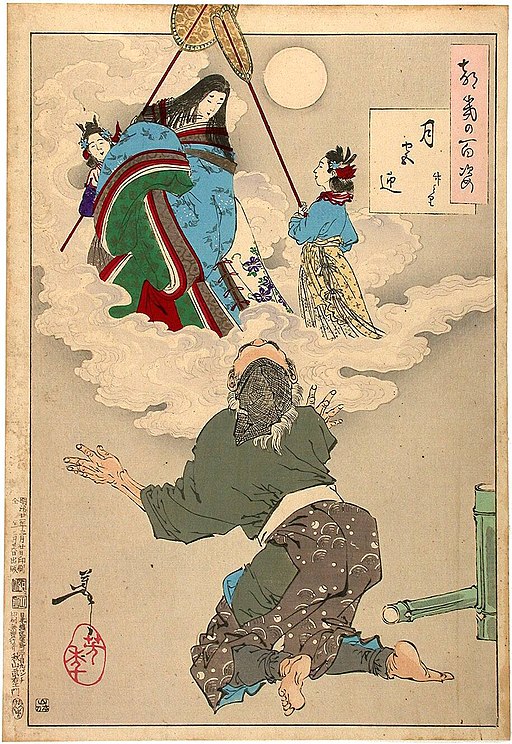
But when the celestial entourage came for Princess Kaguya, she chose to go with them. With tear-stained eyes, she bid farewell to her foster parents. But before she left, she took a little of the elixir of immortality and attached it to her letter to the Emperor. As she handed the elixir to the Emperor’s guard, a feather robe was placed on her shoulders.
Immediately and instantaneously, all of her sadness and compassion for the people of the Earth were forgotten. The heavenly entourage ascended into the sky, taking Kaguya back to the moon. She forgot her parents and all her time on Earth. She returned to the realm of the moon where she stayed and remained thereafter.
Legend has it that the word for immortality (不死, fushi), became the name of the mountain, Mount Fuji.
Storytelling Tradition
The Tale of the Bamboo Cutter is a popular folk tale from Japan. It has been adapted, updated and reworked into numerous modern media, especially Japanese pop culture media such as manga and anime. Taketori Monogatari, as the folktale is known in Japanese, is a fictional prose narrative (monogatari) containing elements of Japanese folklore.
Even though the exact date of the composition of the story is unknown, The Tale of the Bamboo Cutter is considered the oldest surviving monogatari. The oldest surviving manuscript is dated to 1592.
The mention of smoke rising from Mount Fuji in the story may be an indicator that the volcano was still active at the time of the tale’s composition. Mount Fuji is believed to have stopped emitting smoke between 870-905 CE.

The Moon Motif
The motif of the moon is a common one. Often, it represents that our worries and even our delusions are the result of previous and past experiences. The emotional anguish that we tend to experience is often due to traumatic memories. Sometimes, when the experience is particularly traumatic, we may repress them deep inside our subconscious instead of choosing to deal with them.
Feelings, especially repressed feelings, have a way of resurfacing, especially when we least expect it. When the moon is used as a metaphor, we usually expect a certain measure of unpredictability. Instead of analysing situations using logic, one must ‘feel’ in order to decide what the right decision is. Are you happy? In the end, Princess Kaguya makes the choice that will bring her happiness.
Sometimes, we have, within ourselves, mental obstacles and self-defeating thought patterns. But if we pay attention and use our reasoning abilities to analyse the messages and urges that our subconscious mind is revealing to us, we can be guided towards greater levels of self-knowledge.
Lunar phases, in other words, the four phases of the moon; can guide us in navigating between the seen and unseen worlds. Many cultures, throughout history, have used rituals to adjust and adapt to the cyclical ups and downs of the moon. The full moon, in particular, was when we realised what we needed to let go of in order to make room for new facets of ourselves to emerge.
In the end, Princess Kaguya lets go of her earthly family in order to embrace her heavenly family. In a way, then, the story reminds us that we cannot fall for the traps–the material attachments–that are placed on our path. Like Princess Kaguya, we are but temporary visitors on planet earth, and will one day have to return to where we truly belong.


 Twinn Swan
Leave a comment