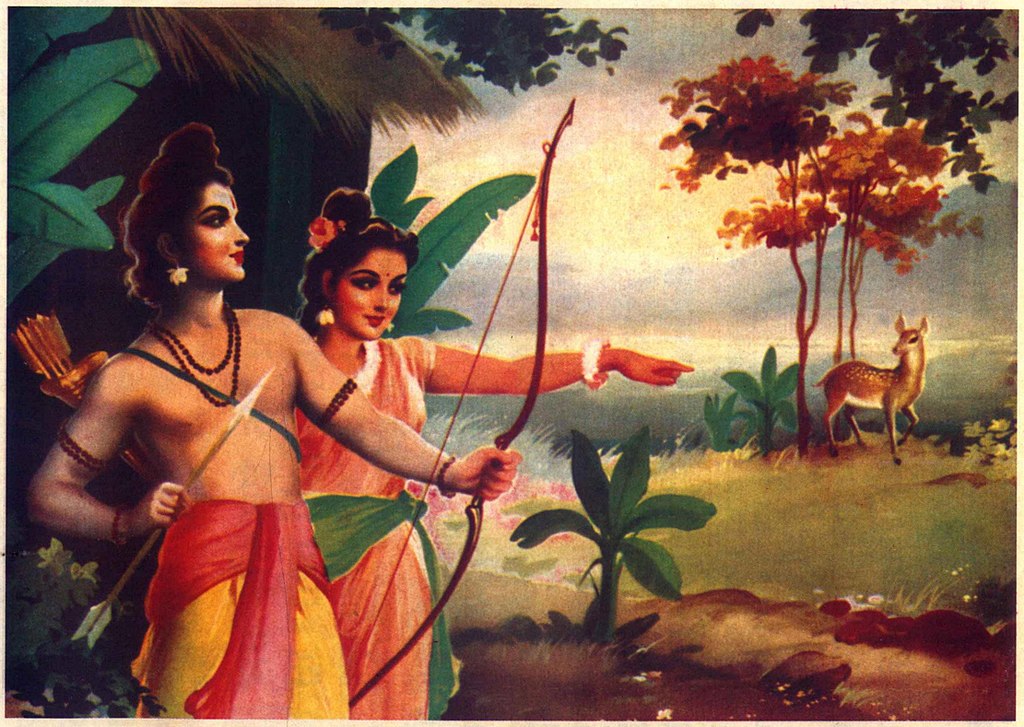
In Vedic texts, the deer is a symbol for a goal. Whether our goal is a deer in the forest or a fancy meal at a nice restaurant, the goal is an object of our desire. In the Manusmriti–the Laws of Manu–kings were warned and advised not to indulge too much in chasing after deer.
It goes without saying that there were those who hunted as a necessity and there were those who did it as a sport. Hunting, much like gambling, was one of the ills of ancient society. Even though hunting was not prohibited, it was an activity that needed to be limited, lest it get out of hand and spiral out of control. Much like gambling, hunting was not banned outright, but rather, actively discouraged and advised against.
In Hindu mythology, the deer hunt is a recurring theme and it is usually one that foretells the coming of trouble. It is, ultimately, the deer that defies–and you could even say defeats–the hunter. The deer, despite its status as a prey, is a symbol of the target that will never be achieved.
In both The Mahabharata and The Ramayana, the royal hunt often led to dangerous consequences for the king. The forest would fight back, transforming the man who thought he had entered it as an aggressor into one that would ultimately have no choice but submit to Nature’s laws. The hunter would thus become the hunted.
Carrying on from that, the warning that is always given to the hunter is that the hunt is not something to be indulged in. Hunting is one of the four vices that the king is counselled to avoid. But despite this, the practise persisted. The royal hunt, when executed successfully, ultimately seems to be a story of how the king tackles the untamed forces that exist in the world.

The Law of Nature
In ancient India, the relationship between the forest and settled society was both divisive and complementary. The forest was the scene where men went hunting, retreated into hermitages or went into exile. The forest represented both the unknown and the uncomfortable. It existed beyond the laws of dharma for it was older and more ancient than dharma. The forest revealed and forced us to confront the untamed forces of this world that existed beyond manmade laws.
Nature had its own set of laws: the law of the jungle. Humanity, through its ethical framework of dharma, was aspiring to go beyond its animal instincts. We humans had created our own laws to replace Nature’s laws.
Nevertheless, even from its early days, the activity of hunting was advised against for a reason. The hunt, the speed of the hunt, the thrill of the hunt–and the feeling and the emotion of power that came with it–completely blinded the hunter to the consequences of his actions.
In a way, then, the deer is a metaphor for the restless mind that always feels the need to chase after a goal. It is the thrill of the chase–and not the deer itself–that the ancient texts were warning against. Once you find what you are looking for, there is usually no need to go running after it anymore.
It is, ultimately, not the goal, but the result of the goal that takes the thrill away from the hunter. In the end, the deer that is relentlessly hunted despite all forewarning is nothing more than trouble in disguise.
Hunting, apart from being hazardously addictive, also makes us insensitive towards life. Overhunting can deplete and destroy entire species. Hunting can be disastrous–on both the hunter and the hunted–when it crosses a line and goes over a limit.
Hunting requires being on the move continuously, with an immense focus on the target at great speed. The need for quick decision-making can blind us to other realities as well as the pending consequences of those decisions.
In Tamil iconography, Lord Shiva is often shown holding a deer in his hand. The deer is a metaphor for our desire to go after our goals. In the ancient world, hunters used the bow and the arrow–the technological tools that they used to hunt deer–to capture the object of their desire. Hunters needed balance, focus and precision in order to capture the deer.
They also needed to be satisfied when they finally found it.




 Twinn Swan
Leave a comment